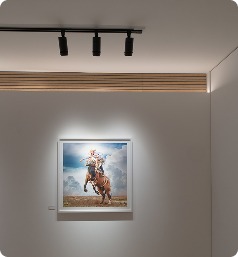
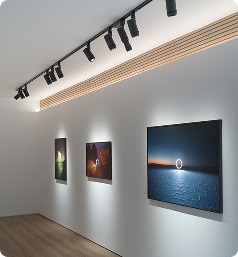
Adjustable ceiling light illuminating framed artwork with controlled beam and color accuracy
A ceiling light for artwork is one of the most critical elements in professional art presentation. Whether in a museum, commercial gallery, artist studio, or refined residence, overhead lighting defines how color, texture, and depth are perceived.
Unlike decorative ceiling fixtures, a properly specified ceiling light for artwork must provide controlled beam geometry, accurate color rendering, and glare management. The goal is not simply to illuminate a wall, but to reveal the artwork with precision and respect.
This guide explores how to select and position the ideal ceiling light for artwork across studios, galleries, and private collections.
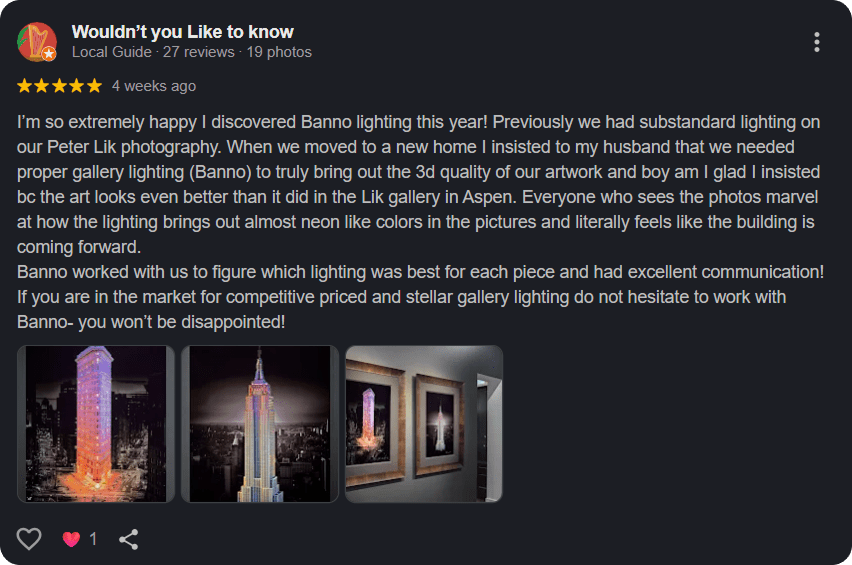
Gallery Owner Testimonial: Why Professionals Choose Our Display Lighting
Why Overhead Light for Artwork Matters
An overhead light for artwork offers several advantages:
- Clean architectural integration
- Minimal visual clutter
- Precise directional control
- Balanced distribution across vertical surfaces
Overhead lighting for artwork ensures consistent beam angles and allows alignment with ceiling grids and wall layouts.
Unlike table lamps or floor lights, ceiling mounted systems create a stable and professional presentation environment.
Recessed Ceiling Light for Artwork
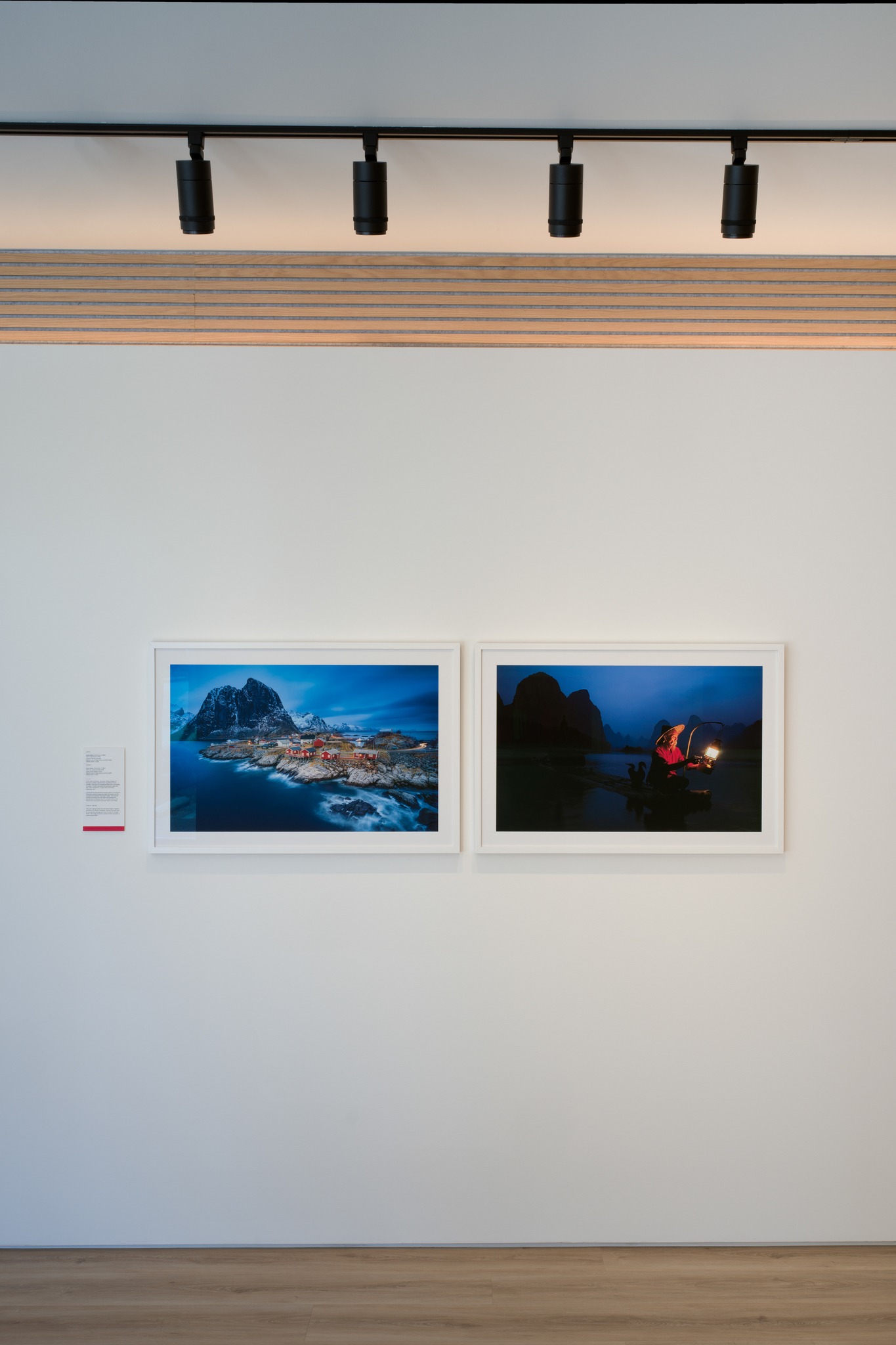
Adjustable recessed fixture highlighting painting while maintaining clean architectural ceiling lines
A recessed ceiling light for artwork integrates directly into the ceiling plane. This approach is common in museums and minimalist contemporary spaces.
Benefits include:
- Discreet appearance
- Adjustable tilt and rotation
- Reduced visual distraction
- Clean ceiling architecture
However, recessed systems must be adjustable. Fixed downlights rarely provide correct beam angle for art.
Ceiling art spotlight fixtures within recessed housings should allow aiming at approximately 30 degrees from vertical to reduce glare and enhance surface texture.

4.9-star rated by art collectors and gallery professionals
Ceiling Track Lighting for Art
Ceiling track lighting for art offers the highest level of flexibility.
Track systems allow:
- Fixture repositioning without rewiring
- Adjustable beam angles
- Interchangeable optics
- Adaptation to changing artwork layouts
In galleries where exhibitions rotate, ceiling track lighting for art is often preferred over fixed recessed installations.
Flexible systems such as Multi allow curators to reposition fixtures easily. Precision models like Zoom provide tight beam control for smaller works. Museum oriented solutions such as Deluxe prioritize visual comfort and stable output in permanent installations.
Each plays a role in professional art lighting ceiling strategies.
Ceiling Light for Art Studio
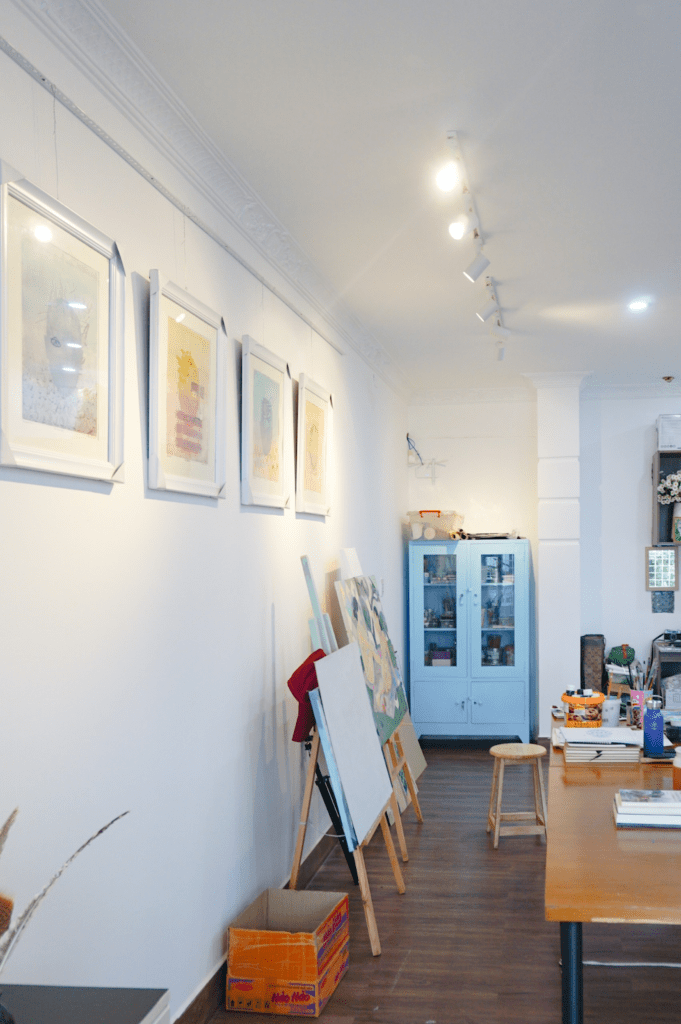
Art studio environment combining ambient light and focused ceiling mounted accents
A ceiling light for art studio environments must serve two functions:
- Accurate production lighting
- Presentation quality illumination
Best ceiling light for art studio setups combine:
- Even ambient distribution
- High CRI LED modules
- Adjustable directional accents
Best overhead light for art studio environments ensures accurate color mixing while allowing artists to evaluate texture and shadow.
Ceiling light fixture for art studio installations should not cast distracting shadows on canvases.
Ceiling Light for Painting and Texture Evaluation
A ceiling light for painting must reveal surface detail.
Directional overhead light for painting allows artists to assess:
- Brushstroke depth
- Layer transitions
- Gloss versus matte contrasts
Impasto texture
Without directional control, paintings appear flat and lose dimensionality.
The best ceiling lights for an art studio provide adjustable tilt and beam width for accurate evaluation.
Ceiling Lights for Art Gallery

Contemporary art gallery wall illuminated by evenly spaced ceiling accent lights
Ceiling lights for art gallery environments must meet higher standards.
Requirements include:
- Precise beam control
- Consistent color temperature
- Subtle contrast above ambient levels
- Glare reduction
Ceiling mounted accent lights for artwork should align precisely with artwork centers to maintain visual rhythm.
Lighting for artwork in galleries is about balance, not brightness.
Overhead Light for Wall Art in Residential Settings
In residential spaces, overhead light for wall art transforms ordinary walls into curated displays.
When installing a ceiling light for wall art:
- Maintain approximately 30 degree beam angle
- Match beam width to artwork size
- Avoid spill onto adjacent surfaces
- Keep color temperature consistent throughout the room
Overhead light for pictures in hallways or living rooms should elevate the artwork subtly without overpowering the environment.
What Is the Best Lighting for Artwork

High CRI LED ceiling light revealing accurate colors and fine artwork detail
When asking what is the best lighting for artwork, the answer typically includes:
- High CRI LED
- Stable color temperature around 2700K to 3000K
- Adjustable beam control
- Dimming capability
- Glare management
A ceiling light for artwork must combine these features to deliver professional results.
Ceiling Mounted Accent Lights for Artwork
Ceiling mounted accent lights for artwork provide controlled directional emphasis.
These are particularly effective for:
- Highlighting focal pieces
- Creating subtle visual hierarchy
- Isolating artwork within larger walls
However, intensity differences must remain refined. Excessive contrast disrupts cohesion.
Professional overhead art light systems balance clarity and comfort.
Overhead Lighting for Artwork and Surface Reflection

Art lighting adjusted precisely to eliminate reflections on gallery photographs
Framed works behind glass require careful positioning of overhead lights for paintings.
To reduce reflection:
- Aim fixtures at approximately 30 degrees
- Avoid direct alignment with viewer sight line
- Adjust beam spread carefully
Even small adjustments can dramatically improve clarity.
Overhead lighting for artwork must always account for glazing and varnish.
Ceiling Light for Art Room and Multi Purpose Spaces
A ceiling light for art room installations must support both creation and display.
In multipurpose spaces:
- Ambient lighting ensures general comfort
- Track or recessed directional lighting highlights artwork
- Dimming systems allow flexibility between tasks
Best overhead light for art room setups prioritize consistency and adjustability.
Can You Paint Ceiling Light Fixture

Ceiling art light fixture installed carefully to maintain thermal performance
In some cases, designers ask whether you can paint ceiling light fixture housings to match interiors.
While possible, performance must not be compromised. Heat management and optical precision should remain intact.
Function must always take priority over purely aesthetic modifications.
Overhead Lighting Meaning in Art Context
In art environments, overhead lighting meaning extends beyond general illumination.
It refers specifically to:
- Directional ceiling mounted lighting
- Controlled beam geometry
- Subtle contrast creation
- Professional presentation standards
Ceiling light for artwork installations define spatial hierarchy and shape viewer experience.
Long Term Stability and Maintenance

LED ceiling art lights providing consistent color output over years
Professional ceiling light for artwork systems should offer:
- Long LED lifespan
- Stable output over time
- Replaceable optics
Easy repositioning
Consistency ensures that artwork appears the same months after installation as it did on opening day.
High quality art lighting ceiling systems maintain color integrity and performance across extended periods.
Ceiling Height, Throw Distance, and Beam Geometry
When specifying a ceiling light for artwork, ceiling height directly influences performance.
The relationship between:
- Ceiling height
- Distance to artwork
- Beam angle
- Lumen output
determines whether the illumination feels refined or overpowering.
In lower ceilings under 2.7 meters:
- Medium beam spreads are typically appropriate
- Glare control becomes more critical
- Fixtures must remain visually discreet
In higher ceilings above 3 meters:
- Narrow beam optics may be required
- Higher lumen packages may be necessary
- Precision aiming becomes essential
A ceiling art spotlight in a tall space without the correct optic will create either weak illumination or excessive spill. Professional art lighting ceiling systems are selected based on throw distance calculations, not guesswork.
Beam Edge Quality and Artwork Clarity

Professional art lighting optics delivering consistent brightness across painting surface
Not all ceiling mounted fixtures produce the same beam quality.
A high performance ceiling light for artwork should provide:
- Clean beam edges
- No visible ring artifacts
- Smooth fall off from center to edge
- Minimal stray light
Poor optics produce a bright central hotspot and darker corners, especially noticeable on large canvases. Precision optics distribute light evenly across the entire surface.
In gallery environments, this difference is immediately visible.
Overhead Light for Artwork and Contrast Ratios
Contrast ratio defines how much brighter the artwork appears relative to its surroundings.
For refined environments:
- Artwork should be modestly brighter than ambient light
- Excessive contrast should be avoided
- Visual comfort should remain high
Overhead lighting for artwork must balance focus and subtlety.
Too little contrast makes the artwork disappear. Too much contrast makes the room feel theatrical rather than curated.
Professional ceiling light for artwork installations often aim for a gentle hierarchy that enhances depth without distraction.
Ceiling Light for Pictures in Multi Artwork Walls

Track lighting aligned precisely with artwork centers across continuous display
When illuminating multiple framed works in a row, consistency becomes critical.
Ceiling light for pictures arranged in sequence requires:
- Even spacing between fixtures
- Identical beam angles
- Consistent color temperature
- Equal intensity levels
If one piece appears brighter than another unintentionally, the viewer subconsciously assigns importance.
Ceiling mounted accent lights for artwork must be carefully aligned to preserve curatorial neutrality.
Overhead Light for Art Studio and Artist Shadow Control
In studio environments, overhead light for art studio use must consider the artist’s movement.
If a ceiling light for art studio is positioned incorrectly:
- The artist may cast shadows onto the canvas
- Color perception may shift due to uneven lighting
- Surface evaluation becomes inconsistent
Best overhead light for art studio layouts often position tracks slightly forward of the work plane, allowing light to fall naturally without obstruction.
This placement allows artists to step back and evaluate their work under gallery like conditions.
Overhead Light for Wall Art and Glazing Challenges

Demonstration of glare reduction using correct overhead lighting angle placement
Framed artwork under glass introduces reflection challenges.
When installing overhead light for wall art:
- Avoid positioning fixtures directly above the artwork centerline
- Maintain approximately 30 degree aiming
- Use glare shielding when possible
Subtle adjustments in tilt can dramatically improve viewing clarity.
Ceiling lights for art gallery installations often include anti glare accessories specifically designed for this purpose.
Ceiling Light for Art Room With Changing Displays
A ceiling light for art room installations should allow flexibility.
Art rooms often change layouts, rotate student work, or host exhibitions.
Ceiling track lighting for art offers:
- Easy repositioning
- Interchangeable beam optics
- Scalable fixture numbers
Flexible systems such as Multi support dynamic layouts. Precision fixtures like Zoom provide tight beam control when isolating individual pieces. Museum oriented systems such as Deluxe deliver refined stability and visual comfort when art rooms transition into public viewing spaces.
Adaptability is essential.
Light Spill and Wall Wash Considerations

Controlled beam spread preventing excess light spill around framed artwork
Sometimes, designers intentionally combine ceiling art spotlight fixtures with wall washing.
Wall washing creates a soft, even glow across the surface, while directional ceiling lights highlight specific works.
The key is balance.
If wall wash overpowers directional lighting:
- Artwork loses definition
- Contrast disappears
- The space feels flat
If directional lighting dominates too strongly:
- The wall appears fragmented
- Visual comfort decreases
Professional art lighting ceiling strategies layer these approaches carefully.
Overhead Lights for Paintings and Large Scale Works
Large paintings often require multiple overhead lights for paintings to achieve even coverage.
Key considerations include:
- Beam overlap alignment
- Matching output levels
- Avoiding visible seams
- Maintaining consistent color temperature
When two beams overlap incorrectly, bright bands become visible.
Precision optics and careful calibration prevent this issue.
In high ceiling galleries, narrow beam fixtures may be spaced evenly along the ceiling track to maintain uniformity.

Ceiling Light for Artwork and Energy Efficiency

Modern LED ceiling spotlight delivering efficient illumination for gallery artwork display
Modern LED ceiling light for artwork systems offer significant efficiency advantages.
Benefits include:
- Reduced heat load
- Lower energy consumption
- Extended fixture lifespan
- Minimal maintenance
This is particularly important in museums where lighting operates for extended hours.
Heat reduction also protects artwork integrity over time.
Emotional and Spatial Impact
Lighting shapes atmosphere.
A carefully calibrated ceiling light for artwork can:
- Enhance the depth of color
- Reveal subtle texture
- Increase perceived value
- Encourage longer viewing time
Subtlety is key.
In refined spaces, the lighting should feel natural and effortless. Visitors should focus on the artwork, not the fixtures.
When overhead art light systems are properly specified, they disappear visually while enhancing every piece on the wall.
Long Term Calibration and Maintenance
Even the best ceiling light for artwork requires occasional recalibration.
Over time:
- Artwork positions may shift
- Tracks may require realignment
- Dimming levels may need adjustment
Periodic review ensures that beam angles remain precise and presentation standards remain high.
Professional art gallery environments often include routine lighting audits to maintain consistency.
Final Perspective

Professional ceiling lighting transforming gallery wall into refined art display
A ceiling light for artwork is more than a ceiling fixture. It is a precision instrument.
It must deliver:
- Clean beam geometry
- High color rendering
- Controlled contrast
- Minimal glare
- Architectural integration
Whether illuminating a single painting in a private residence or an entire exhibition wall in a museum, overhead lighting defines perception.
Precision systems such as Zoom provide tight beam control for smaller works. Flexible solutions like Multi support evolving layouts. Museum focused systems such as Deluxe offer stable output and visual comfort across permanent collections.
Ceiling lighting for artwork is not decorative. It is foundational to how art is experienced, evaluated, and preserved.
20 FAQs
1. What is a ceiling light for artwork?
A ceiling mounted fixture designed specifically to illuminate artwork with controlled beam and color accuracy.
2. What is the best lighting for artwork?
High CRI LED with adjustable beam control and proper color temperature.
3. What angle should ceiling lights be positioned?
Approximately 30 degrees from vertical.
4. Is recessed ceiling light good for artwork?
Yes, if adjustable and properly aimed.
5. What color temperature is best for art?
Typically between 2700K and 3000K.
6. Can overhead lights damage paintings?
High quality LED is safe when intensity is controlled.
7. What is ceiling track lighting for art?
A flexible system allowing repositionable fixtures along a track.
8. How do you light artwork on a wall?
Use directional overhead lighting with correct beam width.
9. Are ceiling mounted accent lights effective?
Yes, for highlighting specific artworks.
10. What is the best ceiling light for art studio?
One with high CRI LED and adjustable beam angles.
11. Can ceiling lights be dimmed for art?
Yes, dimming supports conservation and ambiance control.
12. How bright should artwork lighting be?
Bright enough for clarity but within conservation limits.
13. Is LED better than halogen for artwork?
Yes, due to lower heat and stable output.
14. How do you avoid glare from overhead lights?
Use proper beam angle and glare shielding.
15. What is overhead art light?
Directional ceiling lighting designed to highlight artwork.
16. Can track lighting be installed on ceilings?
Yes, it is common in galleries and studios.
17. What is ceiling light for art studio?
Overhead lighting that supports both creation and display.
18. How do museums light artwork?
With adjustable LED fixtures and controlled dimming systems.
19. Should all ceiling lights match in a gallery?
Yes, consistency ensures professional presentation.
20. Why is ceiling light important for artwork?
Because it shapes perception, enhances clarity, and protects the artwork.
What Our Clients Are Saying About Our Lighting Systems