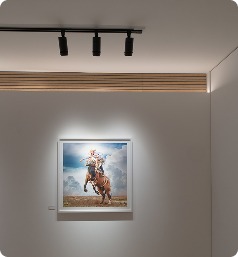
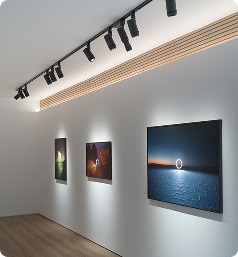
Sophisticated track lighting system highlighting a diverse modern art collection.
Lighting is the silent partner of every great gallery. It decides what visitors notice first, how long they stay, how deeply they connect, and how accurately they see the art. Great art gallery lighting makes work look alive. It reveals color faithfully, brings out texture, controls reflections, and creates a calm atmosphere where the art feels premium. Poor lighting does the opposite. It flattens form, shifts color, creates glare, and makes even important pieces feel ordinary.
A gallery is not a normal commercial space. It sits somewhere between a museum and a luxury retail environment. The lighting must honor the artwork, protect sensitive materials, and still look clean and intentional in the architecture. That is why so many professionals choose art gallery track lighting rather than fixed downlights. Track based systems are flexible, scalable, and designed to adapt as exhibitions change.
This guide is written to help you make confident decisions. It covers art gallery lighting design, practical art gallery lighting guidelines, how to select art gallery lighting fixtures, and what to look for when choosing the best track lighting for art gallery spaces. It also explains why many galleries today choose led track lighting for art gallery environments and how a fixture family like Zoom, Multi, and Deluxe can be used to build a complete system.
What Art Gallery Lighting Actually Needs to Do

Protective LED lighting shielding delicate pigments from heat and UV.
The purpose of art gallery lighting is not to make the room bright. It is to make each piece look correct, feel intentional, and remain protected over time. That requires control. Control of beam shape, direction, intensity, color quality, and glare.
A good system supports three goals at once.
First, presentation. The art must look strong from a distance and rich up close. Visitors should see depth, detail, and accurate color.
Second, comfort. People should not squint. They should not be distracted by hot spots or harsh reflections. They should feel drawn toward the work naturally.
Third, conservation. Light exposure can degrade pigments, paper, fabrics, and photographic materials. Heat and ultraviolet output must be minimized and illumination levels managed responsibly.
When you design around these three goals, lighting becomes an advantage, not a compromise.

4.9-star rated by art collectors and gallery professionals
Why Led Track Lighting for Art Gallery Spaces Is the Modern Standard

Flexible track infrastructure allowing for quick exhibition layout changes.
Most contemporary galleries use led track lighting for art gallery installations because it solves the biggest operational problem in galleries: change. Exhibitions rotate. Art moves. Walls get re hung. Collections evolve. Fixed lighting becomes outdated quickly.
Track lighting provides a flexible electrical backbone. You install the track once, then you reposition and re aim fixtures as needed. You can add or remove heads. You can change optics. You can shift the balance between wall washing and accent lighting without re wiring the ceiling.
LED technology adds critical benefits. LEDs produce very low heat compared with older halogen systems. They have minimal ultraviolet output. They are energy efficient and long lasting. They also allow advanced optics and controlled beams that are ideal for artwork.
A professional track system is not just convenient. It is often the most cost effective long term option because it prevents repeated renovations as exhibitions change.
Art Gallery Lighting Fixtures and Why Quality Matters

High-end fixtures delivering uniform light across an entire exhibition wall.
There are many types of art gallery lighting fixtures, but not all of them are suitable for high level art presentation. A fixture can look modern and still perform poorly. What matters in a gallery is performance on the wall and on the artwork.
Key qualities to prioritize include color accuracy, beam precision, glare control, and consistency across the space. A gallery can have beautiful architecture, but if lighting varies from one wall to another, the space feels unprofessional. Consistency is part of luxury.
A strong fixture family should also be modular. In real galleries, you need a range of beams and outcomes without needing ten completely different fixture types. That is where a platform approach becomes powerful.
This is exactly how Zoom, Multi, and Deluxe fit in. They are not random products. They are roles within a system. Zoom gives you adjustable beam control. Multi gives you flexible optics for different situations. Deluxe gives you premium output and color performance where the presentation must be perfect.
Art Gallery Lighting Design Starts With Intent

Intentional lighting placement accentuating the unique architecture of the space.
Good art gallery lighting design begins with a simple question: what is the experience you want visitors to have?
Some galleries want a calm museum like feel where the walls are softly lit and nothing feels harsh. Others want dramatic accents where each piece pops with strong contrast and controlled shadows. Many spaces need both, depending on the exhibition.
Design is not just fixture placement. It is the choreography of attention. Lighting should guide the visitor through the space without them realizing it. It should create subtle hierarchy, so key works feel important. It should support pacing, so the gallery feels alive rather than flat.
To design well, you must evaluate the architecture.
Ceiling height matters because it affects beam spread and intensity on the wall. White ceilings reflect and lift overall brightness. Dark ceilings absorb light and increase contrast. Wall color changes perceived brightness and influences the amount of spill you can tolerate. Floor reflectance affects glare and comfort.
Art also matters. Paintings behave differently than photography. Sculptures need modeling from multiple angles. Textiles and paper have conservation limits. A good design adapts to the medium.
Art Gallery Lighting Guidelines You Can Actually Use
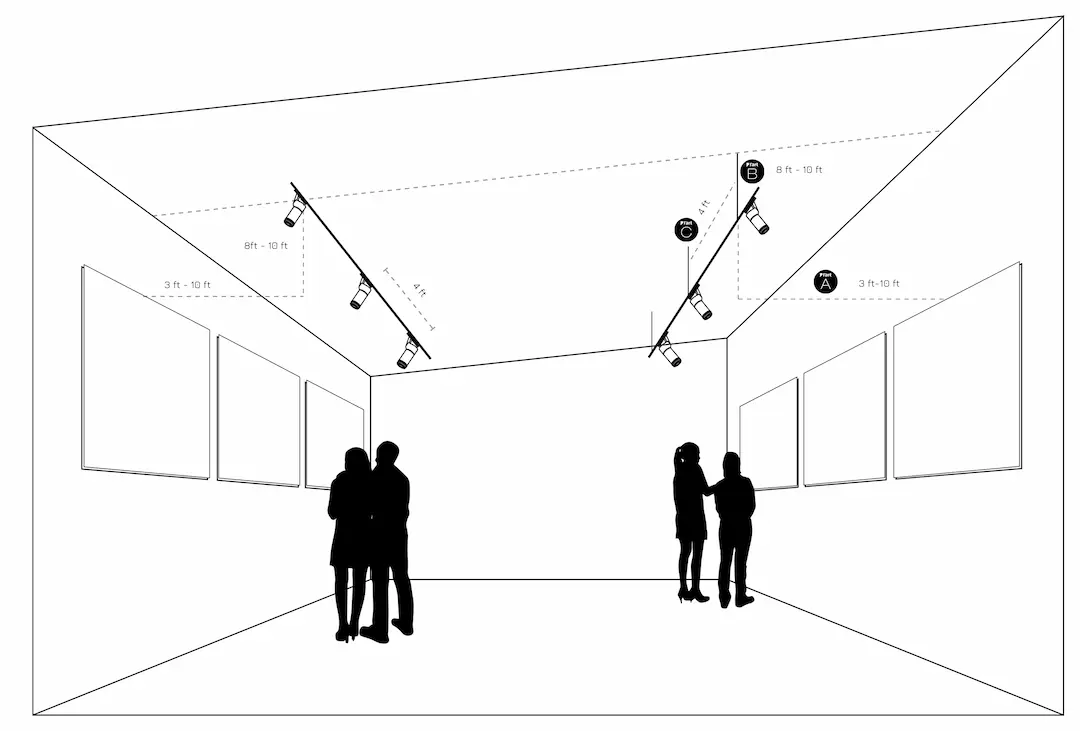
Graphic showing the ideal distance between tracks and exhibition walls.
Professional art gallery lighting guidelines can feel abstract, but the practical idea is simple. Use light strategically and responsibly.
You want enough illumination to reveal detail and create impact, but not so much that the work is over exposed or uncomfortable to view. You want to minimize glare and reflections. You want to avoid uncontrolled spill that makes the space feel messy. You want to keep color consistent and accurate.
A practical set of guidelines looks like this.
Start with consistency. Choose a fixture family and keep output and color stable across the space. Mixing random fixtures creates uneven results.
Control glare. Use optics, shielding, and aiming angles that hide the source from direct view.
Use beam control. Narrow beams for feature pieces, medium beams for general artwork, wide beams and wall wash for ambient presentation.
Layer the lighting. Combine wall illumination with accents rather than relying on one approach.
Use dimming. Dimming gives you control for events, different times of day, and sensitive materials.
Minimize heat and ultraviolet output. This is one reason LED is preferred.
These guidelines sound basic, but most galleries fail because they ignore one of them.
Understanding Beam Angles and Why They Decide Everything

Wide beam spread providing soft, even coverage for large paintings.
Beam angle is the shape of attention. A narrow beam creates drama and focuses the eye. A wider beam creates calm and context. If you choose the wrong beam, even the best fixture will disappoint.
Narrow beams are best for sculptures, small works, or moments where you want a strong focal point. Medium beams are best for most framed works. Wide beams are best for large pieces, groups, or when you need soft coverage.
This is why Zoom is such a practical product in galleries. Zoom lets you adjust the beam instead of guessing. You can respond to the real wall, the real artwork, and the real viewing distance. You can tighten the beam to reduce spill. You can widen it to cover a larger canvas. You can tune the experience quickly when a new exhibition arrives.
Multi supports the same goal through interchangeable optics. It gives you a toolkit of beam shapes to adapt the system to the show.
Deluxe is the premium option when you want the highest quality of beam, the most refined cut off, and the strongest presentation for high value work.
Color Accuracy and Why It Protects Your Reputation

Full-spectrum light revealing the true, vibrant palette of an artist.
Color accuracy is a core requirement of art gallery lighting. If the light source distorts color, the viewer is not seeing the work truthfully. That affects trust. It affects brand reputation. It affects sales. Collectors notice when reds look dull or whites look green. Photographers notice when prints shift. Artists notice when their palette is misrepresented.
High quality LED modules with strong color fidelity reveal subtle gradients and preserve natural tones. This matters most in skin tones, delicate neutrals, and saturated colors where cheap lighting fails first.
When you build a system around a consistent fixture family like Zoom, Multi, and Deluxe, you reduce the risk of mixed color performance across walls. That consistency is what makes the gallery feel intentional.
Color Temperature and the Mood of the Space

Crisp, neutral white light providing a modern feel for photography.
Color temperature sets the emotional tone. Warmer light can feel intimate and classic. Neutral light can feel clean and contemporary. The right choice depends on the style of work and the desired atmosphere.
Many galleries prefer a neutral approach because it feels balanced and modern. Some prefer slightly warm tones for traditional work. The key is consistency and control. If different areas of the gallery shift in tone, the space feels disjointed.
A good design plans the temperature choice and keeps it stable. It also plans how daylight interacts with the space. Daylight can be beautiful, but it can also create inconsistent viewing conditions. That is why many galleries use controlled artificial lighting as the primary presentation layer and treat daylight as ambient background.
Glare Control and Reflections

Hidden light sources ensuring the viewer sees art, not reflections.
Glare is one of the biggest reasons visitors do not enjoy a gallery, even if they cannot name the problem. When the light source is visible or reflections bounce off glass, viewers lose the ability to see detail. They step sideways to avoid reflection. They disengage.
Glare control comes from three things: optics, aiming, and shielding. A deep recessed optic can reduce source visibility. A honeycomb louver can cut glare. A well chosen aiming angle can prevent reflections into the viewer’s line of sight.
When you specify art gallery lighting fixtures, you should prioritize fixtures designed for visual comfort. This is especially important in photography exhibitions and in framed pieces with glass.
Zoom and Deluxe are useful here because they allow controlled beams and refined optics that keep light where it belongs, on the art rather than in the eyes of the viewer.
Wall Washing Versus Accent Lighting

Focused accent lighting drawing the eye to a central masterpiece.
Most successful art gallery lighting design uses a combination of wall washing and accent lighting.
Wall washing creates a calm, even base across the wall plane. It makes the space feel open and intentional. It helps visitors see the context of the exhibition.
Accent lighting creates hierarchy. It brings attention to key works. It adds contrast and drama. It can be used to create moments within the space.
If you rely only on accents, the gallery can feel spotty and harsh. If you rely only on wall washing, the exhibition can feel flat. The balance depends on curatorial intent.
Track systems are ideal because you can adjust that balance without re wiring. You can add more accents for a dramatic show. You can increase wall illumination for a calm presentation. You can do both in different zones.
Lighting Different Types of Artwork

Soft, low-intensity illumination for sensitive textiles.
Art is not one thing. It is material, surface, and sensitivity. Your lighting must respect that.
Oil paintings often benefit from angled light that reveals texture. A slight grazing angle can make brushwork visible and increase depth.
Photography often requires very careful glare management. Even a small reflection can ruin the viewing experience. Narrower beams and controlled angles help.
Sculpture needs modeling. One light rarely shows form well. Two or three lights from different directions can reveal volume and create an intentional shadow pattern.
Works on paper and textiles are often more sensitive. They may require lower light levels and controlled exposure time. Dimming and scene control become important here.
The advantage of a system built on Zoom and Multi is adaptability. You can tune beam and distribution to the medium without changing infrastructure.
Planning Track Layout and Fixture Placement

Parallel track runs ensuring perfect aiming angles for wall-mounted art.
Track layout is the foundation of art gallery track lighting. Done well, it gives you flexibility for years. Done poorly, it locks you into awkward aiming angles and uneven coverage.
Track is often installed in linear runs parallel to the walls, or in grids that allow coverage across multiple exhibition zones. The right layout depends on ceiling height, wall lengths, and the style of exhibitions.
You want to be able to place fixtures where they can hit the artwork at an effective angle. Too steep and you create glare and reflection. Too shallow and you can create unevenness or exaggerated texture.
A good starting approach is to plan tracks so fixtures can aim at artwork from a comfortable distance. You also want enough track capacity so you can add more fixtures for dense exhibitions or reduce them for minimal shows.
Here are practical placement considerations.
Start with the wall plane. Most art is on walls, so plan track lines that support strong wall lighting.
Consider ceiling height. Higher ceilings require stronger optics or tighter beams to maintain intensity.
Plan for flexibility. Include track capacity beyond what you need today.
Keep it clean. Track should support the architecture, not clutter it.
Lighting Controls and Scenes

Automated lighting scenes optimized for conservation and public viewing.
Controls transform a lighting system from static to intelligent. Dimming allows you to tune the space based on the show, the time of day, or conservation requirements. Scene presets allow quick changes for events, openings, talks, and private viewings.
Controls also support energy management. You can reduce lighting when the gallery is closed. You can limit exposure in sensitive areas. You can create different moods without physically changing fixtures.
A track system paired with good control strategy becomes a professional platform, not just lighting.
Best Track Lighting for Art Gallery Spaces

Top-tier lighting system providing museum-quality visuals in a gallery.
When people ask for the best track lighting for art gallery spaces, they usually mean one thing. They want art to look exceptional with minimal effort and maximum flexibility.
The best solution is not a single fixture. It is a system built around a consistent platform with the right options.
Zoom is ideal when you need adjustable beam control because exhibitions change. It reduces guesswork and gives curators practical power.
Multi is ideal when you want modular optics and versatile distribution across many walls.
Deluxe is ideal when the presentation must be premium, with top tier color quality, refined optics, and the most polished output.
Together, Zoom, Multi, and Deluxe cover the real needs of galleries. They let you build a clean track infrastructure and then adapt the lighting layer to each show.
Common Mistakes That Make Galleries Look Cheap

Illustration of incorrect aiming causing glare in a visitor's eyes.
Many galleries invest heavily in art, walls, and branding, but under invest in lighting quality and planning. The result is a space that feels unfinished.
Common mistakes include using generic retail track heads that have poor beam control and poor color rendering. Another mistake is aiming lights too steeply, creating glare and reflections. Another is inconsistent color temperature across fixtures, which makes the walls feel patchy. Another is using beams that are too wide, causing spill and reducing contrast.
A professional system avoids these mistakes by prioritizing optics and consistency first, then flexibility.
A Simple System Approach Using Zoom, Multi, and Deluxe

Sleek lighting fixture providing refined, high-accuracy artwork illumination.
If you want an easy way to think about building a professional gallery system, think in layers and roles.
Start with the track infrastructure as the backbone. This is your long term platform.
Then choose fixtures by role.
Use Zoom where exhibitions frequently change and beam flexibility matters.
Use Multi for general coverage where you want a reliable mix of optics.
Use Deluxe in hero zones, entry walls, and feature rooms where premium presentation is essential.
This approach keeps the system coherent and makes it easier for staff to maintain consistency across the gallery.
After paragraphs, here are a few practical role examples.
- Zoom on rotating exhibition walls where artwork size varies weekly
- Multi along long wall runs where you need reliable consistent coverage
- Deluxe for feature pieces, high value works, and flagship rooms
Art Gallery Lighting Fixtures for Galleries That Sell

Professionally lit showroom making art look more valuable to collectors.
If your gallery sells work, lighting directly affects revenue. When pieces are lit correctly, they look more valuable. Visitors spend longer looking. They take more photos. They feel the exhibition is more premium. That perception transfers to the artwork.
The goal is to make the art look like it belongs in a museum while still feeling inviting. Track lighting gives you that balance. High quality fixtures give you the accuracy and polish.
When a collector sees a piece under refined light, they imagine it in their own home or collection. Lighting is not just about the gallery. It is part of the buyer’s mental picture.
Final Art Gallery Lighting Guidelines Summary

Balanced exhibition room following all professional lighting best practices.
To close, here is a clean checklist that captures the most practical art gallery lighting guidelines without turning your project into a technical headache.
Start with a track backbone for flexibility.
Choose high quality optics and consistent color performance.
Layer the lighting with wall illumination plus accents.
Control glare with optics and correct aiming angles.
Use adjustable beams or interchangeable optics to adapt to exhibitions.
Use dimming and scenes for events and conservation needs.
Keep the system consistent across rooms so the gallery feels premium.
Conclusion

Elegantly lit gallery space showcasing the power of professional lighting.
Professional art gallery lighting is the difference between a room that displays art and a gallery that elevates it. The best results come from flexible art gallery track lighting infrastructure paired with high performance art gallery lighting fixtures designed for artwork, not general retail.
That is why led track lighting for art gallery spaces has become the modern standard and why a platform approach using Zoom, Multi, and Deluxe makes sense. Zoom gives you beam flexibility for changing exhibitions. Multi gives you modular optics for versatile coverage. Deluxe delivers premium presentation where accuracy and refinement are non negotiable.
If you want, I can also produce a matching SEO package next: meta title, meta description, FAQ schema questions, internal link anchors, and a product comparison section that pushes Zoom, Multi, and Deluxe harder without sounding salesy.
Professional Art Gallery Lighting Systems
Professional art gallery lighting systems are designed to balance visual presentation with technical performance. Unlike ordinary commercial lighting, gallery systems must support a constantly changing environment where exhibitions rotate and artworks vary in size, material, and sensitivity.
A typical art gallery lighting system includes track infrastructure, adjustable fixtures, precision optics, and dimming controls. Each element works together to ensure that lighting remains flexible and consistent across the space.
Art gallery track lighting systems are widely used because they allow fixtures to be repositioned easily without modifying the electrical installation. When exhibitions change, lighting can be adjusted within minutes. This flexibility is essential for galleries that regularly rotate collections or host temporary art exhibitions.
A well planned system also allows curators to adjust beam angles and intensity levels to suit each piece. This ensures that artworks remain properly illuminated regardless of their size or position within the gallery.
Gallery Lighting Design and Spatial Balance

Modern gallery layout with lighting emphasizing focal artworks and calm transitions
Gallery lighting design is not simply about placing lights on the ceiling. It involves understanding how visitors move through the space and how their attention shifts between artworks.
Lighting should guide the viewer naturally from one piece to another. Strong focal points can draw attention to key works, while softer lighting can create calm transitions between pieces.
When lighting an art gallery, designers must consider several architectural elements.
Ceiling height influences beam spread and intensity on the wall. Higher ceilings require tighter beams or higher output fixtures to maintain proper illumination.
Wall color affects how light reflects throughout the space. White walls reflect light evenly and can make the gallery feel brighter. Darker walls absorb more light and create stronger contrast around artworks.
Floor materials also influence glare levels. Highly reflective floors can bounce light back toward viewers and cause visual discomfort.
A thoughtful gallery lighting design considers these elements together to create a balanced environment where artworks remain the visual focus.
Art Gallery Lighting Fixtures and Their Role
Art gallery lighting fixtures are specifically engineered for precision and reliability. Unlike decorative fixtures used in retail environments, these fixtures prioritize optical performance.
High quality art lighting fixtures deliver consistent color rendering and controlled beam distribution. This ensures that artworks appear natural and vibrant without uneven brightness.
Professional fixtures often include interchangeable optics or adjustable beam angles. These features allow curators to adapt lighting to different artworks without replacing equipment.
For example, narrow beams can be used for small framed works, while wider beams provide coverage for larger paintings or installations.
Consistency across fixtures is also important. If color temperature or brightness varies from one fixture to another, the gallery can appear uneven and unprofessional.
Using a coordinated fixture family ensures that lighting remains uniform across walls and exhibition areas.
Art Gallery LED Lighting and Efficiency

Energy efficient LED spotlights illuminating artwork inside contemporary gallery
Art gallery LED lighting has become the preferred solution for modern galleries because it offers strong performance while reducing energy consumption.
LED technology produces minimal heat and ultraviolet radiation compared with older halogen lighting systems. This is particularly important for preserving sensitive artworks such as photographs, textiles, and works on paper.
Lower heat output also helps maintain stable environmental conditions within the gallery. Excess heat from traditional lighting can affect humidity levels and create uncomfortable conditions for visitors.
Another advantage of LED lighting is longevity. LED fixtures typically operate for many thousands of hours before requiring replacement. This reduces maintenance costs and ensures consistent lighting quality over time.
Because of these benefits, art gallery LED lighting systems are now standard in both commercial galleries and museum environments.
Modern Art Gallery Lighting Approaches
Modern art gallery lighting emphasizes clarity and flexibility. Rather than flooding the entire space with uniform brightness, contemporary galleries use layered lighting strategies.
Ambient lighting provides general visibility across the space. Accent lighting highlights individual artworks. Wall washing can create even illumination along gallery walls.
Combining these approaches allows curators to shape the atmosphere of the exhibition.
For example, a gallery may use soft wall lighting to create a calm background while stronger spot lighting highlights featured works.
This layered approach creates depth and visual rhythm within the space.
Track lighting systems make these strategies possible because fixtures can be adjusted easily to change the lighting balance.
Art Gallery Spot Lighting for Focal Pieces

Directional spotlight enhancing texture and depth of framed painting
Art gallery spot lighting is often used to emphasize important artworks within an exhibition.
Spot lighting uses narrower beam angles to concentrate illumination on a specific piece. This creates contrast between the artwork and the surrounding wall.
When used carefully, spot lighting can enhance texture, depth, and color intensity. Visitors are naturally drawn toward illuminated focal points.
However, spot lighting must be controlled carefully to avoid harsh glare or excessive brightness.
A well designed art gallery lighting system allows spot lights to be balanced with softer lighting so that the exhibition remains visually comfortable.
Natural Light in Art Gallery Spaces
Some galleries incorporate natural light as part of the viewing experience. Natural light can create a soft and pleasant atmosphere that complements artwork presentation.
However, natural light must be managed carefully. Direct sunlight can cause glare and increase exposure to ultraviolet radiation, which may damage sensitive materials.
For this reason, many galleries combine controlled artificial lighting with filtered daylight.
Artificial lighting remains the primary method for illuminating artwork because it provides stable brightness and color consistency.
Natural light is often used as ambient background illumination rather than the main source of display lighting.
This approach allows galleries to enjoy the atmosphere of daylight while maintaining precise control over artwork presentation.
Gallery Lighting for Art Exhibitions

Exhibition space with flexible lighting layout highlighting mixed artwork sizes
Lighting art exhibitions requires flexibility. Temporary exhibitions often include artworks of different sizes and materials, each with unique lighting requirements.
A track based gallery lighting system allows fixtures to be repositioned quickly as exhibitions change.
Curators may adjust beam angles to highlight certain pieces or shift lighting intensity to create a different atmosphere for each exhibition.
Lighting also influences how visitors move through the gallery. Brighter focal areas naturally attract attention, while softer areas encourage slower viewing.
By adjusting lighting distribution, galleries can guide visitors through the exhibition space in a way that enhances the storytelling of the show.
The Importance of Consistent Gallery Lighting
Consistency is one of the most important characteristics of professional gallery lighting.
Visitors may not consciously notice lighting differences, but they immediately sense when a space feels uneven or uncomfortable.
Inconsistent color temperature or brightness between fixtures can make the gallery feel disjointed.
Professional art gallery lighting systems prevent this by using coordinated fixtures with consistent output and color performance.
Maintaining consistent lighting across the gallery helps create a polished, premium environment that supports the artwork.
When lighting is carefully controlled and balanced, visitors can focus entirely on the art itself.
FAQs
1. What is the best lighting for an art gallery?
The best lighting for an art gallery combines high color accuracy, controlled beam angles, glare reduction, and flexible positioning, usually achieved with professional LED track lighting systems.
2. Why do galleries use track lighting instead of ceiling downlights?
Track lighting allows galleries to reposition fixtures and adjust beam angles easily as exhibitions change, making it more flexible than fixed ceiling lights.
3. Why is LED track lighting preferred for art gallery environments?
LED track lighting produces less heat, minimal ultraviolet radiation, high energy efficiency, and long lifespans, making it ideal for protecting artwork.
4. How does lighting affect how artwork is perceived?
Lighting reveals texture, color, and depth in artwork. Proper lighting enhances the viewer’s experience, while poor lighting can flatten details and distort colors.
5. What color temperature is best for art gallery lighting?
Many galleries use neutral white light because it presents artwork accurately while maintaining a clean and modern atmosphere.
6. What is CRI and why is it important for art lighting?
CRI (Color Rendering Index) measures how accurately a light source reveals colors. High CRI lighting ensures artworks appear true to the artist’s original palette.
7. How can glare be reduced in art gallery lighting?
Glare can be reduced by using deep recessed optics, honeycomb louvers, proper aiming angles, and fixtures designed specifically for artwork illumination.
8. What beam angle is best for lighting artwork?
Narrow beams highlight small works or sculptures, medium beams suit most paintings, and wide beams are ideal for large artworks or wall washing.
9. What is the ideal angle for lighting paintings in a gallery?
Lighting paintings at approximately a thirty-degree angle helps illuminate the artwork evenly while minimizing reflections and glare.
10. What is the difference between wall washing and accent lighting?
Wall washing creates even illumination across a wall surface, while accent lighting highlights individual artworks to create visual focus and hierarchy.
11. How should sculptures be lit in a gallery?
Sculptures are best illuminated using multiple directional lights from different angles to reveal form, depth, and shadow.
12. Why is glare especially problematic for photography exhibitions?
Photographs are often displayed behind glass, which can easily reflect light sources. Controlled beams and proper angles help prevent reflections.
13. How does gallery lighting protect sensitive artwork?
Professional lighting systems minimize heat, reduce ultraviolet radiation, and allow dimming to control light exposure for delicate materials.
14. What types of artworks require lower light levels?
Works on paper, textiles, historic photographs, and delicate pigments often require lower illumination to prevent long-term damage.
15. How should track lighting be positioned in an art gallery?
Track lighting is often installed parallel to exhibition walls or in grid layouts so fixtures can be aimed at artworks from effective angles.
16. Why is consistent lighting important in a gallery?
Consistent lighting across walls ensures the gallery feels professional and prevents visual distractions caused by uneven brightness or color shifts.
17. How do lighting controls improve gallery lighting systems?
Dimming and scene controls allow galleries to adjust brightness levels for exhibitions, events, conservation requirements, and different viewing conditions.
18. What are the common mistakes in art gallery lighting design?
Common mistakes include using generic retail lighting, poor beam control, inconsistent color temperature, excessive brightness, and incorrect aiming angles.
19. How does lighting influence art sales in commercial galleries?
Well-designed lighting makes artwork appear more valuable, encourages visitors to spend more time viewing pieces, and improves overall presentation.
20. What should galleries look for when choosing track lighting fixtures?
Galleries should prioritize high color accuracy, precision optics, glare control, beam flexibility, and consistent performance across all fixtures.
You’re in expert hands when it comes to art lighting