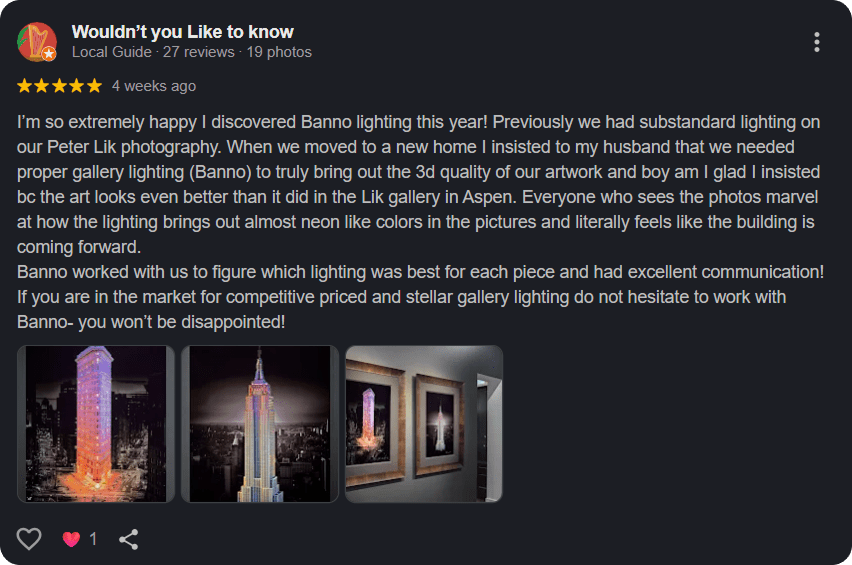
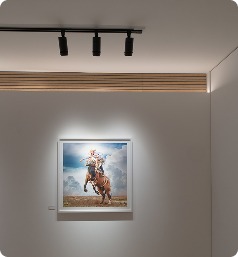
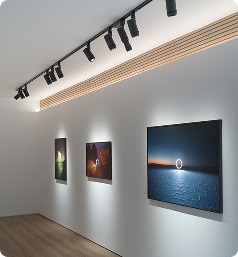
Modern LED art lighting illuminating paintings in a minimalist gallery interior
Art lighting LED systems have transformed how artwork is presented, protected, and perceived. In galleries, museums, and refined residential collections, LED technology now defines the standard for precision illumination.
A well specified art lighting LED solution enhances color accuracy, reveals texture, reduces heat exposure, and provides long term stability. Unlike older lighting technologies, modern LED lighting for art allows fine control over beam angle, intensity, and conservation requirements.
This guide explores how art lighting LED systems should be designed, selected, and integrated into professional art environments.
What a Gallery Owner Says About Our Precision Lighting Systems
Why Art Lighting LED Is the Modern Standard
Traditional halogen and incandescent lighting produced significant heat and UV radiation. For sensitive artworks, especially works on paper and textiles, this posed risks.
Art lighting LED offers:
- Minimal heat emission
- No ultraviolet output
- Stable color temperature
- Energy efficiency
- Long lifespan
- Dimming compatibility
Fine art LED lighting has therefore become the preferred solution in art gallery LED lighting installations worldwide.
What Is Lighting in Art and Why It Matters

Artwork illuminated with directional lighting emphasizing texture and dimension
Before discussing technology, it is important to understand what is lighting in art.
Lighting influences:
- Color perception
- Texture visibility
- Depth and dimension
- Emotional tone
- Viewer engagement
Different types of lighting in art environments include:
- Accent lighting
- Ambient lighting
- Wall washing
- Task lighting
Art lighting LED systems are primarily used for accent lighting, isolating and enhancing specific artworks within a space.

4.9-star rated by art collectors and gallery professionals
Artwork LED Lighting: Core Principles
When designing artwork LED lighting, several technical principles must be respected.
Color Rendering
High CRI LED modules ensure accurate pigment representation. Poor color rendering distorts artwork appearance.
Beam Control
Recessed LED lighting for artwork or LED track lighting for artwork must match beam spread to artwork size.
Glare Management
LED light sources should be shielded to prevent visible glare.
Conservation
Does LED light damage paintings? High quality LED systems produce minimal heat and no UV, making them safer than older technologies. However, light levels must still be controlled within conservation guidelines.
LED Lighting for Artwork on Wall
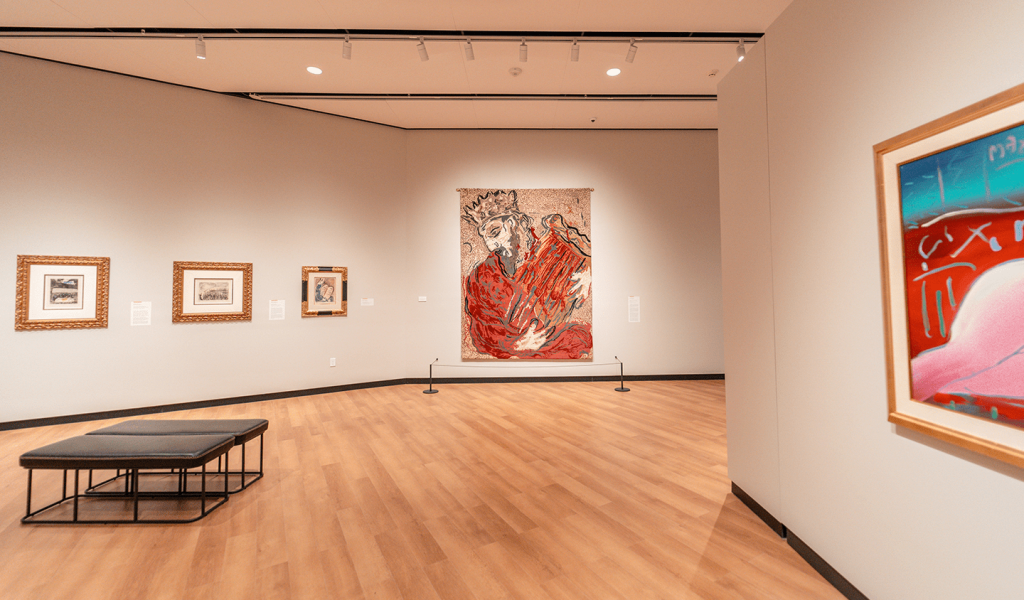
Ceiling mounted LED art lights aimed toward framed gallery paintings
LED lighting for artwork on wall installations must consider angle and beam spread.
The recommended aiming angle is approximately 30 degrees from vertical. This prevents glare and reveals surface detail.
LED lighting for wall art should:
- Provide even distribution
- Avoid hotspotting
- Maintain consistent color temperature
Wall art LED lighting systems can be ceiling mounted, recessed, or track based depending on architectural design.
LED Track Lighting for Artwork
LED track lighting for artwork offers flexibility for evolving exhibitions.
Advantages include:
- Repositioning without rewiring
- Adjustable beam angles
- Interchangeable optics
- Clean architectural integration
In art gallery LED lighting environments, track systems are often preferred due to their adaptability.
Flexible systems such as Multi allow curators to adjust layouts as exhibitions rotate. Precision tools like Zoom provide narrow beam control for smaller works. Museum focused systems such as Deluxe prioritize stability and visual comfort in permanent collections.
Each contributes to professional art lighting design strategies.
Recessed LED Lighting for Artwork

Minimalist art gallery using recessed lighting to highlight modern artworks
Recessed LED lighting for artwork integrates into ceilings, creating minimal visual intrusion.
This approach is common in:
- Museums
- High end residential galleries
- Contemporary white cube spaces
Recessed fixtures must provide adjustable tilt and rotation to maintain correct beam geometry.
LED Lighting for Art Studio
Art studio LED lighting differs slightly from exhibition lighting.
In studios, lighting must support:
- Accurate color mixing
- Even workspace illumination
- Reduced eye strain
Best LED lighting for art studio environments typically includes:
- Neutral white color temperature
- High CRI
- Balanced ambient distribution
- Supplemental directional accent lighting
LED lighting for art studio UK and international installations follow similar principles.
Fine Art LED Lighting and Conservation

Museum gallery with controlled LED lighting protecting sensitive artworks
Fine art LED lighting prioritizes preservation.
Light exposure is cumulative. Even LED systems, though safer, must be managed carefully.
Museum grade LED art gallery lighting includes:
- Dimming capability
- Lux monitoring
- Stable spectral output
- Controlled beam placement
This ensures that artwork lighting enhances visibility without compromising longevity.
LED Lighting Behind Artwork
LED lighting behind artwork is often used in contemporary installations.
Applications include:
- Floating frames
- Backlit acrylic panels
- Shadow gap installations
While visually striking, LED lighting behind artwork should complement rather than replace directional accent lighting.
Backlighting adds atmosphere. Directional art lighting LED reveals detail.
LED Art Display Lights and Large Installations

Large contemporary artwork highlighted using balanced LED lighting system
LED art display lights must adapt to artwork scale.
For large works:
- Wider beam spreads are required
- Multiple fixtures may be needed
- Output must be balanced evenly
LED art light for painting installations must avoid visible seams between overlapping beams.
Consistency in brightness and color temperature across multiple artwork lights is essential.
Artistic Lighting and Emotional Tone
Artistic lighting shapes atmosphere.
Warm tones create intimacy.
Neutral tones create clarity.
Higher contrast creates drama.
Art lighting design must align with curatorial intent.
In contemporary art spaces, slightly heightened contrast may be used to create tension. In classical museum galleries, balanced and subtle illumination is often preferred.
Creative LED Lighting in Contemporary Spaces

Minimal gallery interior with creative LED lighting design
Creative LED lighting ideas are increasingly used in modern art contexts.
Examples include:
- Linear LED accents integrated into architectural details
- Controlled wall grazing
- Subtle perimeter lighting
However, creative LED lighting should never compete with artwork itself.
Art lighting LED systems must remain disciplined and focused on presentation quality.
LED Lighting for Photographing Artwork
LED lighting for photographing artwork must ensure:
- Even distribution
- Accurate color reproduction
- Minimal glare
- Controlled shadow
Professional documentation setups often use balanced LED sources positioned symmetrically to eliminate reflection while preserving texture.
What Is the Best Lighting for Artwork

High CRI LED spotlight illuminating framed artwork in gallery setting
When asking what is the best lighting for artwork, the answer typically includes:
- High CRI LED
- Approximately 3000K color temperature
- Adjustable beam angle
- Dimming capability
- Glare control
Art lighting LED systems meeting these criteria provide professional level results.
Art Lighting Guide for Galleries and Homes
An effective art lighting guide includes:
- Match beam width to artwork size.
- Position fixtures at approximately 30 degrees.
- Maintain consistent color temperature.
- Use dimming for conservation.
- Avoid mixing fixture types without calibration.
Whether in a museum or a private residence, art lighting LED must be specified with precision.
Precision Beam Control in Art Lighting LED

Precision LED fixture producing clean beam edge on gallery wall
The defining advantage of art lighting LED is beam control. Unlike older technologies that relied on reflectors alone, modern LED systems use engineered optics to shape light with accuracy.
A refined artwork LED lighting system should deliver:
- Clean beam edges without visible rings
- Smooth transition from center to perimeter
- Minimal spill beyond the artwork boundary
- Stable intensity across the illuminated surface
Poor beam control creates hotspots in the middle of a painting while leaving corners underlit. Precision LED art display lights maintain visual balance, allowing the artwork to appear naturally illuminated rather than artificially highlighted.
Light Distribution and Wall Interaction
Art lighting LED does not exist in isolation. Light interacts with wall color, texture, and reflectance.
In white cube galleries:
- Spill light becomes highly visible
- Beam discipline must be precise
- Contrast should be subtle
In darker interiors:
- Slightly higher output may be required
- Contrast becomes more pronounced
- Shadows appear deeper
Art lighting design must account for the full environment, not just the artwork itself.
LED Lighting for Large Scale Installations
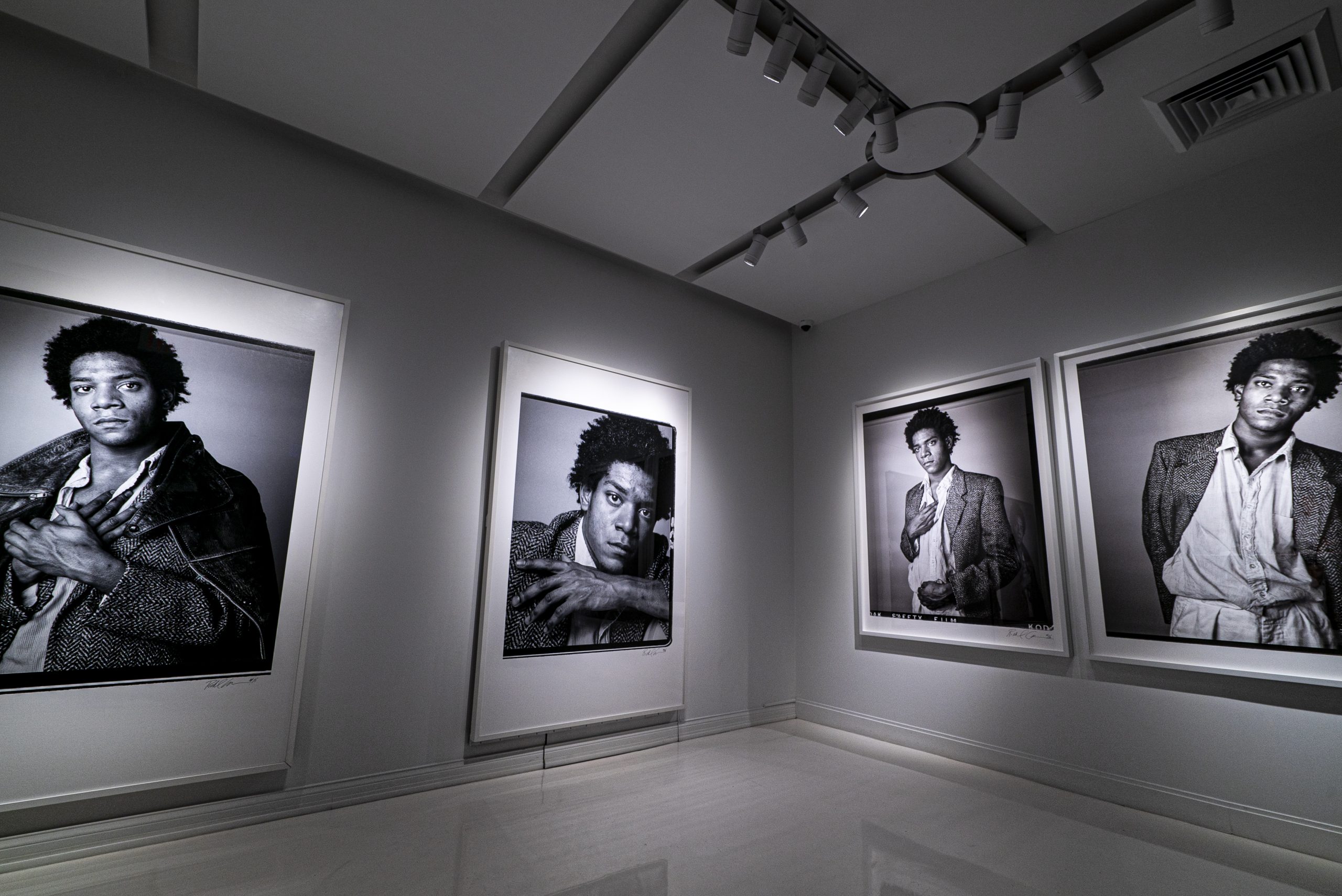
Oversized artwork illuminated using multiple LED art spotlights
Large contemporary works require careful LED lighting for artwork planning.
When illuminating oversized canvases or multi panel installations:
- Multiple LED art light fixtures may be required
- Beam overlap must be carefully aligned
- Output consistency across fixtures is critical
Inconsistent brightness between two fixtures creates visible banding. Professional art gallery LED lighting systems are calibrated to maintain uniform tone across wide surfaces.
Flexible systems such as Multi allow fixtures to be repositioned easily for large installations. Precision optics in Zoom style fixtures provide tight beam shaping when isolating sections of expansive works. Museum grade systems like Deluxe maintain consistent performance over long exhibition periods.
Dimming and Conservation in Fine Art LED Lighting
Light exposure is cumulative. Even safe LED systems must be managed carefully.
Fine art LED lighting installations should incorporate:
- Smooth dimming curves
- Independent zone control
- Adjustable output per artwork
- Monitoring of lux levels
For sensitive works on paper or textiles, reduced light levels are essential. LED lighting for art allows precise control without color shift, which was a common issue in older technologies.
This stability makes art lighting LED particularly valuable in museum contexts.
Color Accuracy and Pigment Integrity

Detailed artwork texture visible under accurate LED gallery lighting
Color rendering is one of the most critical aspects of art lighting LED.
High quality LED modules reproduce pigments accurately, ensuring that:
- Reds remain vibrant
- Blues retain depth
- Subtle tonal transitions are visible
- Skin tones in portraiture appear natural
Low quality LED can distort color, introducing unwanted green or magenta shifts.
Best LED art lighting systems are engineered to maintain consistent spectral performance over time, ensuring that exhibitions appear the same months after installation as they did on opening night.
LED Lighting for Art Studio vs Exhibition
Art studio LED lighting serves a different function than exhibition lighting.
In studios:
- Even ambient light supports painting and drawing
- Neutral white tones aid color mixing
- Reduced shadowing prevents distortion
In exhibitions:
- Directional accent lighting defines focus
- Controlled contrast enhances texture
- Subtle hierarchy guides movement
Best LED lighting for art studio environments often includes a combination of overhead panels and directional fixtures.
Lighting for art studio setups must prioritize accuracy during creation, while exhibition lighting prioritizes presentation.
Recessed LED Lighting for Artwork in Minimal Spaces

Clean architectural ceiling with adjustable recessed LED fixtures
Recessed LED lighting for artwork is favored in minimalist architecture.
This approach:
- Keeps ceilings visually clean
- Reduces fixture visibility
- Maintains architectural integrity
However, recessed fixtures must offer sufficient adjustability. Fixed downlights are rarely suitable for professional art lighting.
Art lighting LED systems installed in recessed housings should allow tilt and rotation to maintain correct beam geometry.
LED Lighting Behind Artwork and Contemporary Effects
LED lighting behind artwork is often used in modern installations to create a floating effect.
Applications include:
- Shadow gap frames
- Acrylic mounted photographs
- Backlit translucent panels
While visually dramatic, backlighting should complement, not replace, directional art lighting LED.
Backlighting enhances atmosphere. Directional lighting reveals detail and texture.
LED Lighting for Photographing Artwork

Professional artwork photography setup using balanced LED illumination
Documentation requires precision.
LED lighting for photographing artwork must ensure:
- Balanced exposure across the entire surface
- Elimination of glare
- Faithful color reproduction
- Consistent intensity
Often, two or more LED sources are positioned symmetrically to avoid reflection while preserving dimensionality.
The same principles used in art gallery LED lighting apply in photography, though the arrangement may differ.
Artistic Lighting and Spatial Experience
Artistic lighting shapes how visitors experience a space.
In contemporary galleries:
- Slightly higher contrast can create intensity
- Narrow beams isolate focal works
- Layered lighting supports movement
In museums:
- Balanced, subtle lighting encourages contemplation
- Uniformity across walls reinforces coherence
- Visual comfort is prioritized
Art lighting LED provides the control required to shape these experiences without compromising conservation standards.
LED Wall Lighting Ideas for Gallery Walls

Adjustable LED track lighting installed above artwork display wall
LED wall lighting ideas in art environments often include:
- Adjustable track systems aligned with artwork
- Recessed fixtures with interchangeable optics
- Integrated control systems for scene presets
- Subtle perimeter lighting to support accent layers
LED lighting for wall art should always prioritize beam precision over decorative effect.
The goal is clarity and integrity.
Longevity and Maintenance
One of the most significant benefits of art lighting LED is longevity.
LED fixtures offer:
- Extended operating life
- Reduced maintenance
- Stable output over time
- Lower energy consumption
For institutions managing permanent collections, this reliability reduces operational disruptions.
Consistent performance ensures that artwork lighting remains stable throughout exhibition cycles.

Emotional Impact of Art Lighting LED

Balanced art lighting enhancing depth and visual presence
Lighting influences perception more than most viewers realize.
A properly calibrated LED art light:
- Enhances depth
- Reveals brushwork
- Increases viewer dwell time
- Elevates perceived value
Harsh or poorly aligned lighting diminishes impact, even when the artwork itself is exceptional.
Art lighting LED allows designers and curators to create subtle emotional environments aligned with the exhibition narrative.
Conclusion

Energy efficient lighting solution for art collections
Art lighting LED is now the foundation of professional artwork illumination.
Its advantages in:
- Precision beam control
- Color accuracy
- Heat reduction
- Dimming flexibility
- Long term stability
make it indispensable in galleries, museums, art studios, and refined residential collections.
When carefully specified and positioned, LED lighting for art reveals texture, preserves pigment integrity, and shapes how artwork is experienced.
Lighting is not an accessory. It is a critical part of artistic presentation.
For serious collectors and institutions, art lighting LED represents both technological progress and curatorial responsibility.
20 FAQs
1. What is art lighting LED
LED lighting specifically designed to illuminate artwork with precision and safety.
2. Does LED light damage paintings
High quality LED produces minimal heat and no UV, making it safer than traditional lighting.
3. What is the best lighting for artwork
High CRI LED with adjustable beam and proper color temperature.
4. What color temperature is best for art lighting
Typically around 2700K to 3000K.
5. Is LED track lighting good for galleries
Yes, it offers flexibility and precision.
6. Can LED lighting be recessed for artwork
Yes, recessed adjustable systems are common in museums.
7. What is fine art LED lighting
LED systems designed with conservation and color accuracy in mind.
8. How do you light artwork on a wall
Position the fixture at about 30 degrees and match beam width to artwork size.
9. Is LED safe for works on paper
Yes, when intensity is controlled appropriately.
10. What is LED lighting behind artwork
Backlighting used for contemporary or floating installations.
11. What is artistic lighting
Lighting designed to shape mood and enhance visual presentation.
12. Can LED lighting be dimmed for art
Yes, dimming supports conservation and ambiance control.
13. What is LED art gallery lighting
Professional LED systems used in exhibition environments.
14. How bright should artwork lighting be
Bright enough for clarity but within conservation limits.
15. What CRI is recommended for art lighting
Typically above 95.
16. Is LED good for art studios
Yes, for both production and display when specified correctly.
17. What is art lighting design
The strategic planning of light placement, beam control, and intensity for artwork.
18. Can LED lighting enhance texture
Yes, when positioned at the correct angle.
19. Are LED art display lights adjustable
Professional systems allow tilt and rotation.
20. Why is art lighting LED important
Because it protects artwork while enhancing clarity and viewer engagement.
Real Feedback from Art Collectors