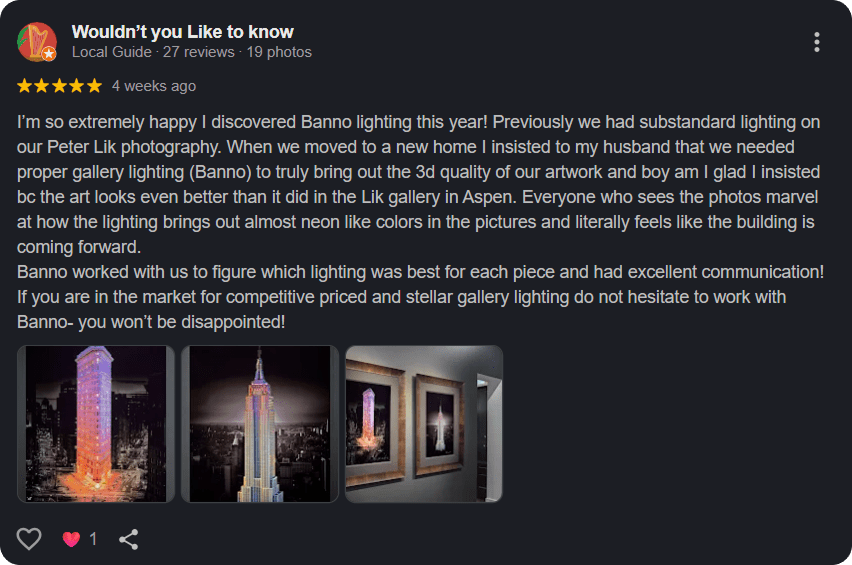
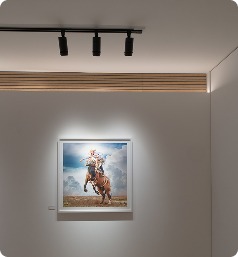
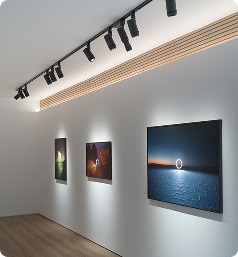
Professional gallery wall showcasing balanced artwork illumination
Gallery art lighting is a fundamental component of professional art presentation in galleries, museums, exhibitions, and high-end private collections. Unlike general illumination, gallery artwork lighting is carefully engineered to enhance visual clarity, preserve artistic integrity, and create a refined viewing experience that aligns with curatorial standards.
Lighting in an art gallery is not simply functional. It is a strategic design tool that influences how artwork is perceived, interpreted, and emotionally experienced. Proper gallery art lighting reveals texture, depth, color accuracy, and compositional nuance while maintaining conservation-safe conditions for valuable works.
Client Testimonial: Real Feedback from a Gallery Owner
What Is Gallery Art Lighting and Why It Is Essential

Evenly lit exhibition space showcasing refined artwork display
Gallery art lighting refers to specialised lighting systems and fixtures designed specifically to illuminate artwork in a controlled and precise manner. These systems are used across museums, commercial galleries, exhibitions, and collector spaces to ensure artworks are presented under optimal visual conditions.
The core purposes of gallery art lighting include:
Enhancing artwork visibility and clarity
Preserving accurate color representation
Reducing glare and visual distortion
Creating visual hierarchy within exhibitions
Protecting artworks through controlled illumination
Without professional gallery lighting, even museum-quality artworks can appear visually flat, uneven, or incorrectly toned.

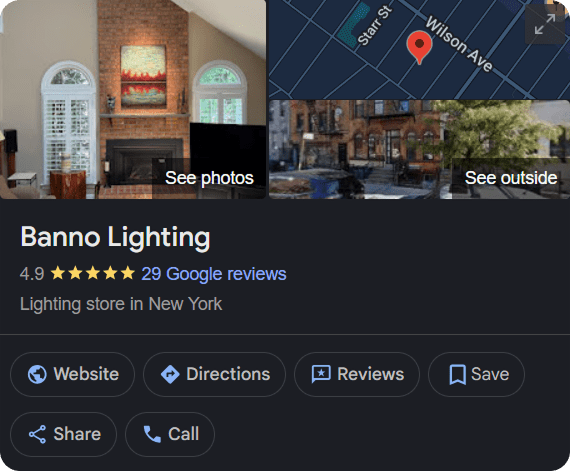
Highly Rated by Clients Across Residential and Commercial Projects
Lighting in Art Gallery Environments: Professional Standards
Lighting in art gallery environments follows strict guidelines that prioritise both presentation and preservation. Unlike retail or decorative lighting, gallery lighting must be consistent, adjustable, and conservation-conscious.
Professional art gallery lighting systems are designed to:
Provide uniform illumination across display walls
Avoid excessive heat and ultraviolet exposure
Maintain stable color temperature
Allow precise beam direction for individual artworks
These standards ensure that each piece is displayed as intended by the artist and curator.
Art Gallery Lighting Design and Curatorial Intent
Art gallery lighting design is deeply connected to curatorial strategy. Lighting is used to guide viewer attention, highlight focal works, and support the narrative structure of an exhibition. Rather than treating all artworks equally, lighting designers often create subtle variations in intensity to establish visual hierarchy.
Key considerations in gallery lighting design include:
Artwork size and medium
Exhibition layout and visitor flow
Wall color and reflectivity
Viewing distance and sightlines
This strategic approach ensures that lighting enhances the storytelling aspect of exhibitions while maintaining visual balance.
Art Gallery Lighting Fixtures and Precision Illumination
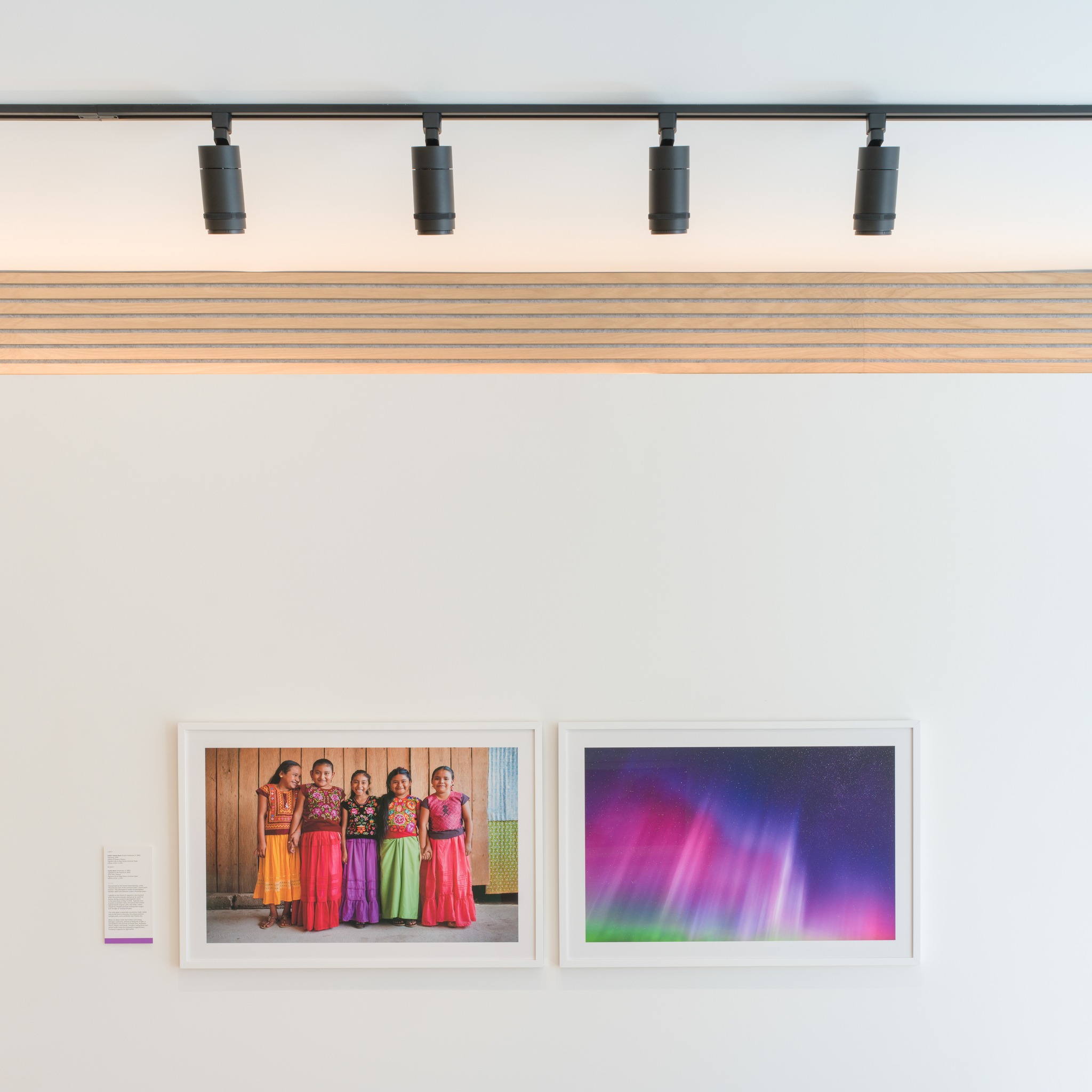
Strategic spotlighting reinforcing curatorial storytelling
Art gallery lighting fixtures are specifically engineered for precision illumination. Unlike standard ceiling lights, these fixtures feature adjustable optics, glare control mechanisms, and high color rendering capabilities that support professional artwork display.
High-performance fixtures typically offer:
Narrow to adjustable beam angles
High CRI for accurate color perception
Dimmable brightness control
Minimal heat emission
Stable long-term performance
These features allow curators and designers to fine-tune lighting based on artwork type and exhibition requirements.
Art Gallery Track Lighting Systems as the Industry Standard
Art gallery track lighting systems are widely used due to their flexibility and adaptability. These systems allow lighting fixtures to be repositioned easily, making them ideal for rotating exhibitions and changing gallery layouts.
Benefits of art gallery track lighting systems include:
Flexible fixture placement
Targeted illumination for individual artworks
Scalable lighting configurations
Efficient maintenance and adjustments
Track lighting also supports modular gallery lighting systems that can evolve alongside exhibition changes.
Gallery Artwork Lighting and Color Temperature Control

Neutral white lighting preserving authentic artwork tones
Color temperature is one of the most critical technical elements in gallery art lighting. Incorrect lighting temperature can distort colors, alter tonal balance, and diminish the authenticity of artwork presentation.
Neutral and controlled color temperature is typically preferred because it:
Preserves true pigment representation
Enhances tonal accuracy
Maintains visual neutrality
Supports museum-grade display standards
Careful calibration of art gallery lighting temperature ensures consistency across different artworks and exhibition spaces.
Modern Art Gallery Lighting and Contemporary Exhibition Spaces
Modern art gallery lighting prioritises minimalism, precision, and architectural integration. Contemporary galleries often use discreet ceiling lights, track systems, and focused spot lighting to maintain a clean visual environment.
Modern gallery lighting design focuses on:
Discreet fixture visibility
Architectural harmony
Advanced optical control
Flexible lighting configurations
This ensures that lighting enhances the artwork without becoming visually intrusive.
Professional Art Gallery Lighting for Paintings and Wall Art

Even illumination across large framed canvas
Gallery painting lighting requires even and controlled illumination to avoid hotspots and shadows that distort visual perception. Wall-mounted artworks benefit from directional spot lighting positioned at calculated angles to reveal texture and detail.
Professional gallery wall lighting enhances:
Brushstroke visibility
Surface texture depth
Color richness and tonal gradients
Overall artwork legibility
This level of precision is essential for fine art exhibitions and curated gallery displays.
Art Gallery Spot Lighting and Focal Emphasis
Art gallery spot lighting is used to create focal emphasis on key artworks within an exhibition. By directing controlled beams onto selected pieces, curators can establish visual hierarchy and guide viewer attention through the space.
Strategic spot lighting allows:
Highlighting of signature artworks
Enhanced visual drama
Clear separation between focal and secondary pieces
Improved exhibition flow
This technique is widely used in museums and contemporary galleries.
Professional Gallery Art Lighting Solutions for High-End Spaces

Museum-grade lighting fixtures in modern gallery
In advanced gallery environments, specialised lighting solutions are used to achieve museum-grade illumination. Precision fixtures such as Zoom (precision art lighting), Deluxe (museum-grade lighting), and Multi (flexible gallery lighting) are particularly suited for gallery art lighting applications due to their refined beam control, high color accuracy, and adaptability across different artwork sizes and exhibition layouts.
These professional lighting solutions enable consistent illumination while maintaining a sophisticated and unobtrusive lighting presence within gallery spaces.
Art Gallery Lighting Guidelines and Conservation Considerations
Art gallery lighting guidelines emphasise conservation-safe illumination to protect sensitive artworks from long-term damage. Excessive light exposure, heat, and UV radiation can gradually degrade materials such as canvas, paper, and pigments.
Conservation-focused gallery lighting includes:
Low UV and infrared output
Controlled lux levels
Stable illumination over time
Minimal thermal impact on artworks
These measures ensure both visual clarity and long-term preservation.
Gallery Lighting for Artwork Uniformity and Balance

Balanced illumination creating cohesive exhibition display
Uniform lighting is essential for maintaining visual balance across gallery walls. Inconsistent illumination can cause certain artworks to dominate visually while others appear subdued or overlooked.
A well-designed gallery lighting system ensures:
Even brightness distribution
Smooth visual transitions between artworks
Reduced glare and shadow interference
Enhanced viewer engagement
This consistency supports professional exhibition standards and curatorial intent.
The Long-Term Impact of Gallery Art Lighting on Viewer Experience
Gallery art lighting significantly influences how viewers interact with and interpret artwork. Proper lighting enhances clarity, emotional resonance, and depth perception, encouraging longer engagement and deeper appreciation.
Effective gallery lighting improves:
Artwork visibility and comprehension
Emotional connection to the piece
Visual comfort within the exhibition space
Overall museum and gallery experience
Ultimately, gallery art lighting is not just a technical installation but a curatorial instrument that shapes the entire viewing experience.
Gallery Art Lighting and Spatial Atmosphere

Comfortable viewing space with refined illumination
Gallery art lighting plays a defining role in shaping the atmosphere of a gallery or exhibition space. Beyond simply illuminating artwork, lighting establishes mood, pacing, and spatial rhythm. A well-lit gallery feels intentional, calm, and immersive, allowing viewers to engage with each artwork without visual fatigue or distraction.
Soft ambient lighting combined with precise accent lighting creates a layered environment where artworks stand out while the space itself remains visually comfortable. This balance is essential in professional galleries where visitors may spend extended periods observing artwork.
Lighting Art Gallery Walls with Precision and Consistency
Lighting art gallery walls requires careful alignment, spacing, and beam control. Uneven lighting across a wall can disrupt the visual harmony of an exhibition and unintentionally prioritise certain artworks over others.
Consistent gallery wall lighting should achieve:
Even illumination from edge to edge
Minimal light fall-off between artworks
Controlled brightness uniformity
Reduced shadow interference
This is typically accomplished through calibrated fixture spacing and directional lighting adjustments that align with artwork placement and scale.
Ceiling Lights for Art Gallery Environments
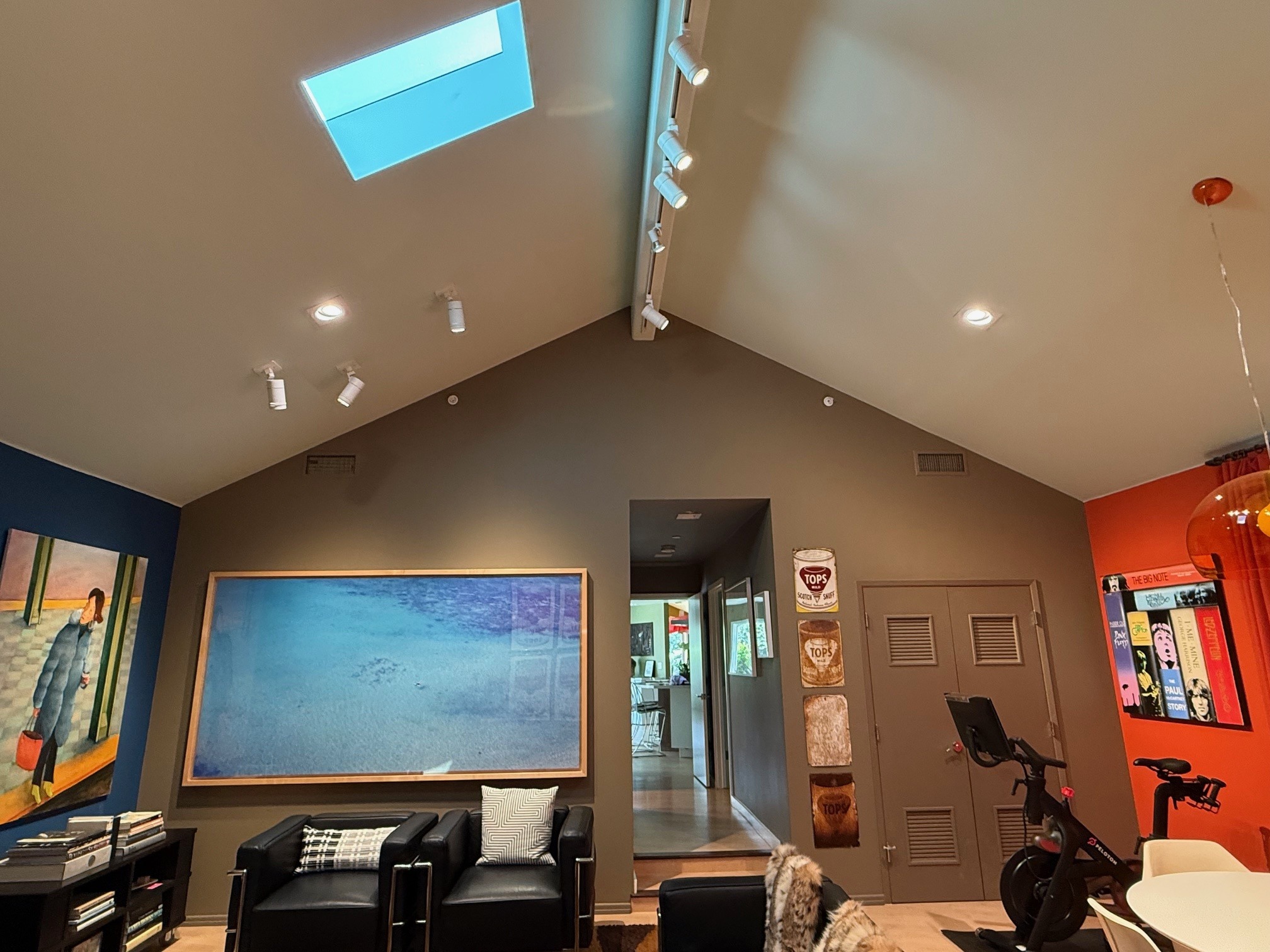
Recessed ceiling lighting supporting exhibition ambiance
Ceiling lights for art gallery spaces must be selected with precision rather than purely aesthetic considerations. General overhead lighting alone is insufficient for gallery art lighting because it can produce flat illumination and unwanted reflections.
Instead, ceiling-integrated lighting systems are often used to support:
Supplementary ambient lighting
Soft background illumination
Visual balance across large exhibition halls
Accent lighting remains the primary source of artwork illumination, while ceiling lights provide atmospheric stability.
Gallery Picture Lighting for Framed Artwork
Gallery picture lighting is particularly important for framed paintings, photographs, and works on paper. Framed artworks often include glass surfaces that reflect poorly positioned lighting, reducing clarity and visual impact.
Effective gallery picture lighting involves:
Angled directional lighting
Anti-glare optics
Balanced beam intensity
Careful fixture positioning above or offset from the frame
This approach enhances detail visibility while preventing distracting reflections.
Modern Gallery Lighting and Minimal Fixture Visibility

Clean gallery architecture with discreet lighting
Modern gallery lighting increasingly emphasises minimal fixture visibility. The objective is to make the lighting system feel invisible while allowing the artwork to dominate the visual experience.
This is achieved through:
Slim track lighting systems
Recessed ceiling lighting
Precision spot lighting
Architectural lighting integration
By reducing visual clutter from fixtures, galleries create a more refined and professional presentation environment.
Art Gallery LED Lighting and Long-Term Performance
Art gallery LED lighting has become the preferred standard due to its reliability, energy efficiency, and conservation-friendly characteristics. Unlike traditional lighting sources, LED systems offer stable illumination without significant heat output or UV emission.
Key advantages of LED gallery art lighting include:
Consistent color rendering over time
Low maintenance requirements
Energy-efficient operation
Reduced thermal impact on artwork
This makes LED solutions ideal for permanent exhibitions and high-value art collections.
Natural Lighting in Art Galleries: Benefits and Limitations

Controlled window lighting protecting sensitive artworks
Some galleries incorporate natural lighting as part of their architectural design. While natural light can create a dynamic and visually appealing environment, it must be carefully controlled to avoid damaging sensitive artworks.
Challenges of natural lighting include:
Fluctuating brightness levels
UV exposure risks
Color temperature inconsistency
Seasonal and time-of-day variation
For this reason, professional galleries often use filtered daylight combined with controlled artificial gallery art lighting systems to maintain stability.
Gallery Lighting for Different Artistic Mediums
Different artistic mediums require tailored gallery art lighting approaches to achieve optimal presentation.
Paintings and Canvas Works
Paintings benefit from soft, even illumination that enhances pigment richness and surface texture without creating glare.
Sculptures and Installations
Three-dimensional artworks require multi-directional lighting to highlight form, contours, and spatial depth.
Photography and Digital Art
Photographic works require highly controlled lighting to prevent reflections and maintain tonal accuracy, especially for glossy finishes.
Mixed Media Artworks
Mixed media pieces often require balanced lighting that accounts for varied textures and reflective materials.
Art Gallery Lighting Systems and Scalability

Adjustable fixtures supporting expanding art collections
Large galleries and museums rely on scalable art gallery lighting systems that can adapt to changing exhibitions and curatorial needs. Modular lighting systems allow for flexible fixture positioning, brightness adjustments, and beam reconfiguration without structural changes.
Scalable gallery lighting systems support:
Rotating exhibitions
Expanding collections
Temporary installations
Curatorial experimentation
This flexibility ensures long-term efficiency and professional adaptability.
Professional Gallery Art Lighting for Collector Spaces and Homes
Gallery art lighting is increasingly used in high-end residential environments where collectors want museum-quality presentation for their private collections. Gallery lighting for artwork in homes follows many of the same principles used in professional galleries but is adapted to interior design aesthetics.
In residential settings, gallery art lighting enhances:
Feature artwork prominence
Interior sophistication
Visual cohesion within gallery walls
Perceived artwork value
This approach transforms private spaces into curated environments that mirror professional exhibition standards.
The Relationship Between Gallery Lighting and Artwork Conservation

Conservation-safe LED lighting protecting paintings
Artwork conservation is a core priority in gallery art lighting design. Prolonged exposure to excessive light can lead to fading, material degradation, and long-term damage to sensitive artworks.
Conservation-focused gallery lighting strategies include:
Controlled lux levels
Low UV emission lighting sources
Reduced infrared heat output
Timed or dimmable lighting systems
These measures ensure that artworks remain preserved while still being presented under optimal visual conditions.
Psychological Flow and Viewer Engagement in Gallery Lighting Design
Gallery art lighting subtly guides how viewers move through an exhibition space. Strategic lighting placement can influence pacing, attention, and emotional engagement.
For example:
Brighter focal lighting encourages viewers to pause at key artworks
Soft transitional lighting supports smooth movement between sections
Balanced ambient lighting reduces visual fatigue
This psychological flow is essential in museums and curated exhibitions where visitor experience is a central consideration.

Long-Term Consistency and Maintenance of Gallery Art Lighting

Cleaned spotlight lens ensuring brightness accuracy
Maintaining consistent gallery art lighting over time is essential for preserving presentation quality. Even the most advanced lighting systems require periodic adjustments to ensure uniform performance across exhibitions.
Best practices for maintenance include:
Regular fixture recalibration
Lens and optic cleaning
Brightness consistency checks
Color stability monitoring
Consistent maintenance ensures that gallery lighting continues to meet professional display standards.
Gallery Art Lighting as a Signature of Professional Excellence

Museum-quality lighting elevating gallery presentation
Ultimately, gallery art lighting is a defining characteristic of professional exhibition spaces. It signals attention to detail, curatorial sophistication, and respect for artistic integrity. When executed correctly, lighting becomes almost invisible, allowing the artwork to command full visual attention.
High-quality gallery art lighting enhances clarity, depth, and emotional resonance while preserving the longevity of artworks. Whether in museums, commercial galleries, exhibitions, or collector environments, expertly designed lighting transforms artwork presentation from simple display into a refined and immersive visual experience aligned with the highest standards of the art world.
FAQs
1. What is gallery art lighting?
Gallery art lighting is specialised lighting designed to illuminate artwork in galleries and exhibitions.
2. Why is lighting important in art galleries?
It enhances visibility, color accuracy, and artwork presentation.
3. What is the best lighting for gallery artwork?
High CRI, low-glare, and adjustable lighting systems are ideal.
4. Do museums use specialised gallery lighting?
Yes, museums use conservation-grade lighting systems.
5. What color temperature is best for gallery lighting?
Neutral color temperatures are commonly preferred.
6. What are art gallery lighting fixtures?
Precision lighting fixtures designed for artwork illumination.
7. Is track lighting good for art galleries?
Yes, it provides flexibility and targeted illumination.
8. How do galleries avoid glare on artwork?
By using angled lighting and anti-glare optics.
9. What is professional art gallery lighting?
Lighting systems designed specifically for museum and gallery standards.
10. Can gallery lighting affect how art looks?
Yes, lighting significantly impacts color, depth, and perception.
11. What is gallery lighting design?
The strategic planning of lighting to enhance artwork display.
12. Are LED lights suitable for gallery art lighting?
Yes, LED lighting offers stability and conservation benefits.
13. How bright should gallery lighting be?
Bright enough for clarity but controlled to avoid overexposure.
14. What is art gallery spot lighting?
Focused lighting used to highlight specific artworks.
15. Can gallery lighting be used in homes?
Yes, especially for private art collections and gallery walls.
16. What are gallery lighting systems?
Integrated lighting setups designed for professional artwork display.
17. Does lighting impact artwork preservation?
Yes, improper lighting can damage sensitive artworks.
18. What is modern art gallery lighting?
Minimalist, precision-focused lighting integrated into contemporary gallery spaces.
19. How do curators use lighting in exhibitions?
To guide attention, create hierarchy, and enhance storytelling.
20. What makes gallery lighting different from regular lighting?
It prioritises precision, conservation, and visual balance for artwork.
Client Feedback and Real Project Success Stories