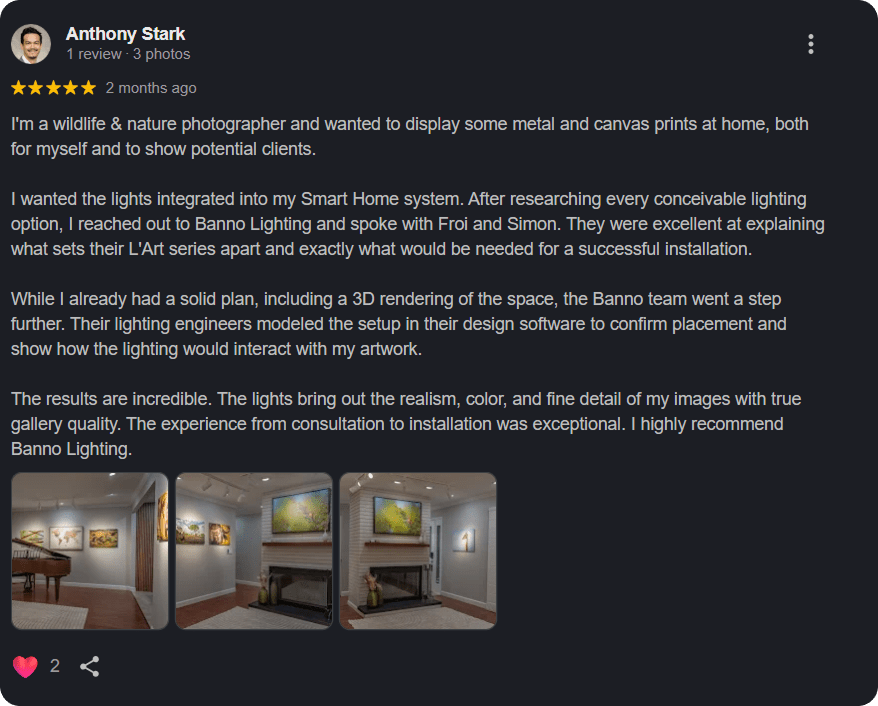
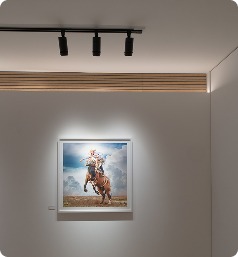
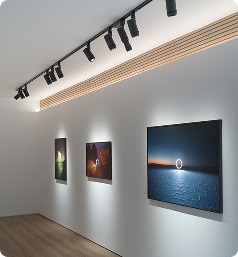
Contemporary gallery interior with precision lighting highlighting artworks
Lighting galleries is not about brightness. It is about control, hierarchy, conservation, and experience. In professional art environments, lighting shapes perception as much as the artwork itself.
Whether in a museum, a contemporary art gallery, or a private collection, lighting galleries requires technical precision and curatorial sensitivity. The wrong lighting flattens color, introduces glare, and diminishes depth. The correct lighting reveals texture, enhances tonal variation, and elevates perceived value.
This guide explores the principles behind lighting galleries at a professional level, focusing on museum standards, gallery lighting fixtures, and modern LED solutions designed specifically for art.
Trusted by Galleries: A Professional Perspective on Our Lighting
Lighting for Art Galleries: Foundational Principles
Lighting for art galleries is governed by five core principles:
- Color accuracy
- Controlled beam spread
- Appropriate contrast
- Glare management
- Conservation safety
Lighting in galleries must balance visibility with protection. Art should be clearly visible without being overexposed or damaged by excessive light.
Unlike residential lighting, gallery lighting for art is intentional and measured. Every beam is positioned with purpose.
Lighting a Gallery: Planning and Layout
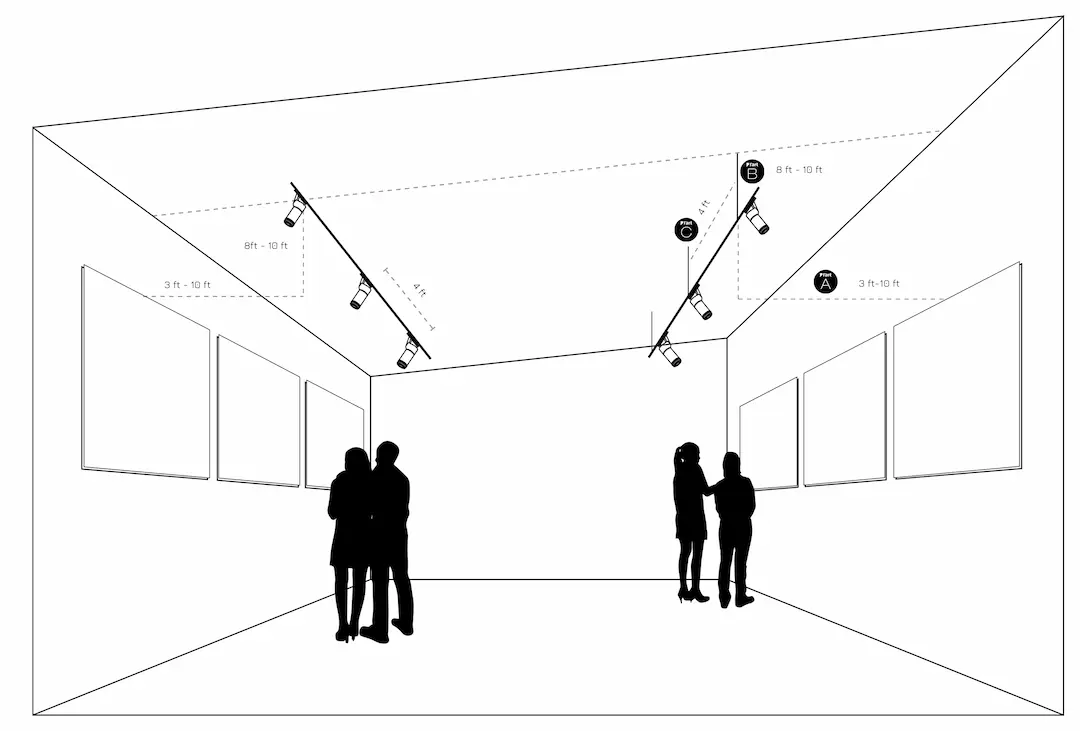
Art gallery layout demonstrating viewing distance and lighting placement strategy
When lighting a gallery, the design process begins before fixtures are selected.
Wall Layout
Artwork placement determines fixture spacing. Lighting gallery wall systems must align with artwork centers, not arbitrary ceiling grids.
Ceiling Height
Ceiling height affects beam angle and output. Taller ceilings require narrower beams and stronger intensity control.
Viewing Distance
Visitor sight lines influence glare and shadow control. Lighting a gallery is always a spatial exercise.
Professional installations often involve on site adjustments once artworks are hung. Fine tuning beam angle is essential to achieving even coverage.
Gallery Lighting Fixtures: Types and Functions
There are several categories of gallery lighting fixtures used in professional environments.
Track Mounted Fixtures
Track systems allow repositioning as exhibitions change. They are the most flexible option for lighting art gallery spaces.
Recessed Adjustable Fixtures
Recessed fixtures integrate into ceilings for minimal visual intrusion. They are common in museum environments where architectural cleanliness is prioritized.
Picture Lights
A gallery light over painting may be wall mounted in smaller or residential spaces. These are most effective in fixed installations where artwork layout does not change.
Regardless of fixture type, optical precision determines performance.

4.9-star rated by art collectors and gallery professionals
Gallery Lighting Kelvin: Choosing the Right Color Temperature

Balanced gallery lighting creating natural artwork color without visual distortion
Gallery lighting kelvin selection directly affects artwork perception.
Common ranges include:
- 2700K for warm, classical interiors
- 3000K for neutral gallery environments
- 3500K for contemporary minimalist spaces
Consistency across all gallery lighting fixtures is critical. Mixing temperatures creates visual fragmentation.
For most art gallery lighting, 3000K with high color rendering provides balanced clarity without appearing cold.
Gallery Lighting LED: Modern Standards
Gallery lighting LED systems have replaced older halogen technologies due to:
- Lower heat emission
- No UV radiation
- Energy efficiency
- Long term stability
- Precise dimming capability
LED systems designed specifically for gallery lighting offer superior color accuracy compared to general architectural LEDs.
Modern precision fixtures such as Zoom allow tight beam shaping for smaller works. Flexible systems like Multi support evolving exhibitions through adjustable positioning. Museum grade solutions such as Deluxe prioritize stability and visual comfort in permanent collections.
Each type serves a distinct purpose within lighting galleries at a professional level.
Lighting Over Gallery Wall vs Lighting On Gallery Wall

Ceiling mounted gallery lights illuminating paintings along exhibition wall
Lighting over gallery wall typically refers to ceiling mounted directional fixtures aimed downward.
Lighting on gallery wall refers to integrated wall mounted picture lights.
Ceiling mounted systems provide greater flexibility and are preferred for:
- Rotating exhibitions
- Mixed size artworks
- Large scale installations
Wall mounted solutions are appropriate for:
- Residential gallery lighting for home
- Fixed artwork layouts
- Narrow corridors
Understanding the difference ensures appropriate fixture selection.
Gallery Light Over Painting: Beam Geometry
When installing a gallery light over painting, beam geometry matters.
The recommended angle is approximately 30 degrees from vertical. This reduces glare while revealing surface texture.
Beam width should match artwork dimensions. Too narrow creates hotspots. Too wide reduces contrast.
Lighting for gallery wall installations must be calibrated to avoid spill onto adjacent walls unless wall washing is intentionally part of the design.
Gallery Lighting Options for Different Art Forms

Photography print illuminated evenly to prevent reflections behind glass
Different media require different approaches.
Oil Paintings
Directional accent lighting enhances brushwork and depth.
Works on Paper
Lower light levels are required. Glare control is critical, especially behind glazing.
Photography
Even distribution prevents reflections and tonal distortion.
Sculpture
Multiple directional sources may be required to avoid harsh shadow lines.
Lighting art exhibition spaces must account for varied mediums within a single room.
Lighting Art Exhibition Spaces
Lighting art exhibition environments often involves layered systems:
- Accent lighting for artwork
- Ambient lighting for visitor comfort
- Subtle wall wash where appropriate
Contrast must be balanced. Artwork should be slightly brighter than surrounding surfaces but not dramatically isolated.
In contemporary exhibitions, slightly higher contrast may be used for dramatic effect. In museums, subtlety and conservation take priority.
Gallery Lighting for Home: Private Collections
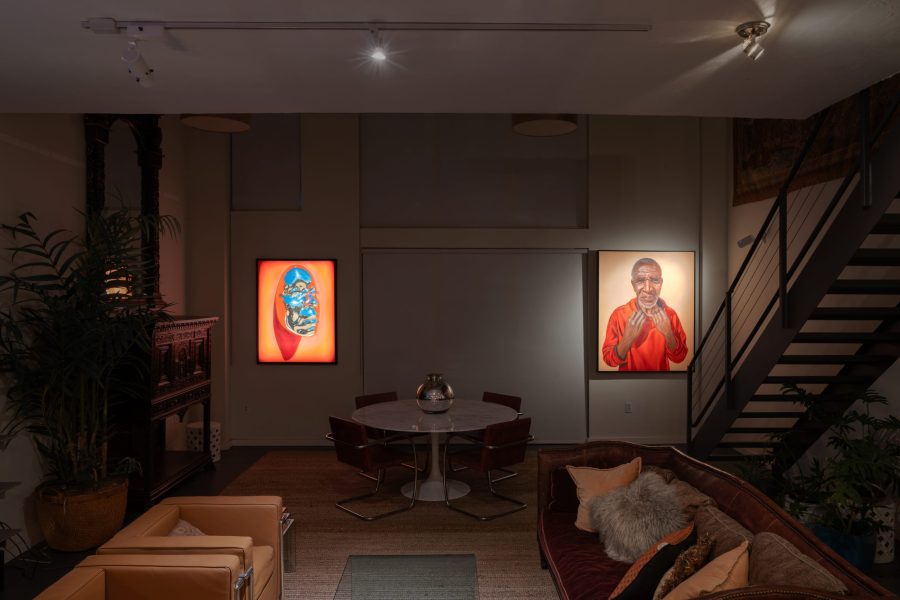
Private collector home gallery wall illuminated with track lighting
Collectors increasingly invest in gallery lighting for home environments.
Key considerations include:
- Consistency across rooms
- Architectural integration
- Discreet fixture profiles
- High CRI LED systems
Lighting a gallery wall at home requires the same discipline as commercial spaces. Random downlights rarely produce professional results.
Track based gallery lighting fixtures allow flexibility as collections evolve.
Rechargeable Gallery Lighting and Wireless Systems
Rechargeable gallery lighting and gallery lighting wireless solutions are often used in:
- Temporary exhibitions
- Historic buildings
- Rental spaces
While convenient, these systems must still meet standards for color accuracy and beam control.
Battery operated gallery lighting fixtures should be selected carefully to ensure consistent output and avoid color shift over time.
Accent Lighting Galleries: Creating Hierarchy

Accent spotlight emphasizing centerpiece painting in contemporary gallery
Accent lighting galleries use focused beams to create visual hierarchy.
Hierarchy can be established by:
- Slightly increasing brightness on key works
- Using narrower beams for focal pieces
- Softening edges on secondary works
The goal is subtle guidance, not theatrical spotlighting.
Professional lighting galleries avoid dramatic overemphasis unless it aligns with curatorial intent.
Lighting in Galleries and Human Experience
Lighting in galleries influences emotional response.
Soft, balanced light creates calm contemplation.
Sharp contrast creates intensity.
Even wall washing creates openness.
Lighting galleries is ultimately about shaping experience.
Visitors may not consciously notice the lighting, but they feel its effect.
Lighting Gallery Art in Large Spaces

Wide gallery room featuring coordinated lighting across multiple artworks
Large galleries require coordinated systems.
Considerations include:
- Consistent fixture spacing
- Unified beam angles
- Integrated dimming controls
- Maintenance access
High ceilings demand narrower beam optics to maintain focus.
Precision systems ensure beam integrity even at greater distances.
Gallery Lighting Ideas for Contemporary Spaces
Modern gallery lighting ideas often incorporate:
- Visible black track systems in industrial spaces
- Minimal recessed fixtures in white cube galleries
- Adjustable heads for changing exhibitions
- Integrated control systems for scene presets
While aesthetics vary, the underlying technical principles remain consistent.
Lighting Galleries With Curatorial Integrity

Professional gallery lighting revealing color and texture of painting
Lighting galleries is not merely technical. It is curatorial.
Light defines:
- How color is perceived
- How texture is revealed
- How movement flows through a space
- How long visitors engage with a work
Precision gallery lighting fixtures protect and elevate artwork simultaneously.
For galleries, museums, designers, and serious collectors, lighting galleries is infrastructure, not decoration. It is foundational to artistic presentation.
The Architecture of Lighting Galleries
When lighting galleries at a professional level, the ceiling becomes a structural lighting grid rather than a blank surface. Every fixture position should correspond to artwork placement, not arbitrary spacing.
In serious art environments, ceiling plans are often developed alongside curatorial layouts. This ensures:
- Fixture alignment with artwork centers
- Consistent spacing across exhibition walls
- Even beam geometry throughout the space
- Clean architectural rhythm
Lighting galleries is therefore an architectural exercise as much as a technical one. The ceiling becomes an invisible framework supporting visual storytelling.
Beam Spread and Artwork Scale

Small artwork illuminated with narrow beam precision gallery spotlight
One of the most important variables in lighting galleries is beam spread relative to artwork size.
Small works require tighter beam angles to prevent spill onto surrounding wall space. Larger works require wider beams or multiple fixtures to ensure even coverage.
When gallery lighting fixtures are mismatched to artwork scale:
- Edges appear dim
- Centers appear overexposed
- Wall spill reduces contrast
Professional lighting galleries use interchangeable optics to adapt beam width precisely to each piece.
Precision tools such as Zoom style fixtures are often selected for smaller, high value works where tight beam control is essential. Larger installations may use flexible systems like Multi to distribute light evenly across broad surfaces.
Lighting Galleries and Surface Reflectivity
Surface reflectivity dramatically affects how lighting performs.
Gloss varnished paintings can produce reflections if lighting angle is too steep. Matte works absorb more light and may require slightly higher intensity.
Glass framed works introduce another layer of complexity. In these cases, lighting galleries requires careful positioning to prevent reflected glare at common viewing angles.
Museum grade fixtures such as Deluxe often incorporate refined glare control systems to reduce visual discomfort while preserving clarity.
Lighting a Gallery With Multiple Mediums

Gallery room using multiple lighting styles for different art mediums
Most exhibitions include a mix of mediums:
- Oil and acrylic paintings
- Photographic prints
- Mixed media works
- Sculptural installations
Lighting galleries with varied mediums requires adaptability.
Directional accent lighting is ideal for paintings. Even distribution works best for photography. Sculpture may require multi directional illumination to avoid harsh shadows.
In exhibition planning, each wall may require a slightly different lighting approach, even within the same room.
Lighting Gallery Wall Installations in White Cube Spaces
White cube galleries emphasize neutrality. Walls are typically matte white, and architecture is minimal.
In these environments, lighting gallery wall systems must be precise and controlled. Excessive spill becomes immediately visible against white surfaces.
Subtle contrast between artwork and wall ensures depth without overpowering the space. Even small inconsistencies in beam alignment are noticeable in minimalist settings.
Lighting galleries in white cube spaces demands discipline and restraint.
Gallery Lighting and Visitor Movement

Lighting guiding visitors naturally through gallery exhibition pathway
Lighting galleries is also about guiding movement.
Subtle brightness differences can encourage visitors to move toward focal works. Balanced illumination across walls supports smooth transitions from one piece to another.
Overly dramatic spotlighting can disrupt flow, creating visual stops rather than fluid progression.
Professional lighting art exhibition design considers the entire visitor journey, not just individual artworks.
Layered Lighting in Galleries
Successful lighting galleries rarely rely on a single layer of illumination.
Layering typically includes:
- Accent lighting for artwork
- Ambient lighting for general comfort
- Transitional lighting in circulation areas
Accent lighting remains dominant, but ambient levels must be sufficient for navigation and safety.
When ambient light is too bright, artwork loses emphasis. When too dim, the space feels uncomfortable.
Balance is critical.
Gallery Lighting LED and Long Term Stability

Professional gallery lights delivering consistent color temperature across exhibition
Modern gallery lighting LED systems offer consistency that was difficult to achieve with older technologies.
Long term stability is important because:
- Exhibitions may remain installed for months
- Permanent collections may remain displayed for years
- Color consistency must be maintained over time
Quality LED gallery lighting fixtures maintain stable color temperature and intensity across extended operating hours.
This reliability supports conservation standards and professional presentation.
Lighting Over Gallery Wall in Historic Buildings
Historic buildings present unique challenges when lighting galleries.
Ceiling access may be limited. Wiring paths may be restricted. Architectural details may prevent recessed installation.
In such environments, surface mounted track systems are often used to preserve architectural integrity while providing flexibility.
Rechargeable gallery lighting or wireless systems may also be considered in heritage contexts, provided they meet optical and color accuracy standards.
Lighting galleries in historic spaces requires sensitivity to both art and architecture.
Gallery Lighting for Home Collections

Collector home displaying paintings with adjustable art lighting
Collectors with significant private collections increasingly adopt professional standards when lighting galleries within residential environments.
Gallery lighting for home installations should include:
- High color rendering LED fixtures
- Adjustable beam angles
- Consistent kelvin temperature
- Clean integration with ceiling design
Lighting a gallery wall at home requires the same principles used in commercial galleries.
Directional precision creates a curated atmosphere rather than a decorative one.
Lighting Art Gallery Installations With High Ceilings
Large contemporary galleries and converted industrial spaces often feature high ceilings.
In these environments:
- Narrow beam optics are essential
- Higher output fixtures may be required
- Precise aiming ensures beam focus
Incorrect beam selection results in excessive wall spill and uneven illumination.
Professional lighting galleries use carefully selected optics to maintain beam integrity even across greater distances.
Gallery Lighting Ideas and Visual Identity

Modern gallery design featuring black track lighting aesthetic
Different institutions adopt different visual identities through lighting galleries.
Some contemporary spaces prefer visible black track systems, emphasizing industrial character. Others prefer recessed white fixtures that disappear into the ceiling.
Regardless of aesthetic choice, technical performance must remain uncompromised.
Gallery lighting ideas should always begin with optical discipline before stylistic decisions.
Lighting Galleries and Emotional Tone
Lighting influences emotional tone.
Soft, evenly balanced light creates calm reflection.
Slightly heightened contrast introduces energy.
Higher intensity can create focus and tension.
Lighting galleries involves shaping this emotional environment in alignment with curatorial goals.
In museums, the tone is often contemplative. In contemporary art exhibitions, lighting may feel sharper and more dramatic.
The lighting strategy should support the narrative of the exhibition.
Gallery Lighting Options for Temporary Exhibitions

Temporary exhibition wall illuminated with adjustable track lighting
Temporary exhibitions require flexibility.
Track based gallery lighting fixtures are ideal because they allow:
- Rapid repositioning
- Lens changes
- Adjustment for varying artwork sizes
Rechargeable gallery lighting may be used for short term installations in non permanent spaces, provided output stability and color consistency are maintained.
Lighting galleries for temporary exhibitions demands adaptability without sacrificing presentation quality.

The Responsibility of Lighting Galleries

Professional gallery lighting revealing depth texture and accurate colors
Ultimately, lighting galleries carries responsibility.
Poor lighting can:
- Distort color
- Reduce perceived quality
- Introduce glare
- Compromise conservation
Well executed lighting:
- Reveals detail
- Enhances texture
- Protects materials
- Elevates visitor experience
Lighting galleries is not decoration. It is infrastructure supporting artistic integrity.
Precision systems such as Zoom enable tight beam control for smaller works. Flexible solutions like Multi support dynamic exhibition layouts. Museum grade systems such as Deluxe provide long term stability and visual comfort.
Each plays a role within professional gallery lighting ecosystems.
Conclusion

Balanced gallery lighting revealing artwork naturally without distraction
Lighting galleries is a discipline combining architecture, optics, conservation, and curatorial intent.
It requires:
- Careful planning
- Technical precision
- Consistent color control
- Respect for artwork
When lighting is correct, it disappears. The artwork feels balanced, dimensional, and authentic.
For galleries, museums, designers, and collectors committed to excellence, lighting galleries is foundational to how art is experienced and understood.
20 FAQs
1. What is the best lighting for art galleries
High CRI LED fixtures with adjustable beam control and proper dimming.
2. What kelvin is best for gallery lighting
Typically 2700K to 3000K depending on interior tone.
3. Should artwork be brighter than walls
Yes, slightly brighter to create subtle contrast.
4. Is LED safe for gallery lighting
Yes, high quality LED emits minimal heat and no UV.
5. What angle should a gallery light be positioned
Around 30 degrees from vertical.
6. Can gallery lighting damage paintings
Excessive light levels can, which is why dimming and lux control are important.
7. Are track systems good for art galleries
Yes, they allow repositioning as exhibitions change.
8. What is gallery lighting for home
Professional style art lighting adapted for residential collections.
9. How do you light a gallery wall properly
Use directional fixtures with beam width matched to artwork size.
10. What is accent lighting in galleries
Focused light used to highlight specific artworks.
11. What is the difference between museum lighting and gallery lighting
Museum lighting prioritizes conservation and stability.
12. Can wireless gallery lighting be effective
Yes, if color accuracy and beam control are maintained.
13. How do you avoid glare on paintings
Use proper beam angle and glare shielding.
14. What is CRI in gallery lighting
Color Rendering Index, measuring color accuracy.
15. Should gallery lighting be dimmable
Yes, for conservation and ambiance control.
16. How bright should gallery lighting be
Bright enough for clarity but within conservation limits.
17. What fixtures are best for gallery lighting
Adjustable track mounted or recessed precision fixtures.
18. Can picture lights be used in galleries
Yes, for fixed installations.
19. How do museums control lighting
Through zoning, dimming systems, and conservation standards.
20. Why is lighting important in galleries
Because it shapes perception, protects artwork, and enhances viewer experience.
What Our Clients Say About Our Gallery Lighting