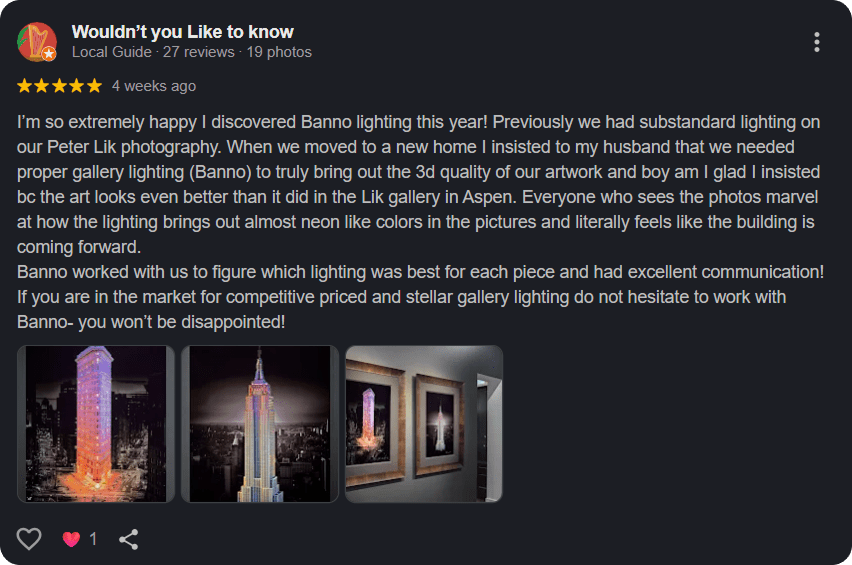
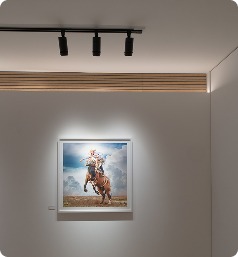
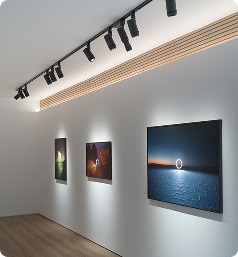
Elegant display atmosphere created by premium overhead track light fixtures.
Museums are different. They are not built to sell a product quickly, or to keep people working comfortably under uniform light. Museums exist to preserve cultural value and to present it in a way that feels truthful, inspiring, and respectful. Lighting is one of the biggest forces that shapes that experience. It decides what visitors notice first, how long they linger, what details they can actually see, and how authentic objects feel in the space.
Professional museum track lighting is not just illumination. It is interpretation plus conservation plus visitor comfort. A lighting system must reveal materials accurately, create visual hierarchy, reduce glare and reflections, and stay flexible as exhibitions change. It must do all of this while keeping light exposure under control for sensitive collections. When track lighting is designed well, it disappears. Visitors only notice the objects. When it is designed poorly, people squint, avoid reflections in glass, miss details, and leave with a weaker impression of the exhibition.
This guide explains how museum track lighting works, why track systems are the backbone of most modern museums, how beam control and color fidelity affect object presentation, and how to plan for high ceilings, long throw projection, and display cases — forming a complete guide to museum and gallery lighting. It also explains how fixture platforms like Deluxe, Zoom, and Multi can be used together as a complete museum lighting toolkit. At the end, you will find a practical FAQ section you can publish as part of the same page.
What Museum Track Lighting Is

Versatile electrified track system supporting multiple adjustable LED fixtures.
Museum track lighting is a system where adjustable fixtures mount to electrified tracks installed on the ceiling or structural elements. The track carries power continuously along its length. Fixtures can be positioned anywhere on the track, moved when displays change, and replaced or upgraded without rewiring the building.
That flexibility is the main reason track systems dominate museum environments. Museums are living institutions. Exhibitions rotate, objects are loaned in and out, case layouts change, temporary installations arrive, and curatorial decisions evolve. A fixed ceiling lighting plan becomes restrictive quickly. Track provides a long term backbone that allows the lighting layer to be reconfigured with minimal disruption.
In museum work, lighting must achieve three outcomes at once.
Presentation
Objects must look natural, detailed, and dimensional.
Comfort
Visitors should not be distracted by glare, hot spots, or harsh reflections.
Conservation
Light exposure must be controlled so sensitive materials are protected over years and decades.
Track lighting is not the only way to achieve this, but it is often the most adaptable and practical approach for specialised lighting for museum environments where exhibitions and display requirements change frequently.

4.9-star rated by art collectors and gallery professionals
Why Museums Prefer Track Systems Over Fixed Downlights

Flexible track lighting allowing easy adjustment for changing display layouts.
Many commercial fitouts rely on downlights because they look clean and they are easy to specify. Museums are different because the goal is not general illumination. The goal is controlled illumination on specific objects. Downlights typically create pools of light that are difficult to aim and difficult to adapt. They also tend to put light where you do not want it, including on the floor and in visitor sightlines.
Track systems solve the adapt to change problem. Once track is installed, staff can do the following without building work.
- Move fixtures to match new object placement
- Change aiming angles to reduce reflections in glazing
- Add more fixtures for dense exhibits
- Remove fixtures for minimal displays
- Swap optics to change beam width or distribution
- Replace fixture heads as technology improves
There is also an architectural benefit. Track can be planned as a clean set of lines that align with the space. Instead of random scattered fittings, the ceiling reads as intentional. For museums in historic buildings, track also reduces the need for cutting and changing heritage fabric repeatedly.
Museum Lighting Design Starts With the Object

Layered exhibition lighting creating a balanced and immersive viewing experience.
Museum lighting design is object first. Every decision should begin with the material, the surface, and the story. A bronze sculpture reflects light differently than a textile. A manuscript requires different exposure limits than an oil painting. A fossil display may need dramatic contrast, while a contemporary installation may require softer ambient balance.
This is where track lighting shines, because it supports object specific decisions. You are not designing one uniform layer. You are designing a flexible platform that can be tuned to each exhibit.
A strong museum lighting plan usually involves layered lighting.
Ambient layer
A controlled base level that supports orientation and comfort.
Accent layer
Targeted beams that reveal the key objects and guide attention.
Case layer
Lighting inside or around vitrines and display cabinets where objects are protected behind glass.
Feature layer
Hero moments where higher intensity or tighter focus is used to create emotional impact.
Track systems allow these layers to be adjusted independently and rebalanced when the exhibition changes.
Beam Angle Control and Why It Matters

Narrow spotlighting creating a dramatic focus on a single object.
Beam angle is one of the most important concepts in museum track lighting. It defines how wide or narrow the light spreads and how precisely illumination can be directed onto an object — a core principle behind precision track lighting for museum artworks. That single parameter influences drama, clarity, glare control, light spill, and the overall professionalism of the exhibition.
Narrow beams create emphasis. They are useful for small artifacts, sculpture highlights, and objects that need crisp separation from the background.
Medium beams suit most framed works and medium sized objects, giving a balance of focus and coverage.
Wide beams are used for larger artworks, groups, and wall washing where an even field of light is required.
Many museums struggle because beam angles are fixed or chosen incorrectly. A beam that is too wide creates spill and reduces contrast. A beam that is too narrow creates hot spots and unevenness. The best systems provide flexibility so staff can respond to the actual object size and viewing distance.
This is where Zoom fixtures become extremely practical. Zoom allows staff to adjust beam width on site. Instead of replacing a fixture or adding extra heads, the beam can be tightened or widened to suit the display. That makes Zoom ideal for rotating exhibitions where object scale varies week to week.
Multi fixtures can also support beam flexibility through interchangeable optics. They allow you to choose the right distribution for each zone, whether that is a tighter accent, a broader coverage, or a more uniform wall distribution.
Deluxe fixtures add another layer. They are designed to deliver refined optical performance, strong projection capability, and high quality beam shaping. In a museum, that matters most where ceilings are high, where throw distances are long, or where the exhibition requires an especially premium presentation.
High Ceilings and Long Throw Projection

High-performance LED projectors maintaining intensity in a double-height space.
Many museums have tall volumes. Historic halls, atriums, double height galleries, and large exhibition rooms often require lighting to project from a greater distance. Long throw lighting is not just about output. It is about keeping the beam controlled, maintaining focus, and avoiding excessive spill that washes the whole room.
This is where Deluxe performs exceptionally well. Deluxe is very good for high ceilings and projecting light because it can maintain beam definition and intensity over distance. It allows you to place the fixture higher while still achieving a crisp, professional result on the object plane.
Zoom and Multi are also great for ceilings, especially when you need flexible beam control across multiple zones. A common museum approach is to use Deluxe as the premium long throw workhorse for tall spaces, while Zoom and Multi handle flexible and adaptable coverage across standard ceiling heights and rotating exhibition walls.
A practical way to think about it is this.
Deluxe
Use when you need reach, refined beam quality, and premium projection.
Zoom
Use when you need the ability to adapt beam width quickly as the objects change.
Multi
Use when you need a versatile range of optics and consistent performance across many walls and zones.
Color Accuracy and Why Museums Cannot Compromise

True-to-life colors in a display revealed by high-CRI lighting.
Color accuracy is one of the fastest ways a museum can feel premium or cheap. Visitors may not know the term color rendering, but they feel it. If whites look greenish, if reds look dull, if subtle gradients disappear, the display feels less authentic. For paintings, textiles, and historical objects, accurate color is part of intellectual honesty. The museum is presenting the object as it truly is, which is why museum-grade lighting for paintings and other sensitive artworks must deliver exceptional color fidelity.
High quality museum track lighting should deliver consistent color fidelity across fixtures and across rooms. Mixed color appearance between zones makes the exhibition feel disjointed. It also causes curatorial issues because objects can look different depending on where they are installed.
Deluxe is often the choice for areas where color precision must be flawless, such as hero walls, high value paintings, and signature galleries. Zoom and Multi can maintain consistency across the broader system while providing flexibility of beam control and distribution.
Color temperature also plays a role. Museums often prefer a stable neutral tone so objects feel natural and materials read accurately. Some exhibitions benefit from a slightly warmer mood, but the key is consistency. If one room is warm and another is cool without intention, the visitor experience feels unstable.
Glare Control and Reflections

Anti-glare accessories ensuring a clear view of framed display items.
Glare is one of the most common museum lighting failures. When visitors can see the bright light source directly, it distracts them and reduces their ability to see detail. Reflections in glass cases and glazing can also make objects difficult to view. This is especially problematic for manuscripts, small artifacts, and framed works behind glass.
Glare control comes from three things.
Optics
Deep set lenses and beam shaping help keep the source visually quiet.
Shielding
Accessories that reduce the visible brightness at certain angles.
Aiming
Correct angles to prevent direct reflections into visitor sightlines.
Track lighting helps because fixtures can be aimed precisely. If glare appears, staff can adjust the angle or position on the track. Zoom can help by tightening the beam to reduce spill on glass. Deluxe can help with refined cut off and controlled projection. Multi can support different optical distributions based on the case type or wall condition.
In practice, glare reduction is not one single trick. It is an ongoing part of museum lighting operations, and track lighting makes that operationally possible.
Conservation and Light Sensitive Materials

Dimmable LED lighting protecting fragile surfaces from excessive light exposure.
Museums are responsible for long term preservation. Many materials are sensitive to light exposure over time. Paper, textiles, photographs, organic materials, and some pigments can degrade with excessive exposure. Even if a visitor cannot see the damage today, the cumulative impact matters over years.
LED track lighting is widely used in museums partly because it produces low heat and minimal ultraviolet output compared to older sources. That reduces risk. However, conservation is not only about UV. It is also about total exposure over time.
This is where lighting controls matter. Dimming, zoning, and scenes allow museums to manage light levels appropriately. For sensitive objects, the display can be lit to the minimum needed for viewing. For robust materials, lighting can be stronger. During closed hours, lighting can be reduced or turned off. Some museums also use occupancy based control in certain galleries to limit exposure, though this must be handled carefully so the visitor experience remains smooth.
A good museum track lighting design anticipates conservation needs by making dimming simple and by enabling staff to tune levels per zone without complicated reprogramming.
Display Cabinets and Mini Track Lights Inside Cases

Tiny LED spotlights highlighting small, detailed items within a cabinet.
Museums frequently use display cabinets to protect fragile objects and to control environmental conditions. Lighting cabinets introduces unique challenges. The space is confined, the viewing is often through glass, and the objects can be small and detailed. Standard track heads can be too large or too visually dominant. They also may not reach into the cabinet cleanly.
This is where mini track lights come in. Mini track lights can be used inside cabinets as well, providing a compact, precise light source that highlights artifacts without overwhelming the display. They are especially useful for jewelry, coins, documents, small sculptures, and delicate objects where fine detail is important.
Cabinet lighting must also be conservative. Many cabinet objects are light sensitive. Mini fixtures paired with dimming and precise aiming allow museums to deliver clarity without excess exposure.
When planning cabinet lighting, the goal is usually to create an even, controlled light field that reveals the object while minimizing reflections. Placement and aiming are critical, and small fixtures give designers more freedom to position the light correctly inside a tight space.
Wall Washing Versus Accent Lighting in Museums

Uniform wall wash lighting providing a calm background for a display.
Museums often use a combination of wall washing and accent lighting. Each serves a different purpose.
Wall washing creates an even, calm background on wall planes. It helps visitors orient themselves and creates a sense of openness. It is often used behind framed works to reduce harsh contrast.
Accent lighting creates hierarchy. It highlights key objects and creates moments of focus. In historical exhibitions, accents can draw attention to signature artifacts. In art exhibitions, accents can shape how the visitor reads the curatorial sequence.
The best museum lighting is usually not all one thing. Too much accent makes the room feel spotty and theatrical. Too much wash makes it feel flat and generic. Track lighting allows designers to balance these approaches and to change the balance when the exhibition changes.
Multi can be useful for broader distributions and consistent coverage. Zoom can shift from a tighter accent to a wider coverage depending on need. Deluxe can create premium, crisp accents where the museum wants a hero moment, especially in large spaces.
Planning the Track Layout
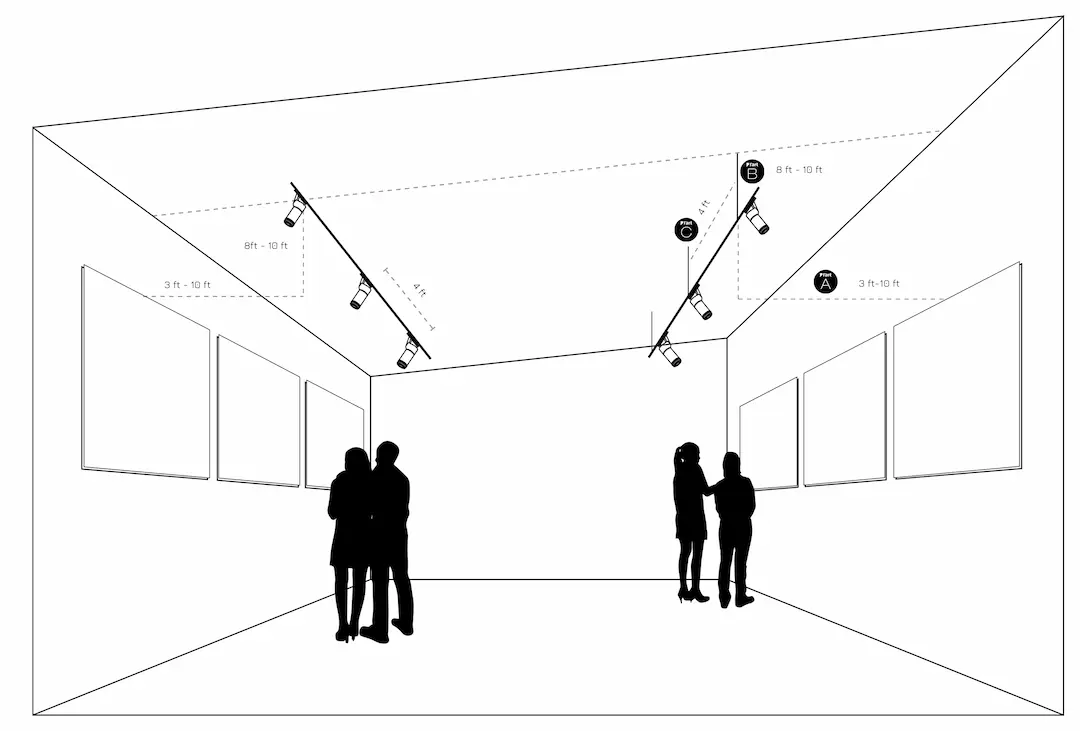
Professional grid track layout offering total coverage for a space.
The track layout is the backbone of the museum lighting system. Good layout gives you flexibility for years. Poor layout locks you into awkward aiming angles and limits what the curatorial team can do.
Track is commonly installed in linear runs parallel to walls, or as a grid that covers multiple zones. The correct choice depends on ceiling height, wall geometry, and exhibition style.
Key considerations include.
Coverage
Ensure track placement allows fixtures to reach all display surfaces.
Aiming angles
Plan so lights can hit objects at effective angles without creating glare.
Capacity
Include enough track length and circuit capacity so you can add fixtures when needed.
Visual order
Align track lines with architecture so the ceiling looks intentional.
Many museums also plan for future. Even if a room is currently minimal, track capacity allows future exhibitions to add density without new construction. This is a major advantage over fixed layouts.
A Practical System Strategy Using Deluxe, Zoom, and Multi

Strategic use of adjustable and fixed-beam fixtures across a space.
Museums often benefit from a platform approach rather than mixing random fixtures. A platform approach means you choose a consistent family of fixtures that share visual language and performance qualities, then you use different models to solve different problems.
A clean strategy looks like this.
Deluxe as the premium projector
Use Deluxe where ceilings are high, throw distance is long, or the museum needs maximum polish and precision. Deluxe is very good for high ceilings and projecting light, which makes it ideal for atriums, large halls, and hero spaces.
Zoom as the flexibility tool
Use Zoom in rotating exhibition areas where object sizes and layouts change frequently. Adjust beam width on site to suit the show without replacing fixtures.
Multi as the versatile standard
Use Multi across general exhibition walls where you want consistent performance and a range of optic options. Multi is also great for ceilings and can support many different museum zones.
This combination gives museums a system that is flexible, professional, and easy to operate. Staff learn one platform, not five unrelated product types. Maintenance becomes simpler. Consistency improves.
Maintenance and Long Term Performance

Technician easily maintaining a track fixture for consistent performance.
LED museum track lighting typically offers long service life and stable output. However, museums still need operational discipline. Optics should be cleaned occasionally, especially in dusty environments. Fixtures should be checked for aim drift over time, particularly after exhibitions are changed. Controls should be tested so scenes and dimming levels remain accurate.
Track systems also offer long term upgrade paths. The track infrastructure can remain for decades while fixture heads are upgraded as technology improves. This protects capital investment and reduces future disruption.
Common Museum Track Lighting Mistakes to Avoid

Corrected aiming preventing unwanted shadows and light spill on walls.
Many museums make the same mistakes, usually because lighting is treated as a secondary layer rather than part of the curatorial experience.
Using generic retail track heads
These often have poor optics, weak glare control, and inconsistent color.
Choosing beams that are too wide
This causes spill, reduces contrast, and makes the exhibition feel washed.
Ignoring glare and reflections
Especially in cases and glazed frames, poor aiming can ruin viewing.
Inconsistent color temperature across zones
This makes the space feel uneven and unprofessional.
No dimming strategy
Without dimming and scenes, museums cannot tune light for conservation and events.
A platform approach with good optics, such as Deluxe, Zoom, and Multi paired with thoughtful track layout and controls, reduces these risks significantly.
Conclusion

A perfectly illuminated display space showcasing the power of professional lighting.
Museum track lighting is one of the most practical and professional ways to light exhibitions because it provides a long term flexible backbone for professional museum and gallery lighting systems. It allows museums to adapt to rotating shows, new acquisitions, and changing layouts without constant electrical work. More importantly, it supports the core mission of museums by balancing presentation quality, visitor comfort, and conservation safety.
A well designed system uses beam control to match object scale, color accuracy to preserve authenticity, glare control to improve viewing, and lighting controls to manage exposure. These qualities are what define the best lighting fixtures for museums, ensuring objects are presented clearly while maintaining long-term conservation standards. It also accounts for high ceilings and display cabinets.
Deluxe, Zoom, and Multi work well as a complete museum toolkit. Deluxe is very good for high ceilings and projecting light. Zoom provides adjustable beam flexibility for changing exhibitions. Multi delivers versatile optic options and consistent performance across many zones. Mini track lights inside cabinets add another layer for protected displays where compact precision is required.
Lighting is not background in a museum. It is part of how culture is communicated.
Museum Track Lighting Systems Explained
Museum track lighting systems form the backbone of most modern exhibition lighting strategies. Rather than relying on fixed ceiling fixtures, museums install electrified track lines that allow lighting heads to be repositioned anywhere along the track. This infrastructure creates a flexible lighting platform that can evolve with the museum over time.
Track lighting systems are especially valuable in museums because exhibitions rarely remain static. Objects are loaned to other institutions, temporary exhibitions are installed, and curators frequently reorganize displays to tell new stories. If lighting were permanently fixed, every exhibition change would require construction work or rewiring.
With museum lighting track systems, the electrical infrastructure remains stable while the lighting layer adapts. Curators and technicians can move fixtures along the track, change their orientation, or swap optics depending on the needs of the display. This flexibility is one of the main reasons track lighting museums rely on this approach for long term operations.
Another advantage is the ability to upgrade fixture heads as technology improves. The track itself can remain installed for decades while newer, more efficient lighting heads are added. This makes museum track lighting systems both adaptable and future proof.
Museum Lighting Design Guidelines Used by Curators
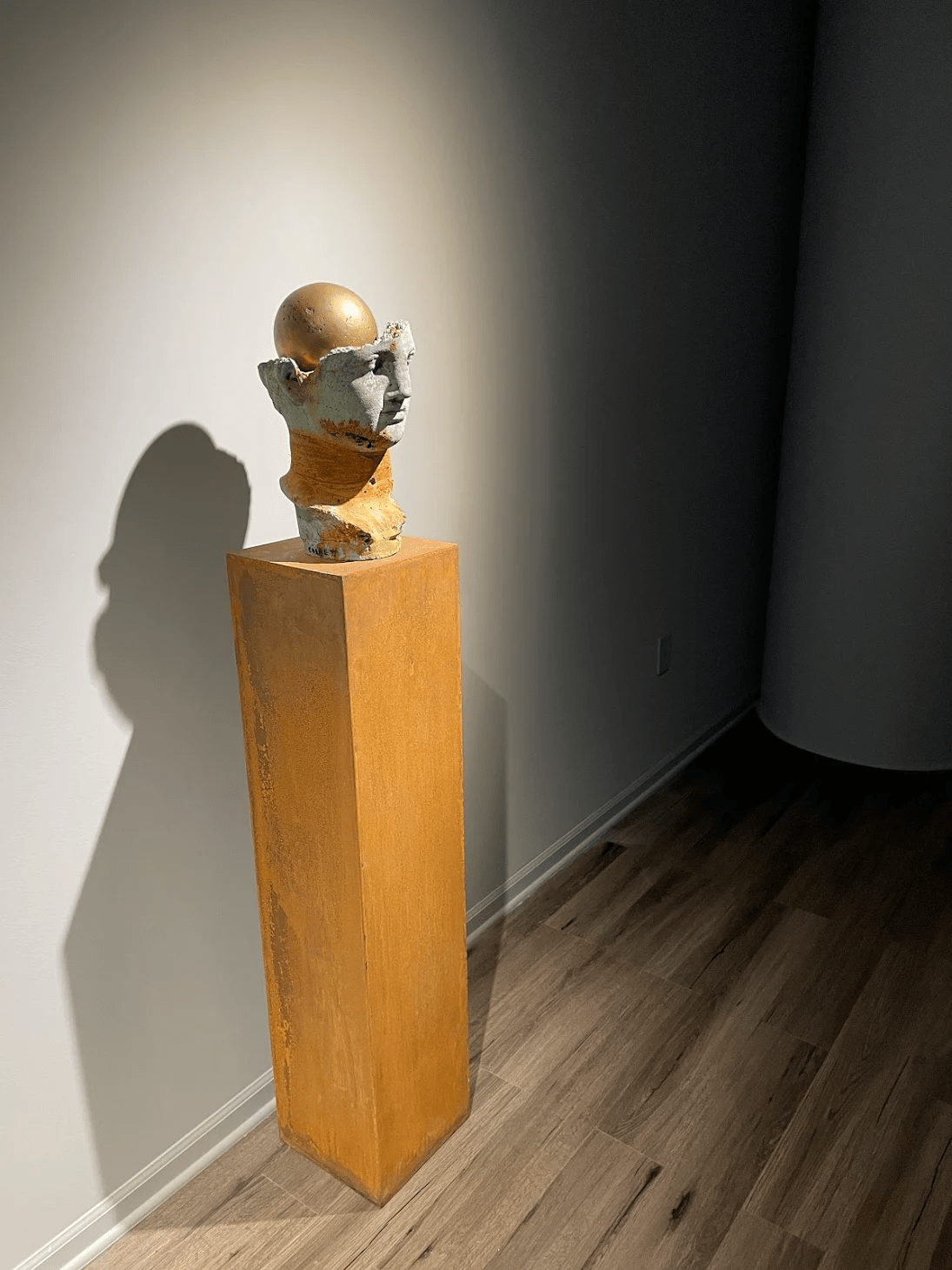
Museum grade lighting fixture demonstrating controlled beam distribution on sculpture
Professional museum lighting design guidelines focus on balancing presentation, comfort, and conservation. Lighting must allow visitors to see objects clearly while also protecting those objects from excessive exposure.
Curators and lighting designers typically follow several key principles when planning museum lighting design.
First, lighting should be directional rather than uniform. Museums rarely aim for general room brightness. Instead, lighting is carefully directed toward specific objects to highlight their form and material.
Second, glare must be minimized. Visitors should be able to approach objects closely without seeing bright light sources reflected in glass or polished surfaces.
Third, color accuracy must be maintained. Museum lighting guidelines emphasize high color fidelity so that artifacts appear natural and historically accurate.
Fourth, conservation requirements must be respected. Certain materials such as paper, textiles, and photographs require lower light levels to prevent long term degradation.
Track lighting supports these guidelines because it allows light to be aimed precisely and adjusted whenever exhibitions change. Instead of compromising with fixed fixtures, museums can refine the lighting design throughout the life of the exhibition.
Museum Grade Track Lighting and Optical Precision
Museum grade track lighting refers to fixtures designed specifically for cultural institutions where presentation quality and conservation standards are critical.
These fixtures differ significantly from general retail lighting. Museum quality track lighting must deliver highly controlled beams, consistent color rendering, and minimal glare.
Optical precision is particularly important. Museum artifacts often include subtle textures, delicate materials, and intricate details that require careful illumination.
A poorly controlled beam can create uneven brightness or distracting spill light. A well designed optic produces a smooth beam with controlled edges and balanced intensity.
High quality LED track lighting for museums also maintains consistent color performance across fixtures. When different fixtures display slightly different color temperatures, the gallery can feel uneven or visually confusing.
Museum grade lighting systems solve this by using tightly controlled LED modules and precision optics that deliver stable, predictable results across the exhibition.
How Track Lighting Works in Museum Environments

Museum lighting rail system providing power to movable spotlight heads
Understanding how track lighting works helps explain why it has become the standard approach for museum environments.
A track lighting system consists of a metal rail that contains electrical conductors along its length. Fixtures connect to the track through a mounting adapter that both supplies power and allows the fixture to be positioned anywhere along the rail.
Once installed, the track provides continuous electrical power while the fixtures remain movable. This means curators can shift lighting positions without altering the electrical infrastructure.
In museum environments, technicians often adjust track lights during exhibition installation. They aim fixtures toward specific artifacts, adjust beam angles, and fine tune brightness levels to create the desired visual effect.
Track lighting also supports different optical accessories. Lenses, beam shaping components, and glare control devices can be added to modify how the light behaves.
Because the track system itself remains fixed while the fixtures remain adjustable, museums gain a powerful tool for adapting lighting to each new exhibition.
High Quality LED Track Lighting for Museums
High quality LED track lighting has become the preferred technology for museums because it offers strong optical performance while reducing energy consumption.
Traditional lighting sources such as halogen lamps produced significant heat and ultraviolet radiation. These factors could accelerate deterioration in sensitive artifacts.
LED technology produces very low heat and minimal ultraviolet output. This makes it safer for museum collections while still delivering strong illumination where needed.
Another advantage of LED museum lighting is efficiency. LEDs consume significantly less energy than older lighting technologies, which helps museums reduce operational costs.
Longevity is also important. LED fixtures can operate for many thousands of hours before requiring replacement. This reduces maintenance disruptions and ensures consistent lighting conditions across exhibitions.
When combined with precision optics and flexible track infrastructure, LED technology enables museums to create lighting environments that are both sustainable and visually refined.

Track Lighting for Museums With High Ceilings

Directional lighting mounted above large exhibition hall
Many museums are located in historic buildings or large architectural spaces with high ceilings. Lighting artifacts from a distance presents unique challenges.
When the ceiling is far from the display surface, the lighting beam must travel further before reaching the object. This requires fixtures capable of maintaining beam intensity and focus over longer distances.
Museum grade track lighting fixtures designed for long throw projection can deliver strong illumination even when mounted high above the exhibition floor.
Optical precision becomes especially important in these environments. If the beam spreads too widely, light may spill across walls and floors instead of focusing on the artifact.
High quality LED track lighting with refined optics helps maintain clarity and contrast even in large museum halls.
Because track lighting allows fixtures to be positioned along different sections of the rail, designers can also place lights closer to the exhibition walls when necessary.
This flexibility helps maintain consistent illumination even in complex architectural spaces.
Balancing Accent Lighting and Ambient Lighting
Museum lighting design often combines two main approaches: ambient lighting and accent lighting.
Ambient lighting provides a gentle level of background brightness that allows visitors to navigate the space comfortably.
Accent lighting highlights individual artifacts and creates focal points within the exhibition.
Track lighting systems make it easy to combine these layers. Some fixtures can be aimed toward walls to create soft ambient illumination, while others focus tightly on specific objects.
Balancing these two lighting layers helps museums create visually engaging exhibitions without overwhelming the viewer.
Too much accent lighting can make the space feel theatrical and harsh. Too much ambient lighting can make artifacts appear flat.
A well designed museum lighting system balances these elements so the exhibition feels calm, intentional, and immersive.
The Role of High Quality Track Lighting in Visitor Experience

Exhibition visitors exploring displays illuminated by controlled lighting beams
Lighting influences how visitors experience a museum more than most people realize.
When lighting is carefully designed, visitors feel comfortable exploring the space. They can see details clearly, move naturally between displays, and remain engaged with the exhibition.
When lighting is poorly designed, the opposite happens. Visitors may struggle with glare, miss important details, or feel visually fatigued.
High quality track lighting helps prevent these problems by providing precise control over beam direction, intensity, and distribution.
Because fixtures can be adjusted easily, museums can refine the lighting during installation until the exhibition looks exactly as intended.
This adaptability ensures that lighting supports the curatorial narrative rather than distracting from it.
Why Museums Continue to Use Track Lighting
Despite advances in architectural lighting technologies, track lighting remains one of the most practical and versatile solutions for museum environments.
Its flexibility allows museums to adapt lighting quickly as exhibitions evolve. Its precision optics help reveal artifacts accurately. Its compatibility with LED technology supports both conservation and energy efficiency.
Museum track lighting systems provide a long term lighting platform that can evolve with the institution.
For museums that regularly update exhibitions and manage diverse collections, this adaptability is invaluable.
Rather than rebuilding the lighting system for every exhibition, museums can rely on a track infrastructure that supports decades of change.
Museum Track Lighting FAQs
What is museum track lighting?
Museum track lighting is an adjustable lighting system where fixtures mount onto electrified tracks. The track supplies power along its length, allowing fixtures to be moved, aimed, replaced, or upgraded without rewiring. This makes it ideal for museums where exhibitions change frequently.
Why do museums use track lighting instead of fixed downlights?
Museums use track lighting because it is flexible. Exhibits rotate and object placement changes. Track allows staff to reposition and re aim fixtures quickly, swap optics, and add or remove fixtures without construction. Downlights are typically fixed and often place light where it is not needed.
Is LED museum track lighting safe for artifacts?
LED museum lighting is widely considered safer than older sources because it produces low heat and minimal ultraviolet output. However, conservation also depends on total exposure over time. Dimming and good operational control are important for light sensitive objects.
What beam angle should be used in a museum?
Beam angle depends on the object and viewing distance. Narrow beams are best for small artifacts and focused highlights. Medium beams suit most framed works. Wide beams are used for larger objects and wall washing. Adjustable beam fixtures like Zoom make it easier to tune the beam as exhibits change.
How do you reduce glare and reflections in museum lighting?
Glare and reflections are reduced by using refined optics, shielding accessories, and correct aiming angles. Track lighting helps because fixtures can be repositioned to avoid reflections in glass cases or framed works. Tightening beam spread can also reduce spill on glazing.
What track lighting works best for high museum ceilings?
For high ceilings and long throw projection, fixtures with strong output and refined optical control perform best. Deluxe is very good for high ceilings and projecting light, making it ideal for tall halls and atriums. Zoom and Multi are also great for ceilings and provide flexible beam control across zones.
Can track lights be installed inside display cabinets?
Yes. Mini track lights can go inside cabinets as well. They are compact, precise, and ideal for highlighting small objects like coins, jewelry, documents, and delicate artifacts. Cabinet lighting should also be paired with dimming to manage exposure for sensitive items.
How bright should museum lighting be?
Brightness should be based on the object’s sensitivity and the desired viewing experience. Sensitive items like paper and textiles often require lower light levels. Durable materials can tolerate higher levels. Museums frequently use dimming and scenes to adjust light safely per zone.
What makes a museum track lighting system future proof?
A future proof system uses track infrastructure as the long term backbone and allows fixture heads to be upgraded over time. This means the ceiling and wiring do not need to be replaced when new lighting technology becomes available.
How long do LED museum track lights last?
Professional LED fixtures often last many years with stable output. Real world performance depends on operating hours, heat management, and maintenance. Periodic cleaning of optics and checking alignment helps maintain consistent results.
You’re in expert hands when it comes to art lighting