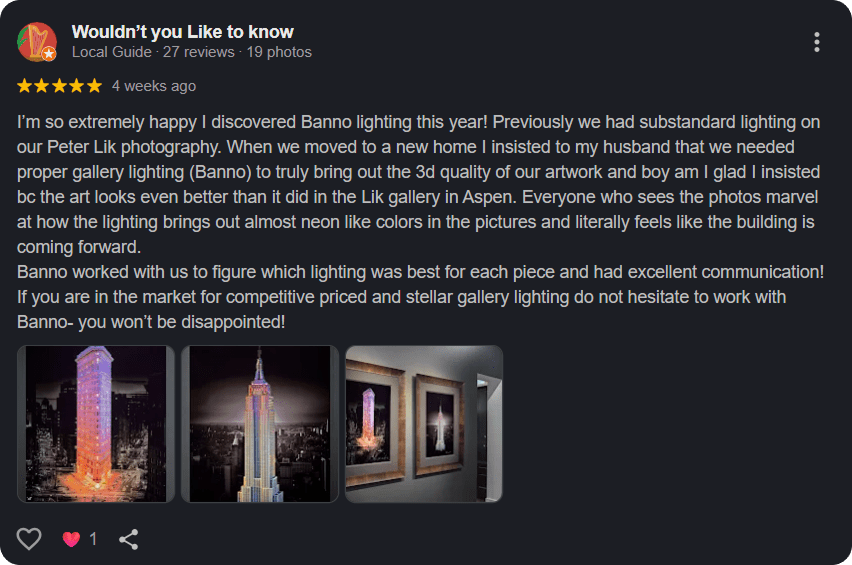
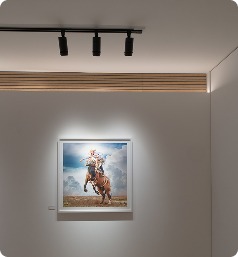
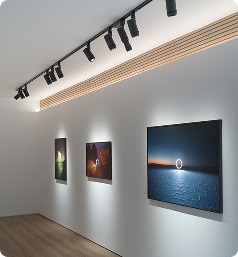
Adjustable ceiling track fixtures highlighting framed artwork
Track lighting gallery systems are considered the gold standard for illuminating artwork in professional art galleries, museums, exhibitions, and collector environments. Unlike fixed lighting solutions, track lighting provides precision, flexibility, and scalability, allowing curators and designers to adapt illumination as artwork layouts evolve.
A well-designed track lighting gallery setup ensures that each artwork is illuminated with controlled brightness, accurate color rendering, and refined beam direction. This creates a cohesive visual experience where artwork remains the focal point while lighting functions as a discreet enhancement.
Trusted by Galleries: A Professional Perspective on Our Lighting
Why Track Lighting Gallery Systems Are Preferred in Art Spaces
Track lighting for galleries is widely used because of its adaptability and precision. Art exhibitions frequently change, and lighting must be able to adjust without major structural modifications. A gallery track lighting system allows fixtures to be repositioned, re-aimed, and reconfigured as artwork arrangements evolve.
Key advantages of track lighting gallery systems include:
- Flexible lighting positioning
- Directional control for individual artworks
- Scalable layouts for large gallery walls
- Professional and discreet illumination
This makes track lighting essential in dynamic gallery and museum environments.
Track Lighting Art Gallery Design Principles

Even light distribution across varied artwork sizes
Designing track lighting for an art gallery requires more than simply installing lights along a ceiling track. Professional lighting design considers artwork size, wall spacing, ceiling height, and beam angles to achieve balanced illumination.
Effective track lighting art gallery design focuses on:
- Even distribution of light across artworks
- Minimisation of glare and reflections
- Consistent brightness levels
- Accurate color representation
These principles ensure that artwork is presented authentically and professionally.

4.9-star rated by art collectors and gallery professionals
Gallery Track Lighting System and Flexibility for Exhibitions
A gallery track lighting system offers unmatched flexibility for rotating exhibitions and evolving collections. Unlike recessed lighting, track lighting fixtures can be easily moved along the rail to accommodate new artwork placements.
This flexibility supports:
- Temporary exhibitions
- Changing gallery layouts
- Multi-art wall displays
- Curatorial lighting adjustments
For galleries and museums, this adaptability is critical for long-term operational efficiency.
LED Track Lighting for Art Gallery Illumination

Conservation-friendly lighting for museum-grade displays
LED track lighting for art gallery environments is the preferred modern solution due to its stability, energy efficiency, and conservation-friendly performance. LED technology provides consistent illumination with minimal heat and UV output, making it suitable for sensitive artworks.
Benefits of LED track lighting in galleries include:
- Low heat emission for artwork protection
- Stable brightness and color output
- Long operational lifespan
- Reduced maintenance requirements
This makes LED track lighting ideal for both institutional and private art collections.
Best Track Lighting for Art Gallery Displays
The best track lighting for art gallery applications combines high color rendering, precise beam control, and adjustable fixtures. Art lighting requires accuracy rather than excessive brightness, ensuring that artwork is illuminated without distortion.
Professional-grade track lighting should provide:
- Narrow and adjustable beam angles
- Glare reduction optics
- Consistent color temperature
- Smooth dimming capabilities
These features allow lighting to enhance artwork rather than overpower it.
Gallery Spotlight Track Lighting and Visual Hierarchy

Subtle lighting contrast guiding viewer attention
Gallery spotlight track lighting is often used to create visual hierarchy within exhibitions. By directing light toward key artworks, curators can guide viewer attention while maintaining overall balance across the display.
Strategic spotlighting enables:
- Highlighting of focal artworks
- Balanced illumination of secondary pieces
- Enhanced exhibition storytelling
- Improved viewer engagement
This layered lighting technique is widely used in museum-grade exhibition design.
Track Lighting for Gallery Wall Installations
Track lighting for gallery wall displays is particularly effective when multiple artworks are arranged in a single visual composition. Adjustable track heads allow each piece to receive tailored illumination while maintaining cohesion across the wall.
Gallery wall track lighting improves:
- Uniform brightness across artworks
- Clear visibility of individual pieces
- Balanced lighting distribution
- Professional presentation quality
This is especially important in curated gallery walls and collector homes.
How to Use Track Lighting in Gallery Environments

Even spacing supporting professional exhibition clarity
Understanding how to use track lighting correctly is essential for achieving professional art illumination. Improper positioning can lead to glare, uneven brightness, or shadow distortion.
Best practices for track lighting gallery setups include:
- Positioning lights slightly in front of artwork
- Using angled beams rather than direct overhead light
- Spacing fixtures evenly across display walls
- Adjusting intensity based on artwork medium
These techniques ensure optimal visual clarity and viewing comfort.
Types of Track Lighting for Galleries and Museums
There are several types of track lighting used in gallery environments, each serving a specific purpose depending on the exhibition design and architectural layout.
Common gallery track lighting types include:
- Linear track systems for large exhibition spaces
- Adjustable spotlight track heads for precision lighting
- Ceiling-mounted track lighting for gallery walls
- Flexible modular track systems for evolving displays
Selecting the appropriate track type ensures compatibility with curatorial and architectural requirements.
Professional Art Lighting Integration with Zoom, Deluxe, and Multi

Deluxe, Multi and Zoom lighting fixtures
In refined track lighting gallery systems, specialised art lighting fixtures such as Zoom (precision art lighting), Deluxe (museum-grade lighting), and Multi (flexible gallery lighting) are often integrated to enhance precision and consistency. These fixtures provide controlled beam accuracy, stable illumination, and adaptability for diverse artwork sizes and mediums.
Their use within track lighting systems allows galleries and collectors to achieve museum-level lighting quality while maintaining a clean and professional visual aesthetic.
Track Lighting for Pictures and Framed Artwork
Track lighting for pictures and framed artwork must be carefully angled to minimise glare, especially when artworks are protected by glass. Proper beam positioning enhances clarity while preserving visual comfort.
Effective lighting for framed pieces ensures:
- Reduced reflective glare
- Enhanced detail visibility
- Balanced illumination across frames
- Comfortable viewing angles
This is essential in both gallery and residential art environments.
Track Lighting Gallery as a Long-Term Professional Solution

Stable LED track maintaining consistent brightness
A track lighting gallery system provides long-term reliability, adaptability, and refined visual performance for artwork displays. Its flexibility, precision, and conservation-friendly characteristics make it one of the most trusted lighting solutions for galleries, museums, designers, and collectors.
By combining adjustable fixtures, controlled beam direction, and stable illumination, track lighting allows artwork to be presented with clarity, depth, and visual authenticity. Whether used in large-scale exhibitions or curated private collections, track lighting gallery systems create a sophisticated display environment where artwork remains the central focus, supported by lighting that is both technically precise and architecturally refined.
Track Lighting Gallery and Beam Angle Control for Artwork Precision
One of the most critical technical aspects of a track lighting gallery system is beam angle control. Unlike general lighting, artwork illumination requires targeted light distribution that enhances detail without flooding the entire wall with excessive brightness. Adjustable beam angles allow lighting designers and curators to fine-tune how light interacts with each piece.
Narrow beam angles are ideal for:
- Small paintings
- Sculptures
- Feature artworks
- High-value focal pieces
Wider beam angles are better suited for:
- Large canvas works
- Multi-piece gallery walls
- Textured installations
- Mixed-media displays
This level of optical precision ensures that each artwork receives appropriate illumination based on its scale and visual importance.
Track Lighting in Gallery Spaces and Ceiling Height Considerations

High ceiling spotlight maintaining focused intensity
Ceiling height plays a major role in determining the effectiveness of track lighting in gallery environments. Higher ceilings require more focused optics and carefully calculated fixture spacing to maintain sufficient light levels on artwork surfaces.
In galleries with higher ceilings, track lighting systems must account for:
- Beam spread over longer distances
- Maintained intensity at artwork level
- Reduced light spill
- Consistent vertical illumination
When properly planned, track lighting remains effective regardless of architectural scale, making it suitable for both intimate galleries and large institutional spaces.
Gallery Style Track Lighting and Architectural Harmony
Gallery style track lighting is designed to integrate seamlessly into architectural environments without distracting from the artwork. The track itself is typically minimal in appearance, allowing the lighting system to blend into the ceiling while directing attention toward the art.
Architectural harmony is achieved through:
- Slim track profiles
- Neutral fixture finishes
- Discreet mounting systems
- Clean ceiling integration
This subtle visual presence is especially valued in contemporary galleries and luxury residential interiors where aesthetic refinement is essential.
Track Lighting for Galleries and Artwork Preservation

LED spotlight reducing heat exposure to paintings
Artwork preservation is a primary concern in professional art lighting design. Track lighting for galleries must deliver illumination that protects artwork while maintaining visual clarity. Modern LED track lighting is particularly suitable due to its low heat output and stable light performance.
Preservation-focused lighting systems help:
- Reduce heat exposure to artwork
- Minimise UV and infrared radiation
- Maintain consistent lighting conditions
- Support long-term conservation standards
This makes track lighting gallery systems compatible with museum-grade display requirements.
Gallery Spotlight Track Lighting and Layered Illumination
Professional galleries rarely rely on a single lighting layer. Instead, gallery spotlight track lighting is used as part of a layered lighting strategy that combines accent, ambient, and supplemental illumination.
A layered lighting approach typically includes:
- Track spotlights for artwork emphasis
- Soft ambient lighting for spatial balance
- Supplementary wall lighting for depth
This layered method enhances the perception of space while ensuring artwork remains the primary visual focus.
Track Lighting for Gallery Wall and Multi-Art Displays

Reduced shadow overlap in multi-art composition
Track lighting for gallery wall installations must accommodate multiple artworks arranged in a cohesive composition. Instead of using a single broad light source, individual track heads can be directed at each piece, ensuring uniform illumination across the entire wall.
Benefits for multi-art displays include:
- Even brightness distribution
- Reduced shadow overlap
- Clear separation between artworks
- Enhanced visual rhythm
This is particularly valuable in exhibition spaces where curatorial layouts frequently change.
Best Gallery Track Lighting and Color Temperature Selection
Color temperature selection is essential when designing the best gallery track lighting system. The wrong color temperature can distort artwork tones, affecting how viewers perceive color, texture, and depth.
Preferred lighting characteristics for artwork include:
- Stable and consistent color temperature
- High color rendering performance
- Neutral white illumination for accurate color perception
- Balanced warmth without yellow distortion
Careful color temperature calibration ensures that artwork appears true to the artist’s original intent.
LED Track Lighting for Art Gallery Efficiency and Longevity

Long-lasting LED fixture reducing maintenance frequency
LED track lighting for art gallery applications provides long-term operational efficiency. Compared to traditional lighting technologies, LED systems consume less energy while delivering consistent illumination quality over extended periods.
Operational advantages include:
- Energy-efficient performance
- Reduced maintenance cycles
- Long fixture lifespan
- Stable lumen output over time
For galleries operating daily, these benefits translate into reliable and cost-effective lighting infrastructure.
Track Lighting Gallery Systems and Curatorial Adaptability
Curators require lighting systems that evolve alongside exhibitions. A track lighting gallery system supports curatorial adaptability by allowing quick fixture repositioning and beam adjustments without altering the ceiling structure.
This adaptability supports:
- Rotating exhibitions
- Temporary installations
- Seasonal gallery redesigns
- Expanding art collections
Such flexibility ensures that the lighting system remains relevant as display requirements change.
Track Lighting for Pictures and Textured Artwork Surfaces

Controlled lighting emphasizing material authenticity
Track lighting for pictures and textured artworks must be carefully angled to reveal surface details without creating harsh shadows. Paintings with heavy brushwork, relief elements, or layered materials benefit significantly from directional lighting.
Proper directional lighting enhances:
- Surface texture visibility
- Depth perception
- Material authenticity
- Artistic detail clarity
This is especially important for contemporary and mixed-media artworks.
Track Lighting Gallery Layout Planning and Fixture Spacing
Fixture spacing within a track lighting gallery system directly impacts lighting consistency. Uneven spacing can create hotspots or dark zones that disrupt the viewing experience.
Optimal layout planning includes:
- Evenly distributed track heads
- Consistent distance from artwork walls
- Balanced beam overlap
- Strategic placement based on artwork size
Professional spacing ensures smooth illumination across the entire exhibition wall.
Track Lighting for Galleries and Glare Control Techniques

Anti-glare optics reducing reflections across gallery wall
Glare is one of the most common challenges in gallery lighting. Track lighting for galleries can effectively reduce glare when fixtures are angled correctly and positioned slightly forward from the artwork plane.
Glare control strategies include:
- Angled beam positioning
- Anti-glare lens systems
- Controlled light intensity
- Avoiding direct frontal lighting
These methods improve viewing comfort and visual clarity.
Track Lighting Gallery in Residential Art Collections
While commonly associated with museums and galleries, track lighting gallery systems are increasingly used in high-end residential interiors. Collectors and designers adopt gallery-style lighting to present artwork with professional-level refinement.
Residential benefits include:
- Museum-style art presentation
- Flexible lighting for evolving collections
- Enhanced interior sophistication
- Architectural lighting integration
This approach transforms private homes into curated art environments.

Track Lighting Art Gallery Systems and Minimal Maintenance

Stable brightness reducing frequent service needs
Maintenance efficiency is a key advantage of modern track lighting art gallery systems. High-quality LED fixtures require minimal upkeep while maintaining consistent illumination performance.
Low-maintenance benefits include:
- Long operational lifespan
- Reduced bulb replacement frequency
- Stable brightness over time
- Reliable system performance
This reliability is especially important for institutions and collectors managing large art displays.
Track Lighting Gallery as a Future-Proof Art Lighting Solution

Modular track system enabling scalable expansion
As gallery design and exhibition formats continue to evolve, track lighting gallery systems remain one of the most future-proof lighting solutions available. Their modular nature allows upgrades, reconfigurations, and expansions without major renovations.
Future-ready advantages include:
- Modular scalability
- Compatibility with new lighting technologies
- Adaptability to changing exhibition needs
- Long-term design relevance
Ultimately, track lighting gallery systems represent a refined balance between precision illumination, architectural integration, and curatorial flexibility. By delivering directional control, conservation-friendly performance, and adaptable lighting layouts, they provide a professional framework for illuminating artwork in galleries, museums, and collector spaces with clarity, balance, and visual sophistication.
FAQs
1. What is track lighting gallery lighting?
It is a flexible lighting system designed to illuminate artwork in galleries using adjustable fixtures mounted on a track.
2. Why do art galleries use track lighting?
Because it allows precise, adjustable illumination for changing artwork displays.
3. Is track lighting good for artwork?
Yes, it provides directional and controlled lighting ideal for art presentation.
4. What is the best track lighting for art galleries?
LED track lighting with high color accuracy and adjustable beam angles is typically best.
5. Can track lighting be adjusted for different artworks?
Yes, fixtures can be repositioned and aimed along the track.
6. Is LED track lighting safe for paintings?
Yes, LED lighting emits low heat and minimal UV, making it conservation-friendly.
7. How far should track lights be from artwork?
They are usually placed slightly in front of the artwork for optimal illumination.
8. Can track lighting reduce glare on framed artwork?
Yes, proper angling significantly reduces glare and reflections.
9. What beam angle is best for track lighting artwork?
Narrow beams for small artworks and wider beams for larger pieces.
10. Is track lighting better than recessed lighting for galleries?
Track lighting offers greater flexibility, while recessed lighting offers a more discreet look.
11. Can track lighting illuminate a gallery wall evenly?
Yes, evenly spaced track fixtures provide balanced wall illumination.
12. Do museums use track lighting systems?
Yes, many museums use track lighting for adaptable exhibition lighting.
13. How long does track lighting last?
High-quality LED track lighting can last many years with consistent performance.
14. Can track lighting be dimmable for artwork displays?
Yes, dimmable systems allow precise lighting control.
15. Is track lighting suitable for collector homes?
Yes, it is widely used in gallery-style residential interiors.
16. Can track lighting highlight focal artworks?
Yes, directional spotlights can emphasise key pieces.
17. Does track lighting affect artwork color appearance?
High-quality lighting preserves accurate color representation.
18. Can track lighting be installed in existing ceilings?
Yes, it can typically be installed without major structural changes.
19. What color temperature is best for track lighting in galleries?
Neutral, stable color temperatures are preferred for art illumination.
20. Why is track lighting considered professional gallery lighting?
Because it delivers precision, flexibility, and consistent illumination for high-quality art displays.
Real Feedback from Art Collectors