Professional art gallery lights illuminating curated exhibition space
Art gallery lights are specialised lighting solutions designed to illuminate paintings, sculptures, and curated collections with precision, consistency, and conservation in mind. This article serves as a complete guide to professional art gallery lighting, explaining why lighting in galleries and museums is never an afterthought but a critical element that shapes how artwork is experienced, valued, and preserved.
Unlike general interior lighting, art gallery lights are engineered to deliver controlled beam angles, high colour accuracy, and minimal glare. The objective is simple but critical: reveal the true depth, texture, and colour of the artwork while keeping the viewer’s attention focused entirely on the piece itself.
For curators, collectors, architects, and designers, the right art gallery lighting is not about brightness. It is about control, balance, and visual hierarchy.
What Are Art Gallery Lights?

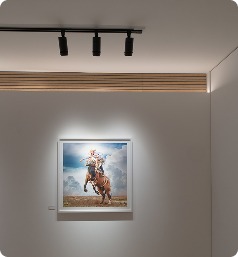
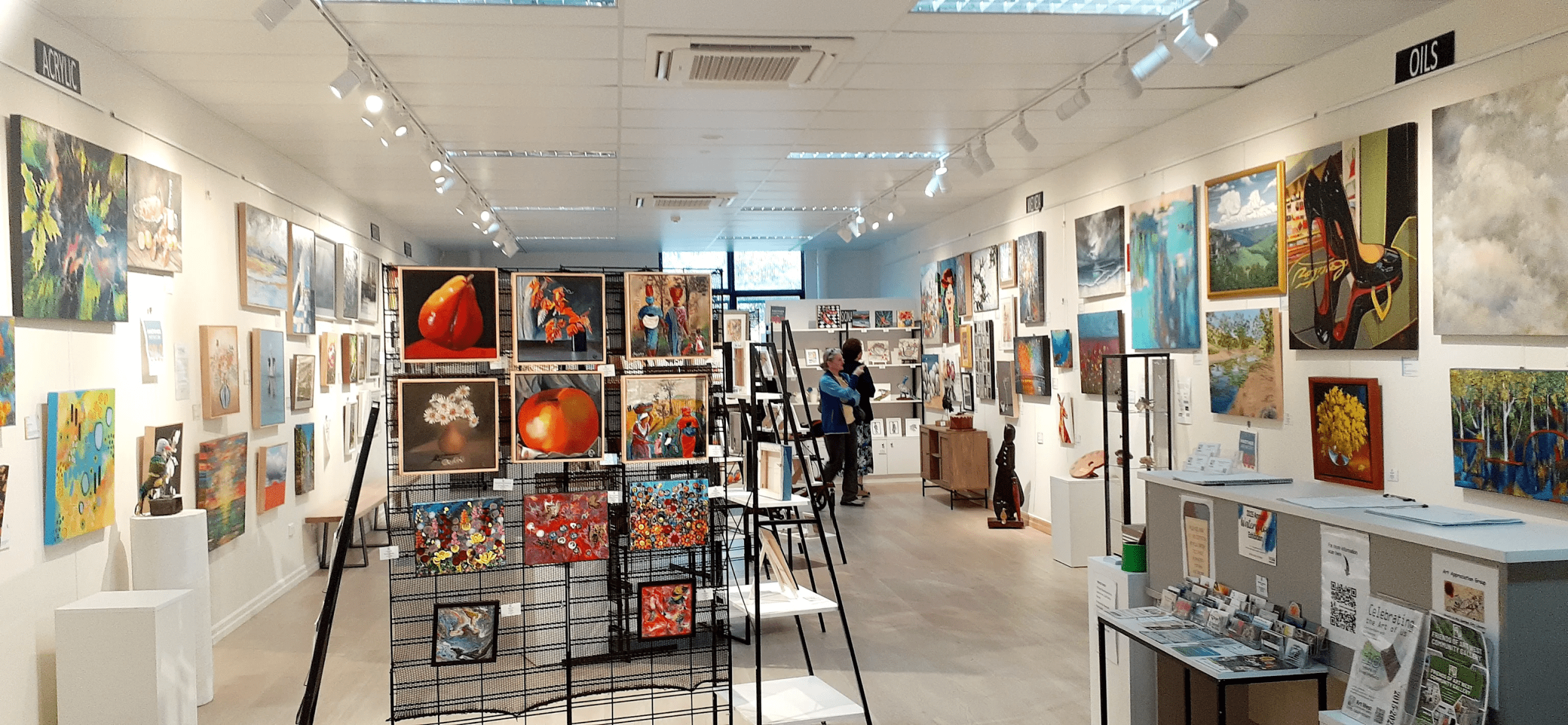
Adjustable track lighting focused on gallery wall artwork
Art gallery lights refer to professional-grade lighting fixtures specifically designed to illuminate artwork in galleries, museums, exhibitions, and high-end residential collections. These lights differ significantly from standard decorative fixtures because they prioritise optical precision and colour fidelity over ambient illumination.
Professional art gallery lighting fixtures typically include:
- Adjustable track lights
- Ceiling mounted art lights
- Precision spotlights for paintings
- Display lights for artworks and sculptures
- Gallery wall lighting systems
These systems allow each artwork to be lit intentionally, rather than flooding the entire space with uniform light.

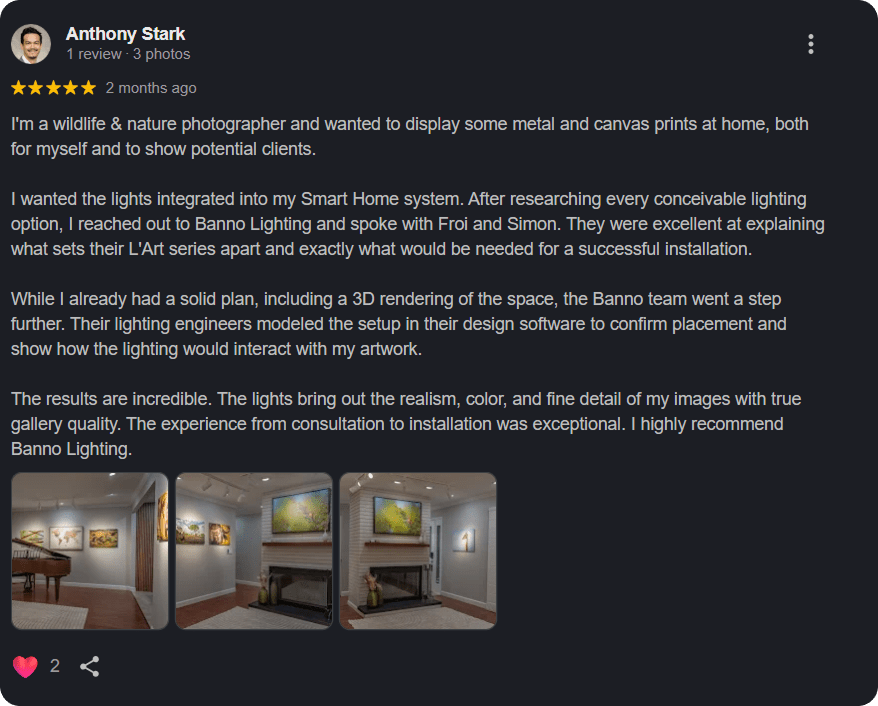
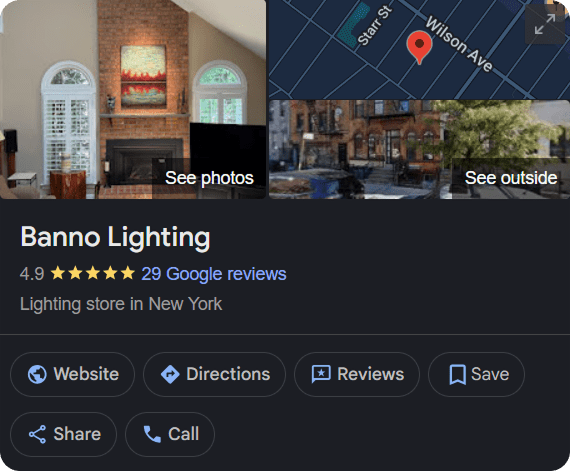
4.9-Star Google Review for Our Art Lighting Solutions
Why Art Gallery Lighting Is Critical for Artwork Presentation

Glare-free illumination enhancing painting surface texture
Lighting directly influences how artwork is perceived. A masterpiece under poor lighting can appear flat, muted, or lifeless. Under properly designed art gallery lights, the same piece can reveal brush texture, tonal depth, and colour accuracy that transforms the viewer’s experience.
Key benefits of professional art gallery lighting include:
- True colour representation through high CRI lighting
- Reduced glare on framed and glass-covered artworks
- Enhanced texture visibility
- Clear visual focus on featured pieces
- Elevated perceived value of the artwork
In high-end galleries and museums, lighting is part of the storytelling. It guides the viewer’s eye and creates intentional emphasis across the exhibition.
The Philosophy of Professional Art Gallery Lights: Less Light, More Focus

Minimal gallery lighting creating strong visual hierarchy
One of the biggest misconceptions in gallery lighting is that more lights create better results. In reality, museum-grade lighting design often uses fewer fixtures with higher precision.
When too many lights are used:
- Artwork becomes visually washed out
- Shadows and glare increase
- The visual hierarchy is lost
Professional art gallery lights focus on controlled illumination. Instead of lighting the entire room equally, the lighting is layered so that the artwork becomes the natural focal point. This approach is commonly used in museums, private collections, and premium gallery environments.
Types of Art Gallery Lights Used in Professional Spaces

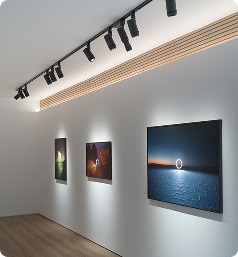
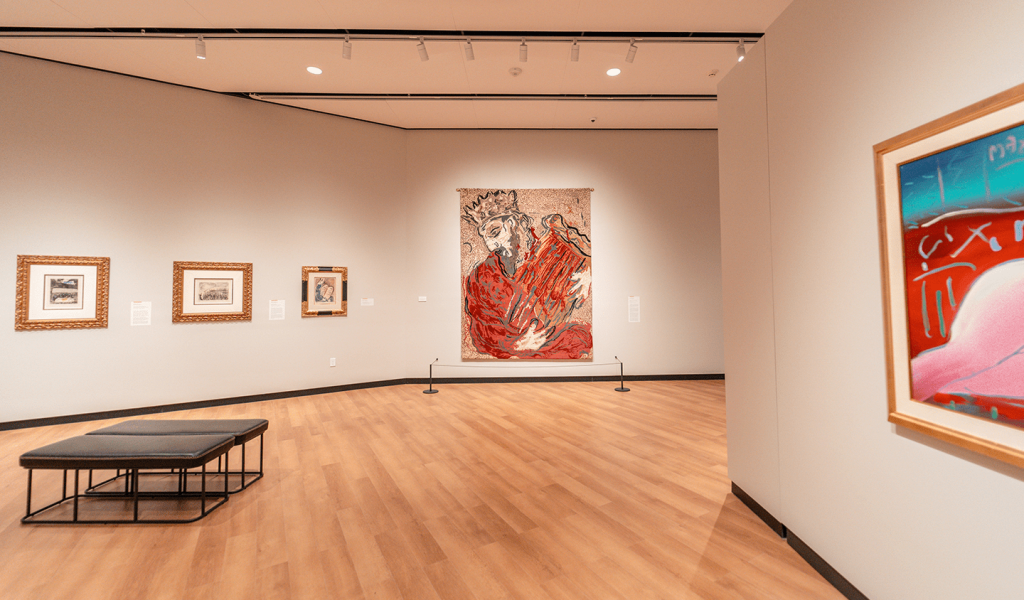
Track-mounted art lights aligned across gallery ceiling
Track-Based Art Gallery Lights
Track lighting is one of the most widely used systems in galleries because of its flexibility and precision. Track-mounted art gallery lights allow curators to reposition fixtures as exhibitions change without altering the ceiling infrastructure.
Benefits include:
- Adjustable beam angles
- Flexible artwork spotlighting
- Scalable lighting layouts
- Clean architectural integration
Track lighting for art galleries is especially effective for rotating exhibitions and multi-piece gallery walls.
Ceiling Mounted Art Gallery Lights
Ceiling mounted art gallery lights are ideal for permanent installations where clean aesthetics and minimal visual distraction are required. These fixtures provide controlled overhead illumination while maintaining architectural elegance.
They are commonly used in:
- Museums
- Luxury galleries
- High-end residential art collections
- Exhibition halls
With the correct beam angle and placement, ceiling mounted lights can deliver museum-grade illumination without visible fixture clutter.
Art Gallery Spot Lights for Paintings
Spot lights are essential for highlighting individual artworks. These art gallery spot lights use narrow beam optics to focus precisely on a painting, sculpture, or display piece without excessive light spill.
This method ensures:
- Clear focal emphasis
- Reduced ambient distraction
- Enhanced viewer engagement
Art Gallery Lighting Fixtures: Zoom, Multi, and Deluxe Systems

Deluxe museum-grade lighting, Multi wall wash, Zoom focus control
Zoom Series Art Gallery Lights for Precision Artwork Illumination
The Zoom series is engineered for precise and controlled lighting of individual artworks. These art gallery lights feature adjustable beam optics that allow curators and designers to fine-tune the light spread based on artwork size and positioning. This makes them ideal for feature paintings, sculptures, and high-value pieces that require focused illumination with minimal glare and spill.
Multi Series Art Gallery Lights for Uniform Wall Lighting
The Multi series is designed for broader and more even illumination across multiple artworks or large gallery walls. In professional gallery environments, these lighting fixtures are used to create consistent brightness across curated displays while maintaining high colour accuracy. This ensures visual balance when showcasing multiple paintings in a single exhibition space.
Deluxe Series Art Gallery Lights for Museum-Grade Lighting
The Deluxe series represents a premium tier of art gallery lighting fixtures built for museums, luxury galleries, and serious collectors. With ultra-high CRI, refined optical engineering, and elegant architectural design, these art gallery lights deliver exceptional clarity and conservation-friendly illumination suitable for valuable and irreplaceable artworks.
Art Gallery Display Lights for Paintings and Sculptures

30-degree angled spotlight reducing frame reflections
Art gallery display lights are specifically used to illuminate paintings, sculptures, and display pieces without causing visual distortion or material damage. As part of practical lighting approaches for displaying art in galleries, these lights are often positioned at carefully calculated angles to achieve even edge-to-edge illumination.
Best practices for lighting paintings in galleries include:
- Mounting lights at a 25–35 degree angle
- Using high CRI LED art gallery lights (95+)
- Matching beam spread to artwork dimensions
- Avoiding direct frontal glare
This method enhances detail visibility while preserving the integrity of the artwork.
Art Gallery Lighting Design and Layout Strategy
Spotlight hierarchy guiding viewer attention naturally
Effective art gallery lighting design requires strategic planning rather than random fixture placement. Lighting designers consider multiple variables, including wall spacing, artwork size, ceiling height, and viewer sightlines.
A professional art gallery lighting layout typically includes:
- Accent lighting for hero artworks
- Uniform wall lighting for collections
- Controlled ambient lighting for spatial balance
- Adjustable fixtures for exhibition flexibility
This layered approach ensures that each artwork receives appropriate visual attention without overpowering surrounding pieces.
Colour Temperature in Art Gallery Lighting

Consistent colour temperature ensuring visual cohesion
Colour temperature plays a critical role in art gallery lighting because it directly affects how colours appear to the viewer. Incorrect lighting temperature can distort tones and reduce artistic authenticity.
Recommended colour temperatures:
- 2700K for classical and warm-toned artwork
- 3000K for balanced gallery environments
- 3500K for contemporary exhibitions
Maintaining a consistent colour temperature across all art gallery lights ensures visual harmony throughout the exhibition space.
LED Art Gallery Lights: The Modern Standard
Energy-efficient gallery lighting with stable output
LED technology has become the global standard for art gallery lighting due to its conservation benefits, energy efficiency, and performance stability. Today’s LED fixtures function as high-performance lights for art galleries and collections, delivering precise illumination while emitting minimal heat and UV radiation, making them significantly safer for delicate and valuable artworks than traditional halogen lighting.
Advantages of LED art gallery lights:
- Low heat emission
- Reduced UV exposure
- Long lifespan (30,000–50,000+ hours)
- Consistent colour rendering
- Energy efficiency
This makes LED gallery lighting ideal for museums, galleries, and private collections where artwork preservation is a priority.
Art Gallery Lights for Large Paintings and Feature Walls

Multi-light configuration evenly illuminating oversized canvas
Large-scale artworks require specialised lighting solutions to achieve uniform illumination. Standard fixtures often create hotspots in the centre and dark edges along the canvas.
Professional solutions include:
- Adjustable art gallery track lights
- Wide-beam gallery lighting fixtures
- Multi-light configurations for oversized artworks
This ensures the entire painting is evenly illuminated without visual imbalance.
Common Mistakes When Choosing Art Gallery Lights
Many galleries and collectors mistakenly use general lighting instead of dedicated art gallery lighting fixtures because they do not fully understand what makes the best lighting for art galleries. As a result, artworks may suffer from poor presentation and potential long-term damage caused by inappropriate illumination.
Mistakes to avoid:
- Using low-CRI lighting
- Over-lighting the artwork
- Incorrect beam angle selection
- Ignoring glare control
- Using decorative instead of professional gallery lights
Selecting purpose-built art gallery lights ensures both visual excellence and conservation safety.
Art Gallery Lighting and Artwork Preservation

Conservation-safe LED reducing UV exposure
Professional art gallery lighting is designed not only for visual enhancement but also for long-term preservation. Excessive heat, UV radiation, and uncontrolled brightness can gradually cause fading and material degradation.
Conservation-focused art gallery lights help:
- Reduce pigment fading
- Protect delicate materials
- Maintain stable lux levels
- Support museum-grade display standards
This is why museums and serious collectors invest in specialised lighting systems rather than general fixtures.
The Future of Art Gallery Lights and Exhibition Lighting

Precision optics enhancing immersive visitor experience
Modern art gallery lighting is evolving toward more precise optical control, higher CRI performance, and adaptive lighting systems. Advanced fixtures now allow refined beam shaping, dimming control, and seamless integration into architectural environments.
As galleries, museums, and luxury collectors increasingly prioritise presentation and preservation, high-performance art gallery lights will remain a cornerstone of professional art display, exhibition design, and premium interior spaces.
Advanced Art Gallery Lights and Visual Hierarchy in Exhibition Spaces

Layered lighting creating emotional exhibition flow
In professional galleries, art gallery lights are not installed randomly. They are used to create a deliberate visual hierarchy that guides the viewer’s eye through the space. The lighting design determines which artworks receive immediate attention, which pieces act as supporting elements, and how the overall exhibition is experienced emotionally and visually.
Rather than evenly lighting every wall, experienced curators use controlled art gallery lighting to establish focal points. Feature artworks receive tighter beam control and higher illumination levels, while surrounding pieces are lit more subtly. This layered approach prevents visual overload and enhances the storytelling of the exhibition.
When art gallery lights are used correctly, the viewer naturally pauses at key artworks without even realising that lighting is influencing their perception.
Art Gallery Lighting for Different Artwork Mediums

Soft lighting enhancing oil painting texture
Not all artworks respond to light in the same way. Professional art gallery lights must be selected based on the medium, texture, and surface finish of the artwork being displayed.
Oil paintings often require soft, controlled illumination that enhances brush texture without producing glare on varnished surfaces. Watercolours and works on paper require lower lux levels and conservation-conscious lighting to prevent fading over time. Photography and digital prints benefit from glare-controlled art gallery display lights that maintain clarity without reflections on glass frames.
Sculptures and mixed media pieces require directional art gallery spot lights that reveal depth, contours, and material detail. This is why adjustable lighting systems are essential in galleries where multiple art forms coexist within a single exhibition.
Art Gallery Lights for Gallery Walls and Multi-Piece Displays
Gallery walls featuring multiple artworks require a different lighting strategy compared to single feature pieces. Art gallery lights used for gallery walls must provide consistent illumination across the entire display while maintaining individual artwork visibility.
This is where uniform beam distribution becomes critical. Uneven lighting can make some artworks appear more important than others, even if that was not the curator’s intention. Professional gallery lighting systems use precise spacing and beam overlap to ensure cohesive visual balance across the wall.
Multi-artwork displays often benefit from wider beam optics combined with refined positioning, ensuring that each artwork is presented with equal clarity and professional consistency.
Beam Angle Control in Art Gallery Lighting

Balanced lighting maintaining consistent display clarity
Beam angle is one of the most important technical aspects of art gallery lights. It determines how wide or narrow the light spreads across the artwork surface.
Narrow beam angles are ideal for small paintings and feature artworks where focused emphasis is required. Medium beam angles work best for standard framed artworks displayed at typical viewing distances. Wide beam angles are used for large canvases, oversized artworks, and full gallery walls where uniform illumination is necessary.
Incorrect beam angle selection can result in overly bright centres, dark edges, or distracting light spill onto surrounding walls. High-end art gallery lighting fixtures often include adjustable optics so the beam can be tailored precisely to the artwork dimensions.
Glare Reduction and Viewer Comfort in Art Gallery Lights

Angled spotlight preventing harsh visual reflections
Glare is one of the most common issues in poorly lit galleries. Reflections from glass frames, glossy surfaces, and varnished paintings can significantly reduce the viewer’s ability to engage with the artwork.
Professional art gallery lights incorporate anti-glare optics, precision lens control, and strategic positioning to minimise reflections. Instead of shining light directly onto the artwork from the front, fixtures are angled to provide even illumination while reducing harsh reflections.
This creates a more immersive viewing experience and allows visitors to appreciate fine details without visual discomfort.
Ceiling Integration and Architectural Art Gallery Lighting

Track lighting integrated seamlessly into gallery ceiling
Modern galleries increasingly integrate art gallery lights into architectural ceiling systems to maintain a clean and minimal aesthetic. Ceiling mounted art lights and track-based systems are often aligned with gallery layouts to ensure that lighting appears intentional rather than intrusive.
Architectural integration allows:
- Seamless lighting alignment with gallery walls
- Reduced visual clutter from fixtures
- Flexible repositioning of lighting heads
- Consistent illumination across exhibitions
This approach is commonly used in museums and high-end galleries where both lighting performance and design aesthetics must meet professional standards.
Art Gallery Lights and Colour Rendering Accuracy

True colour rendering enhancing tonal transitions
Colour Rendering Index (CRI) is one of the most critical metrics in art gallery lighting. High CRI art gallery lights ensure that colours appear true to the artist’s original vision rather than distorted under artificial lighting.
Low-CRI lighting can make reds appear dull, blues appear muted, and fine tonal variations disappear entirely. In contrast, high-CRI art gallery lighting reveals subtle colour transitions, brush techniques, and texture depth that are essential to the viewing experience.
Most professional galleries use art gallery lights with CRI ratings above 90, while museum-grade installations often require CRI 95–97+ for maximum accuracy.
Art Gallery Lighting for Museums and Institutional Spaces
Museums operate under stricter lighting standards than most galleries because of conservation requirements and the value of exhibited works. For this reason, institutions rely on professional lighting systems for art galleries and exhibitions that balance presentation quality with long-term artwork preservation.
Museum lighting strategies often include:
- Controlled lux levels for sensitive materials
- Low UV and infrared emission
- Stable colour temperature consistency
- Precision beam shaping
These factors ensure that artworks remain protected while still being presented in the most visually compelling way possible.
Lighting Large Exhibitions with Art Gallery Lighting Systems

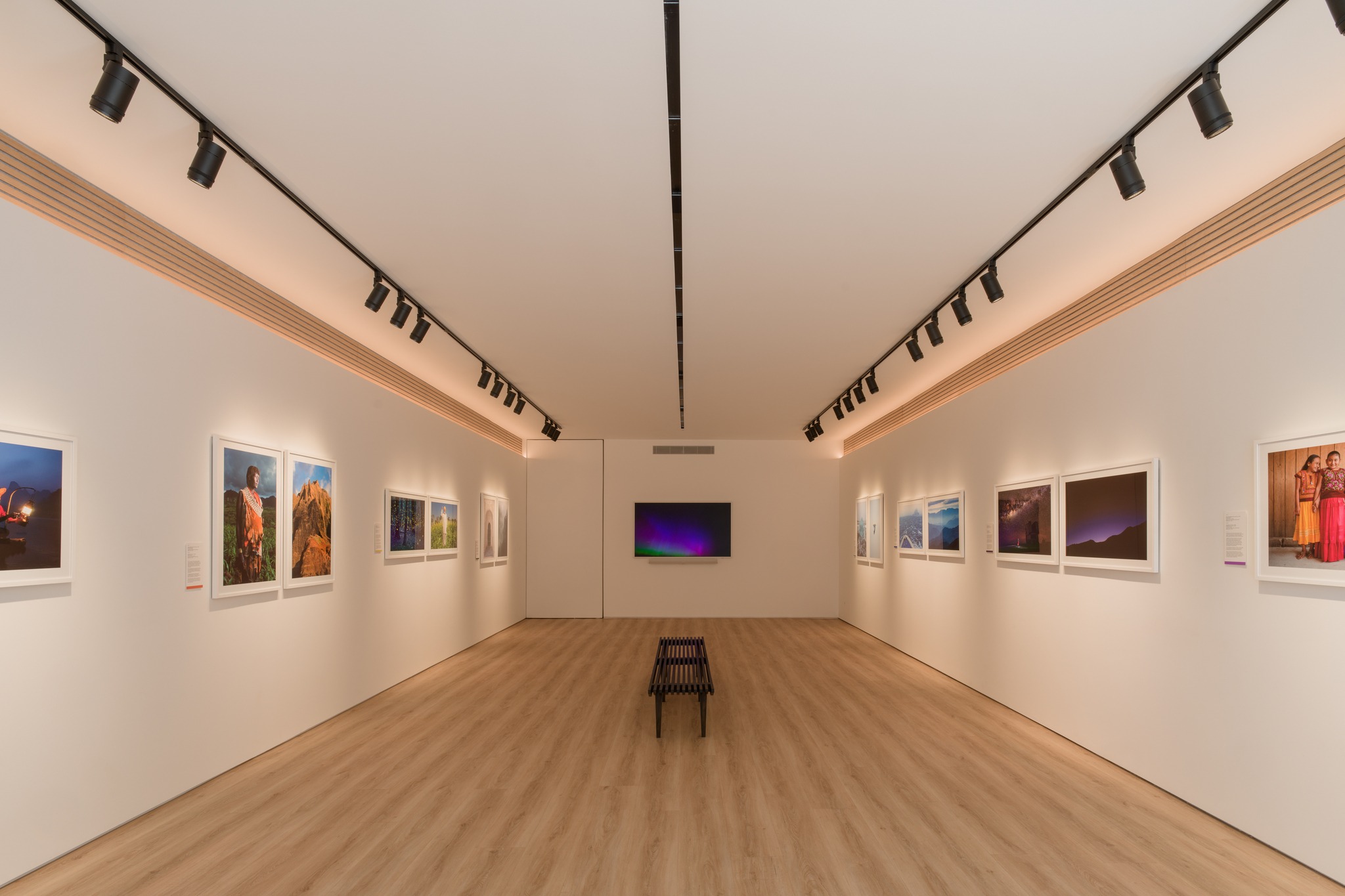
Adjustable track lighting repositioned across large gallery exhibition
Large exhibitions require scalable art gallery lighting systems capable of adapting to different layouts, artwork sizes, and thematic presentations. Designing effective lighting for gallery spaces often involves using adjustable lighting systems rather than fixed fixtures, allowing galleries to reposition and refine illumination as exhibitions evolve.
This flexibility allows curators to:
- Reconfigure lighting layouts quickly
- Highlight new feature artworks
- Maintain consistent lighting standards
- Adapt to rotating exhibitions
Professional art gallery lights designed for exhibition spaces provide both flexibility and performance without compromising visual clarity.
Art Gallery Lights in Luxury Residential Collections
Art gallery lighting is no longer limited to public galleries and museums. Private collectors and luxury homeowners increasingly use art gallery lights to display artwork with museum-level precision in residential environments.
Common residential applications include:
- Feature artwork walls in living rooms
- Hallway gallery displays
- Private art collections
- Architectural statement pieces
Using professional art gallery lighting in residential settings enhances both interior sophistication and the perceived value of the artwork.

Dimming Control and Light Adjustment in Art Gallery Lighting
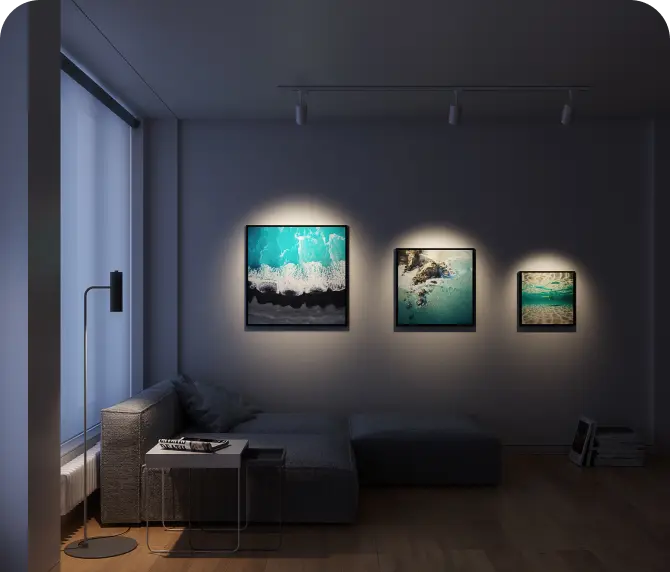
Luxury interior featuring museum-style art lighting
Dimmable art gallery lights provide essential flexibility in professional display environments. Different artworks require different illumination intensities depending on their sensitivity, medium, and visual purpose.
Benefits of dimmable art gallery lighting include:
- Precise brightness control
- Improved conservation protection
- Adaptability for different exhibitions
- Enhanced atmosphere and mood
Dimming capability is particularly important in galleries that host rotating exhibitions with diverse artwork types and materials.
Future Innovations in Art Gallery Lights and Exhibition Lighting

Dimmable spotlight adjusting brightness for conservation
The future of art gallery lights is centred around precision optics, smart lighting control, and adaptive illumination systems. Modern lighting technology now allows curators and designers to fine-tune beam angles, brightness levels, and lighting scenes based on the specific exhibition requirements.
As galleries and museums continue to prioritise visitor experience and artwork preservation, high-performance art gallery lighting systems will play an even more significant role in exhibition design, architectural lighting, and fine art presentation worldwide.
FAQ: Art Gallery Lights
What are art gallery lights used for?
Art gallery lights are used to illuminate paintings, sculptures, and exhibitions with controlled, high-quality lighting that enhances colour accuracy, depth, and visual clarity while protecting the artwork.
What is the best lighting for an art gallery?
The best art gallery lighting uses high-CRI LED fixtures with adjustable beam angles, glare control, and consistent colour temperature to ensure accurate and professional artwork presentation.
How do art gallery lights improve artwork visibility?
Art gallery lights enhance visibility by focusing controlled illumination on the artwork, revealing texture, colour detail, and depth without creating glare or uneven brightness.
Are ceiling mounted art gallery lights better than wall lights?
Ceiling mounted art gallery lights are often preferred in professional spaces because they provide flexible beam control, cleaner aesthetics, and more precise illumination compared to fixed wall-mounted fixtures.
What CRI should art gallery lights have?
Art gallery lights should have a CRI of at least 90, while museum-grade lighting typically uses CRI 95–97+ to achieve true colour representation and maximum visual accuracy.
Can art gallery lights be too bright?
Yes. Overly bright lighting can wash out colours, increase glare, and reduce the visual impact of the artwork. Professional gallery lighting focuses on controlled illumination rather than excessive brightness.
How far should art gallery lights be from paintings?
Art gallery lights are typically positioned above and slightly in front of the artwork, angled around 25–35 degrees to achieve even illumination and minimise glare.
Do art gallery lights damage artwork over time?
High-quality LED art gallery lights are designed to emit minimal UV and heat, significantly reducing the risk of fading and material degradation compared to traditional lighting.
What type of lights do museums and galleries use?
Museums and galleries commonly use track lighting, ceiling mounted art lights, and precision spotlights with high CRI LEDs and controlled optics for conservation-safe illumination.
How many art gallery lights should be used per artwork?
In professional lighting design, fewer precision lights are often more effective than multiple generic fixtures. Controlled spotlighting creates stronger visual focus and a refined gallery atmosphere.
Can art gallery lighting be adjusted for different exhibitions?
Yes. Professional art gallery lighting systems are designed to be adjustable so curators can reposition fixtures, change beam angles, and adapt illumination based on new exhibitions and artwork layouts.
Why is glare control important in art gallery lighting?
Glare control ensures that reflections from glass frames, varnished paintings, and glossy surfaces do not distract viewers, allowing them to fully engage with the artwork’s details and textures.
Extended FAQ: Art Gallery Lights
What lighting do art galleries use?
Professional galleries typically use track-mounted spotlights, ceiling mounted art lights, and precision display lights with high CRI LEDs to ensure accurate colour rendering and controlled illumination of artworks.
What are the best art gallery lights for paintings?
The best art gallery lights for paintings are high-CRI LED fixtures with adjustable beam angles, glare control, and even light distribution to enhance texture and colour accuracy without damaging the artwork.
Are LED art gallery lights safe for artwork?
Yes. High-quality LED art gallery lights emit minimal heat and UV radiation, making them safe for paintings, prints, and sensitive materials when properly specified and installed.
How do you light paintings in an art gallery?
Paintings are typically illuminated using focused art gallery spot lights positioned at approximately 30 degrees above the artwork. This reduces glare and ensures balanced, edge-to-edge illumination.
What colour temperature is best for art gallery lighting?
Most galleries use lighting between 2700K and 3000K because it provides natural colour representation and enhances visual depth without distorting the artwork’s original tones.
Do art gallery lights need high CRI?
Yes. A CRI of 90+ is recommended, while CRI 95–97+ is ideal for museums and galleries where accurate colour rendering is essential for professional artwork presentation.
Can art gallery lighting be used in homes?
Yes. Many collectors and designers use art gallery lighting fixtures in residential spaces to create museum-style artwork displays and highlight feature pieces with precision illumination.
What is the difference between gallery lighting and regular lighting?
Gallery lighting is designed for precise artwork illumination with controlled beam angles and high colour accuracy, while regular lighting is intended for general room brightness rather than focused display.
Are track lights suitable for art galleries?
Yes. Track-mounted art gallery lights are widely used because they offer flexibility, adjustable positioning, and precise spotlighting for changing exhibitions and gallery layouts.
How many lights should be used in a gallery space?
In professional gallery lighting design, fewer high-precision lights are often preferred over excessive fixtures. Controlled, focused illumination creates stronger visual impact and maintains a refined exhibition atmosphere.
Trusted by Collectors, Praised by Designers