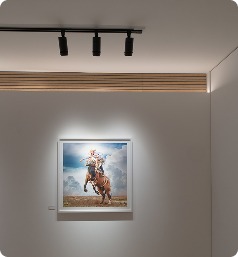
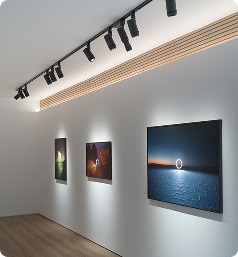
Professional art gallery illuminated with adjustable spotlights
Gallery track lighting is the industry standard lighting solution used in museums, art galleries, and high-end collections to illuminate artwork with precision, flexibility, and conservation-focused control. Unlike general ceiling lighting, a professionally designed gallery track lighting system allows curators, designers, and collectors to direct light exactly where it is needed while maintaining accurate colour rendering and visual balance across exhibition walls.
In professional environments where artwork value, presentation, and preservation are critical, gallery track lighting is not just a lighting choice. It is a curatorial tool. Properly implemented art gallery track lighting enhances texture, depth, and true colour tones while minimising glare, shadows, and long-term light damage to sensitive artworks.
Whether installed in a museum, commercial gallery, luxury residence, or showroom, the right track lighting for art gallery spaces transforms how artwork is perceived and experienced. This complete guide to gallery track lighting and art illumination explains the systems, techniques, and professional standards used to achieve museum-grade artwork presentation.
What Is a Gallery Track Lighting System?

Modular gallery track lighting infrastructure installed
A gallery track lighting system is a flexible lighting infrastructure that consists of a mounted track rail and adjustable luminaires designed specifically for artwork illumination. These systems allow fixtures to be repositioned, angled, and adjusted as exhibitions change, making them ideal for dynamic art environments.
Unlike fixed lighting fixtures, gallery lighting track systems provide:
Precise beam control- Adjustable spotlight positioning
- Consistent illumination across gallery walls
- Scalable lighting layouts
- Museum-grade colour accuracy
Professional track lighting systems for art galleries are engineered to deliver controlled, directional light that enhances artwork rather than overpowering it. This is why nearly every major gallery and museum relies on track lighting systems for art galleries instead of static ceiling lights.

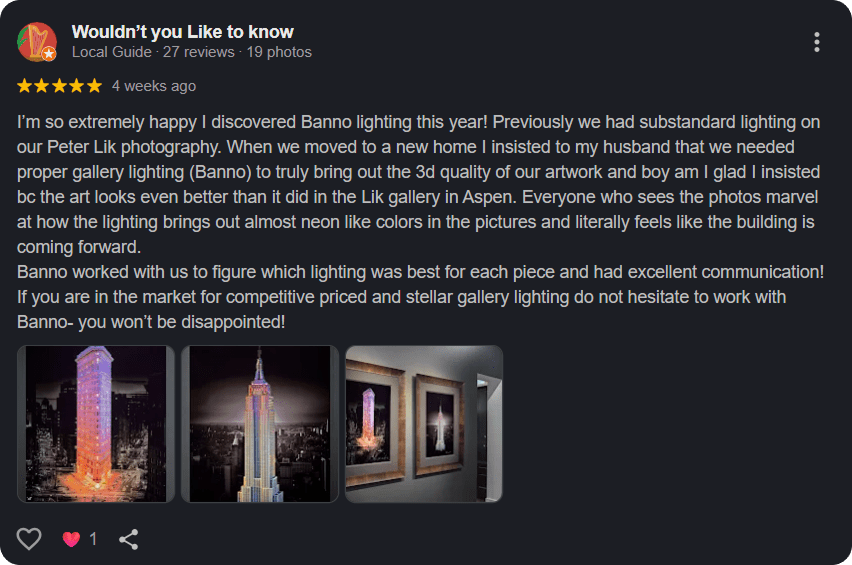
4.9-Star Google Review for Our Art Lighting Solutions
Why Galleries and Museums Use Track Lighting for Artwork

Precision lighting highlighting feature artwork
Understanding how track lighting is used in art galleries begins with recognising that lighting must adapt to rotating exhibitions, varying artwork sizes, and different artistic mediums. Track lighting in gallery environments provides the flexibility required to maintain consistent visual standards across changing displays.
Key reasons professionals choose gallery track lighting include:
- Flexible repositioning of luminaires
- Focused illumination for individual artworks
- Uniform lighting across gallery walls
- Reduced glare and reflections on framed pieces
- Curatorial control over visual hierarchy
From a consultant’s perspective, art lighting track systems allow curators to highlight feature artworks without redesigning the entire lighting layout. This adaptability is essential in exhibition spaces where artwork placement evolves frequently.
Additionally, one of the major benefits of LED track lighting in galleries is that it produces minimal heat and UV radiation, making it suitable for conservation-sensitive environments such as museums and private collections.
Types of Gallery Track Lighting Used in Art Galleries

LED Track Lighting for Art Gallery Spaces
Gallery Spotlight Track Lighting
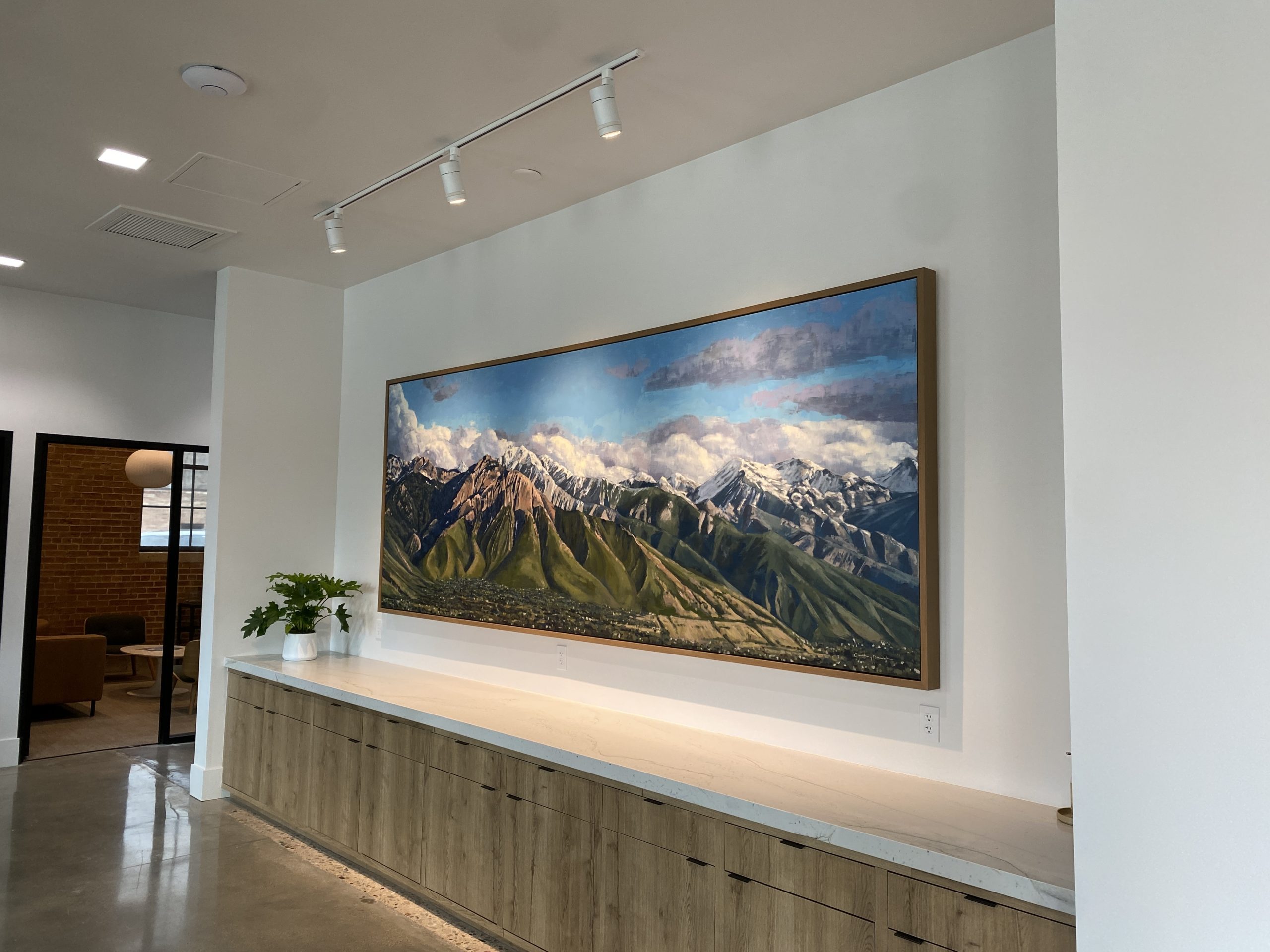
Gallery spotlight track lighting is designed for precise illumination of individual artworks. These fixtures feature narrow to medium beam angles that create controlled focus on paintings, sculptures, and feature installations. Spotlight track lighting is commonly used for hero artworks that require visual emphasis and depth enhancement.
Gallery Wall Track Lighting
Gallery wall track lighting provides broader beam distribution across multiple artworks displayed along a continuous wall. This approach ensures even illumination and prevents visual imbalance between pieces. It is especially effective in large exhibition spaces and curated gallery walls.
Gallery Style Track Lighting
Gallery style track lighting refers to systems engineered specifically for art environments, typically featuring high CRI LEDs, glare control optics, and adjustable beam angles. These systems prioritise colour accuracy, conservation, and refined visual presentation rather than decorative aesthetics.
LED Track Lighting for Art Gallery Spaces
LED track lighting for art gallery installations is now the global standard due to its efficiency, longevity, and conservation safety. High-quality LED gallery track lighting offers stable illumination with minimal heat emission, reducing the risk of artwork degradation over time.
How to Use Track Lighting for Art Gallery and Exhibition Spaces

Track fixtures angled toward artwork surface
Understanding effective track lighting techniques for illuminating art is essential for achieving museum-grade results. Simply installing track lights is not enough. Placement, beam angle, and light intensity must be carefully calibrated.
Professional guidelines for track lighting for gallery applications include:
- Position fixtures at approximately a 30-degree angle to the artwork
- Avoid direct frontal lighting to minimise glare
- Match beam angle to artwork size
- Ensure edge-to-edge illumination without hotspots
- Maintain consistent colour temperature across the gallery
For gallery wall track lighting, spacing between luminaires must be evenly planned to prevent dark zones or overexposed sections. Lighting designers often use layered lighting strategies that combine ambient illumination with targeted track lighting for optimal visual balance.
Beam Angle and Optical Precision in Gallery Track Lighting

Precision optics controlling artwork illumination
One of the most critical technical aspects of gallery track lighting is beam angle selection. Incorrect beam distribution can distort how artwork is perceived.
Typical beam angle applications:
- Narrow beam (10–20°): Small artworks and feature pieces
- Medium beam (24–40°): Standard framed paintings
- Wide beam (40°+): Large gallery walls and oversized artworks
Professional gallery track lighting systems include adjustable optics that allow curators and lighting consultants to fine-tune illumination based on artwork scale and positioning. This level of control is what differentiates best gallery track lighting solutions from generic track lighting products.
Colour Rendering and Museum Lighting Standards

High CRI lighting revealing true artwork colours
Colour Rendering Index (CRI) is a defining factor in art gallery track lighting systems. High CRI lighting ensures that artwork colours appear natural, vibrant, and true to the artist’s original intent.
Recommended CRI standards:
- CRI 90+: Professional gallery standard
- CRI 95–97+: Museum-grade lighting
Low-CRI lighting can distort pigments, flatten textures, and reduce the emotional impact of artwork. This is why leading museums and galleries specify high-CRI LED track lighting for art gallery installations.
Colour temperature also plays a crucial role. Most galleries use lighting within the 2700K to 3000K range to maintain warm, accurate colour representation without visual harshness.
Gallery Track Lighting Solutions: Zoom, Multi, and Deluxe Series

Multi series evenly lighting full exhibition wall
Zoom Series for Precision Gallery Track Lighting
The Zoom series is designed for highly controlled artwork illumination where precision is essential. As a gallery spotlight track lighting solution, it features adjustable beam optics that allow curators to focus light exactly on individual paintings or sculptures. This makes it ideal for feature artworks, high-value pieces, and curated exhibitions that require sharp visual emphasis with minimal light spill.
Multi Series for Uniform Gallery Wall Track Lighting
The Multi series is engineered for broader beam distribution and consistent illumination across multiple artworks. In professional art gallery track lighting systems, the Multi series is commonly used for gallery wall track lighting where visual cohesion and balanced brightness are critical. It ensures that each artwork receives equal lighting attention without uneven hotspots or shadows.
Deluxe Series for Museum-Grade Gallery Track Lighting Systems
The Deluxe series represents a premium tier of gallery track lighting designed for museums, luxury galleries, and high-end private collections. Featuring ultra-high CRI, refined optical engineering, and conservation-friendly LED technology, the Deluxe series delivers exceptional colour accuracy and visual clarity. It is particularly suited for track lighting systems for art galleries that demand both presentation excellence and long-term artwork protection.
Best Gallery Track Lighting for Different Art Spaces
Luxury home art wall with track lighting
Selecting the best track lighting for art gallery environments depends on the scale, layout, and type of artwork being displayed.
For museums and large galleries:
Track lighting systems for art galleries with adjustable optics and high CRI LEDs are essential to maintain conservation standards and visual consistency.
For commercial galleries:
Gallery style track lighting with flexible repositioning allows curators to adapt lighting layouts for rotating exhibitions.
For luxury residential collections:
Compact art gallery track lighting systems provide museum-quality presentation within private interiors, enhancing both artwork visibility and spatial sophistication.
Gallery Track Lighting Layout and Installation Strategy

Even fixture spacing across gallery ceiling
A well-planned gallery lighting track layout ensures that every artwork is illuminated evenly and professionally. Lighting consultants typically assess:
- Ceiling height
- Artwork size and spacing
- Viewing angles
- Wall colour and reflectivity
- Exhibition flow
Track lighting art gallery installations often use linear track configurations parallel to display walls, allowing fixtures to be adjusted as exhibitions evolve. This strategic placement enhances both visual clarity and visitor engagement.
Glare Reduction and Viewing Comfort

Reflection free lighting on glass framed artwork
Glare is one of the most common issues in poorly designed gallery lighting. Reflections on glass frames and glossy surfaces can significantly reduce the viewing experience.
Premium gallery track lighting incorporates:
- Anti-glare optics
- Precision beam shaping
- Honeycomb louvre accessories
- Controlled light angles
These features ensure that viewers can appreciate artwork without visual distraction, which is a core requirement in professional exhibition environments.
Energy Efficiency and Longevity of LED Gallery Track Lighting

Energy efficient gallery lighting installation
Modern gallery track lighting LED systems are significantly more energy efficient than traditional halogen or incandescent lighting. This is particularly important for galleries operating extended hours.
Benefits of LED track lighting for art gallery use:
- 30,000–50,000+ hour lifespan
- Low energy consumption
- Reduced maintenance requirements
- Minimal heat emission
- Stable colour performance over time
From a long-term operational perspective, LED gallery track lighting systems provide both cost efficiency and superior lighting quality.
When to Use Gallery Track Lighting Instead of Other Fixtures

Adjustable track lights replacing fixed ceiling fixtures
Gallery track lighting should be used when:
- Artwork layouts change frequently
- Precise spotlighting is required
- Multiple artworks share a single wall
- Museum-grade lighting control is needed
- High-value artwork requires conservation-safe illumination
Compared to fixed lighting fixtures, track lighting offers unmatched flexibility and professional-level control over artwork presentation.
Advanced Gallery Track Lighting Design for Large-Scale Art Installations
In large exhibition environments, gallery track lighting must be designed as a complete system rather than a collection of individual fixtures. Professional lighting consultants approach art gallery track lighting systems as part of a broader curatorial lighting strategy that considers spatial flow, artwork hierarchy, and visitor sightlines.
For major galleries and museums, track lighting systems for art galleries are often installed in linear or grid configurations along ceiling planes. This allows lighting designers to reposition luminaires as exhibitions rotate without structural changes to the space. The ability to adapt lighting layouts quickly is one of the primary reasons gallery track lighting remains the dominant solution in professional art environments.
Unlike static fixtures, gallery lighting track systems support dynamic exhibitions where artworks of different sizes, mediums, and framing styles are displayed within the same space. This flexibility ensures consistent visual presentation even as collections evolve.
Gallery Track Lighting for Large Paintings and Feature Walls

Even beam spacing on feature wall
Large-scale artworks require specialised track lighting for gallery wall applications. Oversized paintings, triptychs, and feature installations cannot be effectively illuminated with a single narrow spotlight. Instead, lighting consultants use a combination of adjustable beam luminaires to create uniform coverage across the artwork surface.
When designing art gallery track lighting for large paintings, key considerations include:
- Wider beam distribution for edge-to-edge illumination
- Multiple luminaires spaced evenly along the track
- Careful brightness balancing to avoid central hotspots
- Consistent colour temperature across all fixtures
This approach ensures that large artworks maintain visual depth and colour integrity without uneven lighting zones that distract from the artistic composition.
Track Lighting for Gallery Wall Displays and Curated Collections

Curated wall collection under balanced illumination
Adjustable track lighting for gallery artworks is particularly important in curated exhibition settings where multiple pieces are displayed in a linear arrangement along a gallery wall. In these scenarios, lighting must be cohesive rather than isolated.
Professional gallery wall track lighting strategies focus on:
- Equal visual weight across all artworks
- Consistent beam overlap between fixtures
- Uniform lux levels along the display wall
- Glare-free illumination for framed works
From a curatorial standpoint, uneven lighting can subconsciously influence how viewers perceive the importance of each piece. Proper gallery track lighting design ensures that no artwork appears underlit or overemphasised unless intentionally directed as a focal point.
The Role of Lux Levels in Art Gallery Track Lighting

Dimmable spotlight adjusted for preservation
Lux level control is a fundamental aspect of museum and gallery lighting standards. Different artwork materials require different illumination intensities to balance visibility and preservation.
Typical professional guidelines include:
- Oil paintings: Moderate lux with controlled beam focus
- Watercolours and works on paper: Lower lux levels to prevent fading
- Photography and prints: Glare-controlled directional lighting
- Sculptures: Layered track lighting with dimensional emphasis
High-end gallery track lighting systems allow precise dimming control so curators can adjust brightness levels based on conservation requirements and exhibition goals.
Dimming and Smart Control in Modern Gallery Track Lighting Systems
Modern art gallery track lighting systems increasingly incorporate smart dimming and programmable lighting controls. This allows galleries to adjust lighting scenes depending on the exhibition, time of day, or visitor experience goals.
Advantages of dimmable gallery track lighting include:
- Precise illumination adjustments for sensitive artworks
- Energy efficiency during low-traffic hours
- Enhanced atmosphere for curated exhibitions
- Long-term conservation benefits through reduced exposure
In museum environments, dimming is not simply an aesthetic feature. It is a conservation tool that protects artworks from excessive light exposure over extended periods.
Gallery Track Lighting and Conservation-Focused Illumination

LED spotlight with minimal UV emission
One of the most important responsibilities of professional gallery lighting track systems is artwork preservation. Excessive heat, UV radiation, and uncontrolled brightness can gradually degrade pigments, canvas, and delicate materials.
LED gallery track lighting significantly reduces conservation risks due to:
- Minimal UV emission
- Low heat output
- Stable light intensity
- Long-term colour consistency
This makes LED track lighting for art gallery environments the preferred solution for museums and collectors managing high-value and irreplaceable artworks.
Integration of Gallery Track Lighting with Architectural Design

Clean ceiling design supporting artwork display
In high-end galleries and architectural spaces, gallery track lighting is seamlessly integrated into the overall interior design. Rather than appearing as a technical installation, the track system becomes an invisible framework that supports the visual narrative of the space.
Architectural integration considerations include:
- Track colour matching ceiling finishes
- Minimalist luminaire design
- Clean cable management
- Strategic alignment with exhibition walls
Gallery style track lighting is often selected not only for performance but also for its discreet aesthetic, ensuring the lighting enhances the artwork without visually dominating the space.
Gallery Track Lighting for Museums, Luxury Homes, and Commercial Spaces
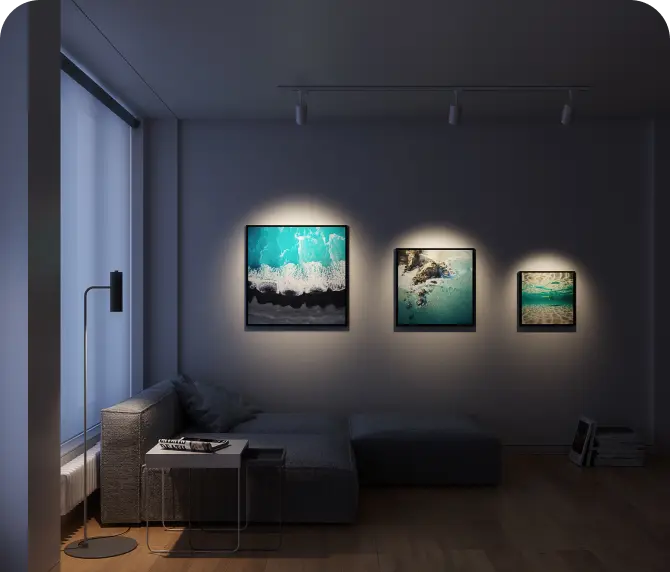
Luxury residential art wall installation
While traditionally associated with museums, gallery track lighting is now widely used in luxury residential interiors, showrooms, and hospitality environments that display artwork professionally.
Common applications include:
- Museum exhibitions and permanent collections
- Commercial art galleries
- Luxury residential art walls
- Corporate showrooms and lobbies
- Cultural institutions and curated spaces
In luxury homes, art gallery track lighting allows collectors to recreate museum-quality presentation, significantly enhancing the perceived value and emotional impact of displayed artwork.
Long-Term Maintenance and Performance of Track Lighting Systems for Art Galleries

Reliable lighting system in exhibition hall
Professional gallery track lighting systems are designed for longevity and consistent performance. Unlike standard lighting fixtures, they require minimal maintenance when specified correctly.
Key maintenance advantages include:
- Long LED lifespan reducing replacement frequency
- Stable optical performance over time
- Modular luminaire replacement without system overhaul
- Reliable performance in high-traffic exhibition spaces
For galleries operating year-round, this reliability is essential to maintaining consistent exhibition standards and operational efficiency.
Future Innovations in Gallery Track Lighting Technology

Next generation optical beam shaping technology
The evolution of gallery track lighting is moving toward increasingly advanced optical precision and adaptive lighting control. Emerging innovations include tunable white lighting, automated beam shaping, and sensor-based illumination adjustments that respond to visitor movement and ambient light conditions.
Future-ready art gallery track lighting systems are expected to prioritise:
- Enhanced conservation-safe illumination
- Advanced glare reduction optics
- Programmable lighting scenes for exhibitions
- Greater energy efficiency and sustainability
As the art world continues to evolve, lighting technology will play an even more critical role in shaping how artwork is presented and experienced in professional environments.
FAQ: Gallery Track Lighting
What is a gallery track lighting system?
A gallery track lighting system is a flexible lighting setup consisting of a ceiling-mounted track and adjustable luminaires designed specifically to illuminate artwork with precision and controlled beam angles.
Why is gallery track lighting preferred in art galleries?
Gallery track lighting is preferred because it offers flexibility, precise artwork illumination, high colour accuracy, and the ability to adapt lighting layouts as exhibitions change.
Is gallery track lighting suitable for large gallery walls?
Yes, gallery wall track lighting is ideal for large exhibition walls because multiple adjustable luminaires can provide uniform illumination across several artworks without uneven brightness.
What is the difference between gallery track lighting and regular track lighting?
Gallery track lighting is engineered for artwork illumination with high CRI, glare control, and precise optics, whereas standard track lighting is typically designed for general interior lighting.
How many track lights are needed for an art gallery wall?
The number of luminaires depends on artwork size, spacing, and beam angle. Professional lighting consultants typically space fixtures evenly to ensure consistent illumination across the gallery wall.
What beam angle is best for gallery track lighting?
Narrow beams (10–20°) work best for small artworks, while medium to wide beams (24–60°) are ideal for larger paintings and gallery wall displays.
Can gallery track lighting damage artwork?
High-quality LED gallery track lighting with low UV and heat output is considered safe for artwork when installed and calibrated correctly.
What CRI is recommended for art gallery track lighting?
A CRI of 95 or higher is recommended for professional art gallery track lighting to ensure accurate colour rendering and authentic artwork presentation.
Is LED track lighting for art gallery use better than halogen?
Yes, LED track lighting for art gallery environments is superior because it produces less heat, consumes less energy, and provides stable colour performance over time.
How do lighting consultants design gallery track lighting layouts?
Consultants analyse artwork placement, ceiling height, viewing angles, and exhibition flow to create a balanced lighting layout that enhances visual hierarchy and visitor experience.
What colour temperature is best for gallery track lighting?
Most galleries use 2700K to 3000K lighting because it produces warm, natural tones that enhance artwork depth without distorting colours.
Can gallery track lighting be dimmed?
Yes, professional gallery track lighting systems often include dimming capabilities to allow precise brightness control for different artworks and conservation requirements.
What is gallery spotlight track lighting?
Gallery spotlight track lighting refers to adjustable luminaires mounted on track systems that provide focused illumination for individual artworks or feature pieces.
How long do gallery track lighting systems last?
High-quality LED gallery track lighting systems can last 30,000 to 50,000 hours or more, making them highly durable for long-term gallery installations.
Is gallery track lighting suitable for private art collectors?
Yes, many private collectors use art gallery track lighting in residential settings to achieve museum-quality artwork presentation and professional visual impact.
What makes the best gallery track lighting system?
The best gallery track lighting system includes high CRI LEDs, adjustable beam optics, glare control technology, dimming capability, and flexible track positioning tailored specifically for artwork illumination.
Extended FAQ: Gallery Track Lighting
What is gallery track lighting used for?
Gallery track lighting is used to illuminate artwork in galleries, museums, and collections with precise, adjustable light that enhances colour accuracy, depth, and visual focus.
What is the best track lighting for art gallery spaces?
The best gallery track lighting features high CRI LEDs (95+), adjustable beam angles, glare control optics, and flexible track systems designed specifically for artwork illumination.
How do art gallery track lighting systems work?
Art gallery track lighting systems consist of a mounted track rail with adjustable luminaires that can be repositioned and angled to highlight different artworks as exhibitions change.
Is LED track lighting suitable for museums and galleries?
Yes, LED track lighting for art gallery environments is ideal because it emits minimal heat and UV radiation, making it safe for paintings, prints, and sensitive artworks.
What are the types of track lighting used in galleries?
Common types include gallery spotlight track lighting, gallery wall track lighting, and gallery style track lighting systems with adjustable optics and high colour rendering.
How do I know what type of track lighting I have?
Track lighting types can be identified by the track system design, connector compatibility, and luminaire adjustability. Professional gallery track lighting systems typically feature modular, adjustable heads and high CRI LED modules.
What colour temperature is best for gallery track lighting?
Most galleries use 2700K to 3000K lighting to maintain natural colour accuracy and enhance the visual depth of artwork without harsh brightness.
Can gallery track lighting be used in residential art collections?
Yes, many collectors install art gallery track lighting in luxury homes to achieve museum-style presentation and refined interior aesthetics.
How should track lighting be positioned for artwork?
Fixtures should typically be angled at around 30 degrees toward the artwork to reduce glare and provide even, balanced illumination across the surface.
Why is high CRI important in gallery lighting track systems?
High CRI ensures accurate colour representation, allowing artwork pigments, textures, and tonal variations to appear true to the artist’s original vision.
Is gallery track lighting better than fixed ceiling lights for artwork?
Yes, gallery track lighting offers superior flexibility, precision beam control, and curatorial adaptability compared to fixed lighting fixtures, making it the preferred solution for professional art environments.
What makes a gallery track lighting system museum-grade?
Museum-grade systems include ultra-high CRI LEDs, advanced optical control, conservation-safe illumination, and flexible track configurations that support evolving exhibition layouts.
As galleries, museums, and collectors continue to prioritise presentation quality and conservation, gallery track lighting systems will remain the foundation of professional art illumination. With precision optics, flexible positioning, and museum-grade colour accuracy, gallery track lighting is not just a technical solution but a critical component of curatorial storytelling and premium artwork display.
Why Designers and Collectors Trust Our Gallery Lights